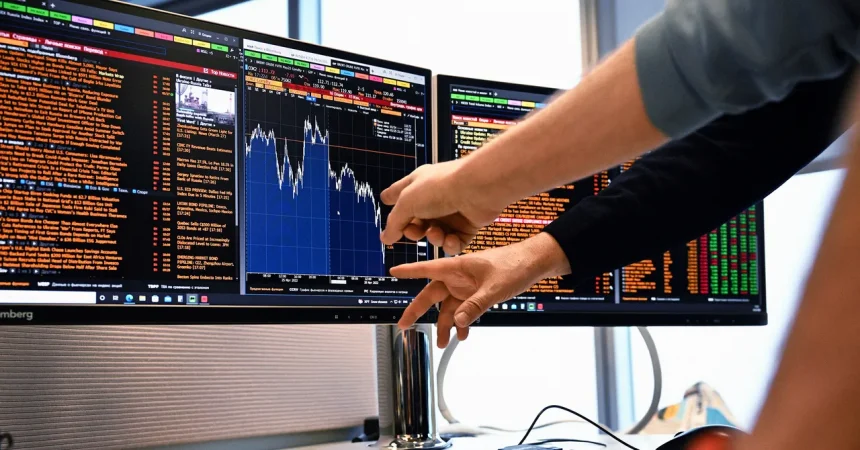
For its famous intractability, the Bloomberg Terminal has long inspired devotion, bordering on obsession. Among traders, the ability to chart a path through the software’s dizzying scrolls of numbers and text to isolate far-flung information is the mark of a seasoned professional.
But as a greater mass of data is fed into the Terminal—not only earnings and asset prices, but weather forecasts, shipping logs, factory locations, consumer spending patterns, private loans, and so on—valuable information is being lost. “It has become more and more untenable,” says Shawn Edwards, chief technology officer at Bloomberg. “You miss things, or it takes too long.”
To try to remedy the problem, Bloomberg is testing a chatbot-style interface for the Terminal, ASKB (pronounced ask-bee), built atop a basket of different language models. The broad idea is to help finance professionals to condense labor-intensive tasks, and make it possible to test abstract investment theses against the data through natural language prompts.
As of publication, the ASKB beta is open to roughly a third of the software’s 375,000 users; Bloomberg has not specified a date for a full release.
WIRED spoke with Edwards at Bloomberg’s palatial London headquarters in early April. We discussed the impetus for revamping the Terminal, whether traditionalists might balk at the change, and Bloomberg’s attempts to iron out hallucinations.
The following conversation has been edited for length and clarity.
WIRED: Shawn, tell me about the rationale for this overhaul of the Terminal.
Shawn Edwards: For years, Bloomberg has kept adding to this comprehensive dataset that we have. Often, finding the right piece of data in the sea of information is the deciding factor in whether you’re successful or not. It has become more and more untenable: You miss things, or it takes too long.
The primary problem we’re solving with generative AI is helping users to find key insights and synthesize a view of the world around a particular idea.
The concept is that untapped alpha lurks somewhere in the data, and ASKB will help to surface it?
Yeah. The user gets to ask the high-level question—the thesis that’s in their head—instead of asking for particular data points. ‘How is the war in Iran and a change in oil prices going to affect my portfolio?’ That’s a big, big question with so many dimensions. Can we synthesize that answer in minutes?
In a scenario where everybody is able to wade through the tangle of data, what will separate mediocre traders from the very best ones?
These tools are not magical. They don’t make an average [employee] all of a sudden great. The difference will be your ideas.
In the hands of experts, it allows them to do better analysis, deeper research—to sift through 10 great ideas when they might have only had time for one. If you’re a mediocre analyst, they’ll be 10 mediocre ideas.
Bloomberg pitches ASKB as a form of agentic AI. On its face, it looks more like a chatbot interface than something that necessarily automates tasks. What is agentic about ASKB?
There are earnings that come out every quarter. My job as an analyst is to be prepared for what might come up in that earnings call. For each company I’m preparing for, I’m looking at how their price compares to their peers, searching through lots of documents, looking at their fundamentals, and on and on. During earnings season, I’m not sleeping.
With ASKB, I can create workflow templates. I can write a long query, and say, ‘Hey, here’s all the data I’m going to need. Give me a synopsis of the bull and bear cases, what the Street is saying, what the guidance is.’ Now, I want to schedule [the workflows] or trigger them when I see this or that condition in the world.