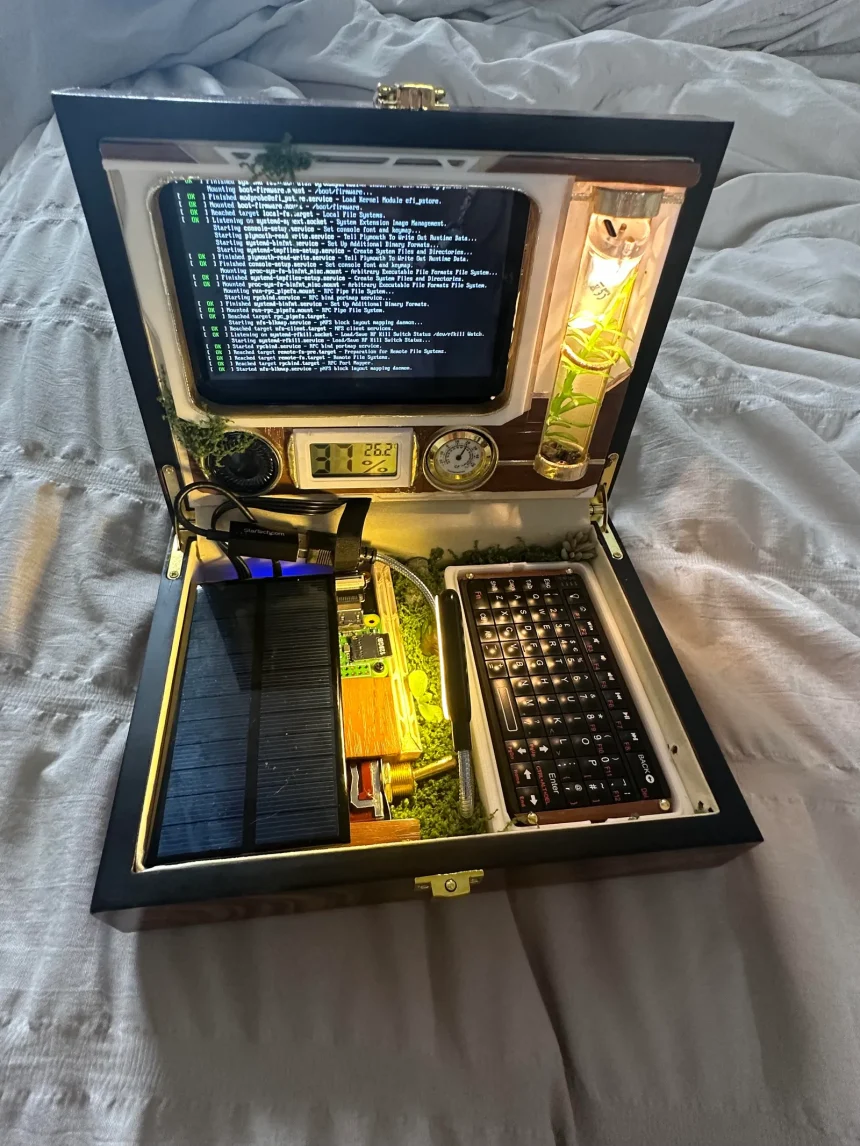
In the years following the book’s release, a bro-y community of hobbyists has dabbled with their own wires and screens to create homebrew devices, frequently for hacking purposes or on-the-go coding. Historically, decks have resembled a heavy-duty laptop, featuring a screen and small keyboard, often sleek, utilitarian, and housed in a Pelican briefcase to survive imagined, apocalyptic scenarios. One niche ham radio YouTuber, over a year ago, titled his tutorial video “DIY Doomsday Cyberdeck EMAIL/TEXT without INTERNET” and, of course, included the “prepper” hashtag.
What sets Tan’s cyberdeck apart is its aesthetic. Inside her refurbished clamshell purse, hardware-wise, is a Raspberry Pi single-board computer with a small keyboard and screen. All fairly standard stuff—the cyberdeck’s feminine shell and crafty details are what subverts expectations. “I’ve not seen anyone do a hyper-femme one before,” she says. Tan felt an appreciation for the tactical aesthetic previously established by the cyberdeck community, but she wanted to craft a version that felt more authentic to her style. “I’ve always been very anti-minimalist,” she says. “In my life, I want color, and I want everything that I own to convey that it’s me.”
To make her mermaid cyberdeck less reliant on internet access, she has transferred heaps of files from her PC, uploading songs, books, maps, Wikipedia articles, and even some photos of her cats directly onto the device. When the custom mouse is connected, she can even run Doom on it.

Tan says the audience for her widely viewed TikToks are around three-fourths women. “A lot of people had the response, ‘Oh, I didn’t know you could make a computer like this. I thought it had to be a gray box, like every other Mac or Dell or whatever,’” says Ling Lu, a 28-year-old product designer and illustrator who lives in New York City. She was inspired by Tan’s videos to try to make her own whimsical gadget, the “cyberduck” audio journal, an avian-shaped recording device for personal use.