
At 17,Ashwathi Pillai beat an opponent six years her senior to become the youngest Swedish national badminton champion in history (at that time). By 24, she had added the title of Financial IP Analyst to her name.
Being a professional athlete with a full-time job sounds like a scheduling nightmare to most people – Ashwathi calls it the only way she knows how to live.
“A traditional 9-to-5 – just doing only that – is the most boring thing ever,” the professional athlete muses.
Ashwathi moved to Sweden at a young age and found the initial transition a bit challenging. Source: Ashwathi Pillai
From Kanyakumari to Stockholm
Her story starts in Kanyakumari, a small coastal town at the southern tip of India, where she was born before her family moved to Bangalore.
She spent her first ten years there, picking up a badminton racket for the first time, before her father was transferred to Sweden in 2010 and uprooted everything. The family arrived knowing no Swedish, in a country where immigrants were still a rare sight. Plus, Ashwathi walked into school as the only person of colour.
Finding her footing in that environment wasn’t easy. “The language was a challenge,” she says. “Back then, children aged 9 to 11 in Sweden didn’t speak English very well.”
Swedes, she found, don’t open up easily — but when they do, they’re worth keeping. Social life there is small and tight, a sharp contrast to the large, close-knit family she left in India.
“I have a big family, with a lot of cousins, and going from that to not having anyone here and building everything from scratch was an adjustment for me,” she says.
Sport was what eventually pulled her through, and the person who made sure of that was her father.
Ashwathi had supportive parents who encouraged her in sports while also pushing her academically. Source: Ashwathi Pillai
The father who set the standard
Ashwathi was introduced to badminton by her father, Vinod Pillai, after watching him play with his friends. By the time she moved to Sweden, the sport was already part of her routine.
Her parents encouraged her to take up the sport, and she embraced it. Badminton brought friends, travel, and the joy of winning. Her father coached her and her younger brother, Deepak, from the beginning and remained a constant presence even as other coaches came and went. He trained with them, coordinated with her school, and met the principal annually to ensure her tournament schedule fit with her studies.
She trained during lunch breaks, used free periods for court time, and sometimes swapped PE class for practice sessions. Her school worked around her, partly because her father had done the groundwork early, and partly because the results were hard to argue with. By her early teens, she was already the national under-13 champion – but her father made sure that didn’t come at the cost of her grades.
“My parents were very strict about education,” the professional athlete says. “I remember getting a C once – they gave me a lecture as though the world had come to an end.”
Badminton and academics both had to be – in her words – at a really, really high level. That standard set by her father became the foundation on which everything else was built, and it paid off sooner than most would expect.
In 2017, at just 17, Ashwathi won the Swedish Senior National Championship. The final was played in Täby, her hometown, with her parents, her brother, and family friends all courtside. Her opponent was six or seven years older than her. “I felt like I had done something huge,” she says. “At that time, I was the youngest-ever national champion.”

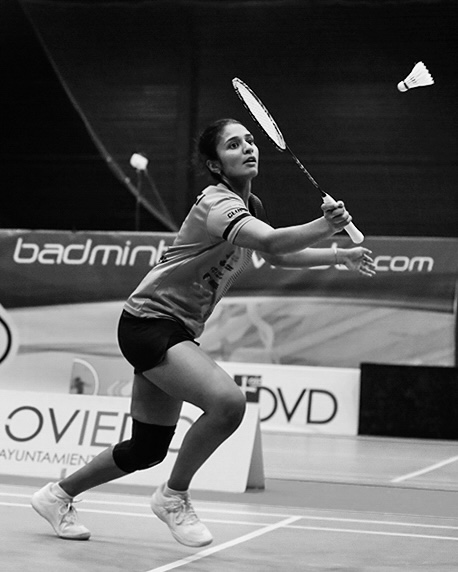
Despite winning the national championship at just 17, Ashwathi remained humble and continued to work hard in training. Source: Ashwathi Pillai
The decision to play as a Swedish professional athlete
Ashwathi competes for Sweden, not India – a choice that required giving up her Indian passport, a weight her family felt clearly. “That’s where we’re from,” she says.
The reasoning was pragmatic, and largely shaped by her father’s reading of what each country’s system could offer. In India, the competition in badminton is fierce enough that a serious athletic path typically demands full commitment from a young age.
Athletes are sent to academies early, and the space to pursue both elite academics and elite sport simultaneously is narrow. Sweden, by contrast, had the infrastructure to hold both.
“A lot of things felt more attainable compared to India,” she says.
The trajectory that followed proved the logic. She was selected to represent Sweden through the Swedish Olympic Committee, competed at the Youth Olympics, and set her sights on the 2024 Olympics.
Only five badminton players in the entire country earned that committee selection, and she was the youngest among them. Although her Olympic journey in 2024 didn’t unfold as she had hoped, she has since made peace with how it turned out.
The detour that redefined everything
In 2022, Ashwathi began a Business and Economics degree at the Stockholm School of Economics, one of the most selective institutions in Northern Europe in this field.
The following year, she took a university exchange term at the University of Richmond in the United States and stepped away from competitive badminton. She was gone from the sport for six or seven months.
The time off clarified something she hadn’t fully registered while she was in it. “I missed it so much that I started again,” she says.
The professional athlete returned, but differently – shifting from singles to doubles and mixed doubles, which is where she competes today.
The academic path also led to a career faster than she expected. During her second year of university, she was approached and offered a part-time role at Bergenstråhle & Partners, an intellectual property firm. She accepted, and the position eventually became a full-time Financial IP Analyst role.

Ashwathi is also grateful to her company and manager, who have been supportive of her badminton career. Source: Ashwathi Pillai
Two careers, one gear
Despite being a professional athlete with a full-time job, what makes Ashwathi’s situation unusual is not that she juggles sport and work. Plenty of people do. What stands out is that she refuses to treat either as secondary.
The itch to improve in badminton hasn’t dulled with age or responsibility. Her goals have shifted, but her belief that she can still grow remains.
“I feel like I can keep improving,” the professional athlete says. “I want to get better and better. I don’t have the same goals as before, but I still believe I can do something meaningful that I’ll be happy with.”
The standard her father set in that Swedish school many years ago – that both things must be at a really, really high level – turns out to have been less a rule than a blueprint she never stopped building from.