
Lucy Fox didn’t take the most obvious path after her zoology degree. She worked with people instead, starting in adult social care through a supported internship, where she spent three years in the field before contributing to the COVID-19 response through Personal Protective Equipment (PPE) logistics. That experience led her to the National Health Service (NHS) and then Citizens Advice as a Portfolio and Planning Manager.
Working across these roles gave her a front-row seat to how complicated — and interconnected — real-world problems can be. “I saw that a holistic approach was lacking and that there were no true systems working,” she says. “I wanted to learn about interesting and challenging topics, and The London Interdisciplinary School (LIS) seemed to be the only university talking about these complex issues and trying to join the dots.”
LIS is the world’s first interdisciplinary university focused on enabling the brightest minds to tackle society’s most complex problems. Established in 2018 by a group of academics, entrepreneurs and investors, it’s the first UK university in over 50 years to open with its own degree awarding powers from inception. And though it’s only been around for less than a decade, LIS is already directly competing with the Russell Group.
It’s not hard to see why for anyone who’s met the LIS team. Professors are extremely passionate about the art of complex problem-solving, to the point of leaving positions in some of the world’s leading higher education institutions, such as Harvard, Cambridge and Oxford, to join this new and radical university in the heart of East London.
Learning from these leading philosophers, epidemiologists, artists, journalists, behavioural scientists, and mathematicians can be high impact. Nearly nine in 10 (89%) of LIS BASc graduates are in skilled employment 15 months after. Now, this same impact has greater reach – the school recently launched the new Master of Arts & Sciences in Interdisciplinary Problems and Methods.
LIS puts teaching at the centre of everything it does. By the time students graduate, they’ve built a well-rounded, adaptable mindset that prepares them for today’s working world. Source: The London Interdisciplinary School
A master’s degree that keeps up with how the world is changing
LIS’s new Master of Arts & Sciences in Interdisciplinary Problems and Methods transforms students into experts at solving some of the world’s thorniest problems. For many students, it was the only programme broad enough to reflect the reality of modern work.
Complex Systems and Problems (MASc) student Mark Richardson-Griffith, for example, was a philosophy graduate who went on to work as a business consultant at PwC, Accenture, and the like, before moving to a social innovation role with a focus on education. “I chose to join this programme to refresh my skills, outlook and to open up new professional opportunities,” he says.
He’s not the only one to find the programme expansive. Complex Systems and Problems (MASc) student Sabine Vidal comes from a background that blends technology, design, social sciences, psychology, and education. LIS stood out to her for its “commitment to not be held back by ‘traditional’ and tired academic traditions and the opportunity they provide us to think critically about what we explore.”
These are their very compelling reasons for choosing the programme, but what does the Complex Systems and Problems (MASc) look like in practice?
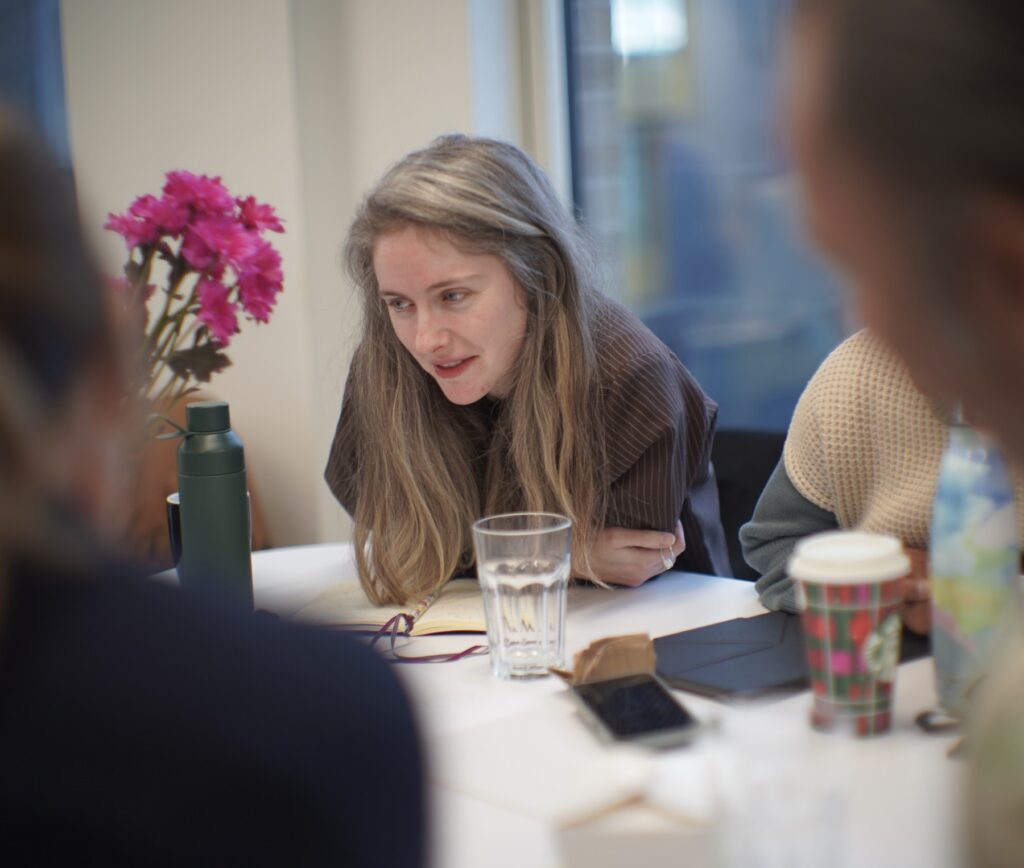
With support from world-class faculty and partners from the LIS network, you’ll have the freedom to explore issues that matter most to you. Source: The London Interdisciplinary School
Explore, experiment, apply
The Complex Systems and Problems (MASc) has two core components: learning how to use interdisciplinary methods and applying them in a Capstone project to tackle real-world problems. Over the course, you’ll explore qualitative and quantitative approaches across programming, statistics, visual media and cultural analysis by working with linguistic, numerical, visual, experimental and algorithmic data.
To Richardson-Griffiths, one particularly memorable class captured the spirit of the programme. “It was thrilling when Dr. Carney showed us how to transform the complete works of Shakespeare and the King James Bible into two very long lists; make a call to Open AI to identify the most common masculine and feminine nouns; and then do some linguistic analysis on the distribution of these nouns in the two texts,” he says.
The Integration module takes this idea of mixing methods even further. Alongside that, you can pick one of three pathways — AI Futures, Designing for Life, or Acting Human — to explore real-world challenges and how they come about. As Fox puts it, “Teaching and learning should be focused on helping people to learn and not about passing exams. LIS has proved that it is possible to take this approach and to support the students to explore concepts they’re interested in. It’s shown me that teaching can be so much more collaborative than is usually done.”
That outlook has stayed with Fox beyond graduation. She plans to remain in her field, but to use what she learned at LIS to resist silos and push for more holistic ways of working. She has even considered starting her own charity or company, an ambition she traces back to the confidence the programme helped her build. Her advice to future students is simple: “If you want to learn a variety of different things, and have an open, curious mind, you should really think about LIS as a top choice. It’s different in a good way and will allow you the space to grow.”
Follow The London Interdisciplinary School on Facebook, X, Instagram, YouTube, LinkedIn, and TikTok