When you think about the history of modern medicine, many of its biggest breakthroughs can be traced back to Europe.
In 1590, Dutch father-and-son duo Hans and Zacharias Janssen invented the first microscope, forever changing how scientists understood the human body. Centuries later, in 1895, German physicist Wilhelm Conrad Röntgen stumbled upon a new form of radiation he named “X-rays,” transforming the way doctors diagnose disease and injury.
And perhaps the most popular is Florence Nightingale, a British social reformer and statistician who revolutionised patient care and established the foundations of modern nursing.
Today, that same spirit of innovation lives on in how Europe’s medical schools prepare students for real-world healthcare challenges. Here are four universities where you can build the foundation for your future career.
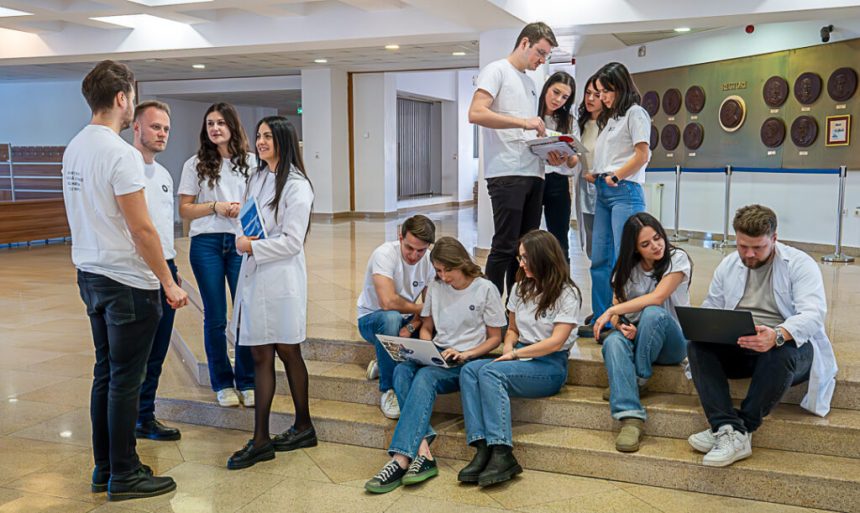
When students feel supported and happy on campus, they are more likely to do well in residency exams and international placements. Source: “Iuliu Hațieganu” University of Medicine and Pharmacy Cluj-Napoca
“Iuliu Hațieganu” University of Medicine and Pharmacy Cluj-Napoca
If you’re thinking about studying medicine or healthcare, UMF “Iuliu Hațieganu” Cluj-Napoca, is one university worth exploring. It is the oldest medical education institution in Transylvania, a historic region in Romania.
With faculties in Medicine, Dental Medicine, Pharmacy, and Nursing and Health Sciences, you can choose from programmes taught in Romanian, English, and French — including an English-taught Nursing programme. You’ll benefit from early clinical exposure, research opportunities, and international exchange programmes that support both personal and professional growth.
A big strength of the university is its modern approach to medical education. You’ll learn in small group classes and work closely with professors. Learning is problem-based so expect to gain practical knowledge and important soft skills like communication, teamwork, and critical thinking.
The support for your growth doesn’t stop in the classroom either. Doing well in your studies may earn you a scholarship. And once you graduate, your ECTS (European Credit Transfer System)-recognised degree can help you continue your training or explore career opportunities across Europe.
Studying medicine can be challenging, but the city of Cluj-Napoca makes it a fun, fulfilling journey. The city was ranked as the safest city in Romania in 2020 and the 13th safest city in the world. In what’s often called the “city of festivals,” big events such as the Transilvania International Film Festival (TIFF) are held here. Add on 9,000 students at the university, including over 3,500 international students from more than 60 countries, and it’s easy to meet people and quickly feel at home.

University of Manchester medical students develop practical skills and experience through service-learning activities. Source: University of Manchester School of Medical Sciences
University of Manchester School of Medical Sciences
It’s no surprise that medical graduates from the University of Manchester are in demand worldwide. The university counts influential names such as Dame Sally Davies, former Chief Medical Officer for England, and Nobel Prize winner Sir John Sulston among its alumni, and its School of Medical Sciences continues to build on that success today.
Teaching takes place both on campus and across major hospitals within the Manchester University NHS Foundation Trust, including Manchester University Dental Hospital, as well as Royal Preston Hospital under Lancashire Teaching Hospitals NHS Foundation Trust.
Here, the hands-on experience starts early. Students in Years 1, 2, and the Graduate Entry Medicine (GEM) programme begin with GP and hospital placements, consultation skills training, and simulated patient sessions. By Year 3, you’ll spend 60% of your time focusing on general medicine and surgery, before moving into clinical rotations across different specialities in Year 4.
Of course, university life isn’t just about studying. Manchester is one of the UK’s best student cities, with plenty of social activities, events, and communities to get involved in outside the classroom.

Charles University students learn in contemporary facilities, including the Czech Republic’s newest anatomical department. Source: Charles University Second Faculty of Medicine
Charles University Second Faculty of Medicine
Studying in Prague gives you the chance to experience one of the world’s top student cities while living in one of Europe’s safest countries. It’s an exciting place to study, especially for future medical students.
Founded in 1348 by King Charles IV, Charles University is one of the oldest universities in Europe — and its Second Faculty of Medicine has been part of that story from the very beginning. Today, the faculty has grown into a modern medical institution with 51 departments, over 1,700 undergraduate students across six Czech- and one English-taught programmes, and 358 PhD students in 17 programmes.
Hands‑on training is built into every stage of your journey; clinical training takes place at the Motol University, Na Bulovce Hospital, and the Military University Hospital. You can even continue your training in many parts of the world after graduating, as the faculty’s degrees are recognised across the European Union, the Medical Board of California in the US and more. And when you leave, you’ll be joining a faculty known not only for producing skilled doctors, but public figures and elite athletes too.

The University of Nicosia is ranked #115 in the world and #1 in Cyprus and Greece for research quality. Source: University of Nicosia Medical School
University of Nicosia Medical School
In 2011, the University of Nicosia’s Medical School made history by launching Cyprus’s first medical programme, the graduate-entry Bachelor of Medicine and Bachelor of Surgery (MBBS), in partnership with St George’s, University of London. Since then, it has continued to lead the development of life and health sciences programmes in the heart of the Mediterranean.
The medical school offers two medical programmes and three postgraduate degrees. No matter which path you take, you’ll learn through a student-focused curriculum taught by internationally recognised faculty members. Teaching, for example, is defined by small-group learning, early clinical exposure, technology-driven education, and community-based experiences that help you understand how science translates into patient care. It’s a learning environment that attracts more than 1,000 students from over 90 countries.
This strong foundation has helped graduates secure placements across more than 20 countries. With their clinical knowledge, critical thinking, and communication skills, they have taken roles in hospitals and research centres, including Addenbrooke’s Hospital in Cambridge, the University of Toronto in Canada, and more.
*Some of the institutions featured in this article are commercial partners of Study International