This year’s annual NAFSA Conference heard many discussions about the relative decline of traditional study destinations amid rising popularity of countries in Europe and Asia.
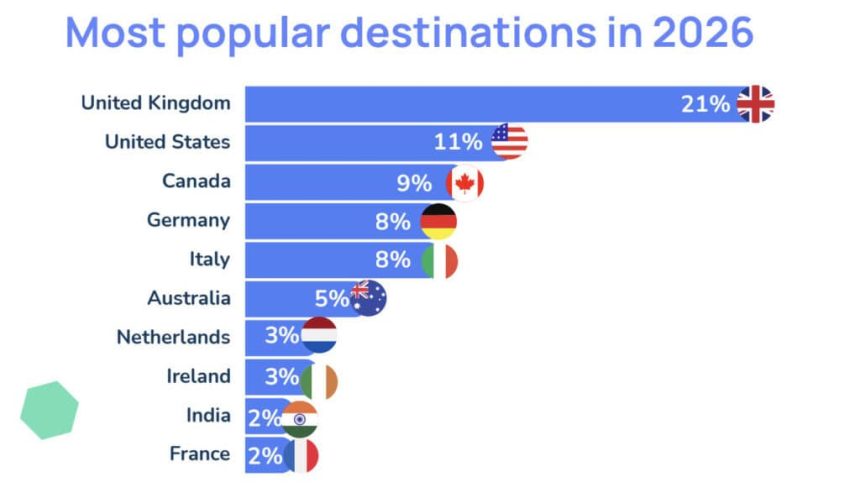
The launch of a new report from Keystone Education Group, based on more than 67,000 prospective students from 150 countries, confirmed the trend, revealing the relative decline of the ‘big four’ destinations, with the largest drops seen in the US.
“Whereas the US remains the most-searched destination across Keystone platforms, it’s losing ground in our survey,” said Keystone CEO Mark Bennett, highlighting the widening gap between interest and intention.
Notably, the US ranked last out of the ‘big four’ and China for student trust, though it was also the destination where responses were most polarised, recording the highest percentages of both “no trust” and “very high trust” responses, showing the wide disparity of student perceptions.
For the second year running, fewer students selected the US as their intended study destination, with the UK standing out as the main beneficiary of this shift and receiving the most interest at 21%, despite facing increased visa obstacles itself.

Bennett cautioned delegates on the absolute order of survey results, which, as with most datasets, will always be shaped by Keystone’s underlying audiences, with Asian destinations under-indexing compared to Europe and North America.
As such, the results are most useful for what they reveal about changing country perceptions rather than relative size.
At AIRC’s Symposium the day prior to NAFSA, attendees heard about the importance of triangulating datasets, with speakers from IDP and StudyPortals – two data giants of the sector – emphasising that every dataset captures only part of the picture, urging colleagues to look at various sources together and beware of confirmation bias.
Meanwhile in the Keystone report, Canada and Australia both showed modest recovery after a 2025 downturn due to policy instability, now taking up third and sixth place respectively.
Bennett explained that while the US’s established reputation means it still garners considerable search interest, the practical reality of studying there means fewer students are choosing it as their intended study destination.
Established, anglophone destinations retain their appeal with prospective audiences, but the barriers preventing them acting upon that appeal are often policy-driven
Mark Bennett, Keystone Education Group
He shared data that saw the US coming bottom of the ‘big four’ in virtually every category, including affordability, visas and entry, cultural appeal, and safety and security. In Academic reputation, it ranked third after the UK and Canada.
More broadly, the report compares student perceptions of the ‘big four’, Asia and Europe, with the latter two regions ranking head and shoulders above the traditional destinations for safety and stability.
Meanwhile: “It’s a close race on [academic] reputation, but not a commanding lead for the big four,” said Bennett. “And the gap widens as we head into practical factors”.
“Again, we see that traditional, established, anglophone destinations retain their appeal with prospective audiences, but the barriers preventing them acting upon that appeal are often policy-driven: whether in terms of how safe students feel, [and] how affordable they find study.”
Elsewhere, the report delivered more heartening sector news regarding AI, showing that while AI tools are being used extensively by students researching universities, trust remains in favour of editorially curated sources and institutional websites.