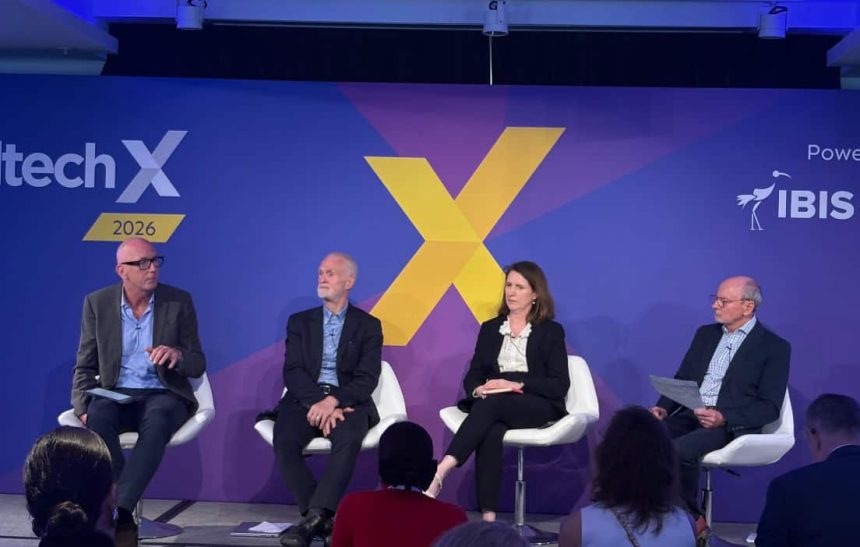
“Consolidate or perish – that is enough to make anybody who works in the higher education sector sit up,” warned Rod Bristow, chair of council at the University of Bradford, opening a panel on international education in the UK at last week’s EdtechX conference in central London.
He set out the background: flat domestic fees eroding in real terms, heavy regulation, and a looming demographic cliff around 2030. Against a backdrop of newspaper headlines asking “Is university worth it?”, he argued that while institutions know they are under pressure, the real question is whether they are prepared to act.
Other panelists agreed that there was a need for universities to move fast.
Simon Nelson, CEO of QA Higher Education, suggested that many wished they could wake from “what feels like a bit of a nightmare”. But he warned that simply “adapting or modifying the existing university experience” would not be enough for the vast majority of players.
While the “highest profile, the richest” universities were likely to be protected from the worst headwinds, he suggested, most institutions would be “significantly challenged”.
“But there is an opportunity to rethink what they do. I think that needs to start with being genuinely student centered or learner centered,” he said.
Despite the noise, Jessica Turner, chief executive officer of QS Quacquarelli Symonds, insisted that despite the rhetoric, there is still broad support for higher education among the general public.
“The rhetoric is so much stronger than the evidence,” she said.
QS’s work with King’s College London shows that while the public believes around 40% of graduates regret going to university, in reality only 8% do, Turner revealed. Similarly, although 49% of the public think student debt seriously harms graduates’ lives, only 16% of graduates say their debt negatively affects them.
For Ian Dunn, provost of the Coventry University Group, the sector is already “awake” but is facing a “moment of reckoning”.
“For far too long we’ve separated the concept of education and skills… they’re not different things; they never have been,” he argued.
For far too long we’ve separated the concept of education and skills… they’re not different things; they never have been
Ian Dunn, Coventry University Group
He called for more pathways between education and work, rather than a linear “school–degree–job” model. But he criticised a “broken” policy and regulatory environment, pointing out that apprenticeship frameworks can take “three or four years” to approve and that proposals for FE–HE mergers have stalled for years.
Nelson argued that partnerships with private providers can help universities move faster, but said that political and regulatory suspicion of the private sector remains a major barrier.
AI was a topic that came up regularly throughout the discussion. At Coventry, said Dunn, AI sits “very high on the list – number one and number two”, as a tool for teaching, research, and freeing up cash through efficiency gains.
Meanwhile, Nelson highlighted work on data infrastructure and AI‑driven student‑retention analytics, while Turner warned that graduates are still “woefully unprepared” for how AI is reshaping work – a gap she sees as a major opportunity for edtech–university collaboration.
Closing the session, Bristow argued that the sector’s future will be decided by its willingness to innovate around skills, adult and lifelong learning, and partnership.