Pressing energy challenges sit at the intersection of engineering, economics, policy, infrastructure, and sustainability. The professionals making the biggest impact are the ones who can connect those dots.
That’s the thinking behind the Master of Science in Engineering in Energy and Sustainability Engineering (MESE) at the University of Pennsylvania’s School of Engineering and Applied Science (Penn Engineering). Designed to produce technically trained professionals, the programme combines rigorous engineering with the economic and policy perspectives shaping the future of energy. It’s all about navigating complexity, identifying opportunities, and driving change.
The person who built MESE understands that challenge firsthand. Programme Director Dr. Lorena Grundy completed her PhD at Berkeley, researching lithium metal batteries before pursuing a postdoctoral fellowship at Tufts focused on engineering education. When the opportunity arose to design a new graduate programme at Penn from the ground up, she saw a chance to rethink how future energy leaders are trained.
Dr. Grundy’s first step was listening to the industry. “When we interviewed industry leaders, we asked them what new hires really needed to be competitive,” she says. “The real gap is in the ability to understand energy and sustainability as a complex interacting system, and to see where your own expertise fits in.”
And this became the foundation of MESE. Rather than producing graduates who only understand one piece of the puzzle, the programme develops engineers who understand how technical, economic, and policy dimensions interact – and identify where they can make the greatest impact.
Four concentrations, one vision
The energy transition needs more than one type of expert. Some challenges are technical. Others are environmental, economic, or political. MESE reflects that reality through four concentrations that approach the future of energy from different angles while remaining connected by a common goal: solving complex, real-world problems.
The Environment and Climate Solutions concentration covers topics such as sustainable materials and carbon capture alongside water treatment engineering. Clean Energy Technology’s coursework spans electrochemistry, solar energy conversion, and wind power systems. Society and Policy merges energy justice, environmental law, and technology deployment. Lastly, Economics and Innovation turns to markets and commercialisation, exploring clean energy supply chains, finance, and the economic forces shaping the sector.
You’ll choose one concentration as your primary focus and draw one course from each of the others. The structure ensures that students develop depth in one area of expertise while also building a broad perspective of the field. “There’s something for everyone,” Dr. Grundy says. “And it’s really rewarding to see students starting to make connections across those different areas.”
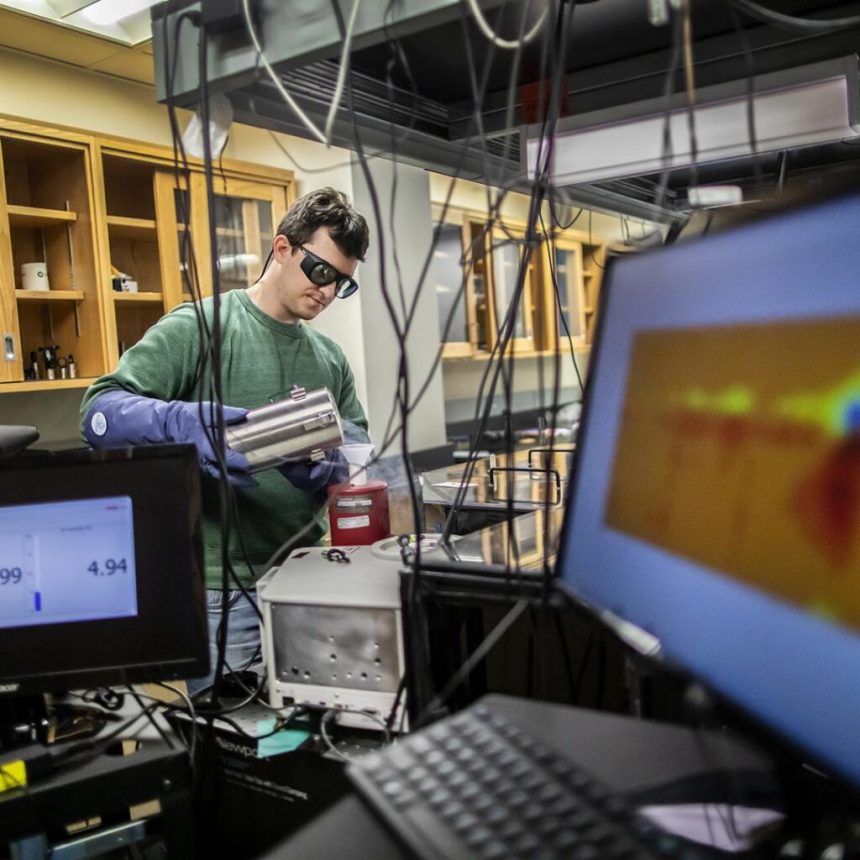
MESE prepares you for energy and sustainability careers through hands-on learning and optional internships that build real-world, job-ready experience. Source: University of Pennsylvania
Learning that goes beyond the classroom
Understanding how energy systems work is important. Applying that knowledge to real-world settings is where MESE stands apart.
In Dr. Grundy’s course, Engineering Sustainability at Penn, students tackle authentic sustainability challenges across Penn’s campus and in the local community. Some have used sensors to monitor energy consumption in laboratory fume hoods. Others have redesigned food systems and processes to improve efficiency and reduce waste.
Such projects don’t stay on paper. One student team developed a system to recycle cooling water in Penn’s chemistry laboratories, and their solution is now being expanded across the university. Another partnered with an architecture lab to evaluate heat-reflective asphalt coatings in a local park, exploring ways to reduce the urban heat island effect.
The whole point of MESE’s experiential learning approach is for you to graduate with evidence of what you can do. “We’ve woven hands-on projects throughout the programme, so that students go into their careers with a portfolio of work they’ve done,” Dr. Grundy says.
Internships fit into this framework, too. One student, after encountering energy storage in an introductory course, followed that interest into a full electrochemistry course, and then into a semester-long battery engineering internship at Tesla. That even led her to secure a full-time position there after graduation. Her path is a good example of how the programme works – each experience building on the last, with industry exposure as the payoff.
Penn’s ecosystem as a competitive advantage
Because few challenges are as interdisciplinary as energy, MESE leverages Penn’s ecosystem. You’ll draw expertise from across the University throughout your studies – think climate finance at Wharton, environmental building design and energy management at the Weitzman School of Design, and policy research through the Kleinman Centre for Energy Policy, one of the programme’s closest collaborators.
Classroom culture further ensures you’ll explore energy from various perspectives. Programme Coordinator Dasha Peppard, who oversees student professional development and policy training, describes the day-to-day experience as one defined by “energy, engagement, and getting to work with classmates from around the world.” Your peers bring a wide range of academic and professional backgrounds into the same room, and the complexity of the problems they’re tackling is precisely what keeps that collaboration purposeful.
The outcomes reflect that breadth. Graduates move into technical engineering roles, consulting positions, finance careers connected to energy systems, and policy-focused work. Others continue into doctoral study at Penn, where master’s coursework can count toward PhD requirements.
Follow Penn Engineering on Facebook, X, Instagram, LinkedIn, and YouTube