When Laura Orozco wasa junior in highschool, confronted by the reality of college applications, ithadn’t evencrossed her mind thatshe’d be going.
Born and raised in Virginia, Orozco is among the millions of first-generation college students in the US. Herdad’s from Guatemala,mom’s from Paraguay, and theyhadn’t ever gone to college —hadn’t ever told Orozco that they expected her to go to college either.
“It was just this unknown expectation throughout the school, that we’reall going,” she says. “They would push you, but they wouldn’t really help you.”
The scene looks different when you’ve got parents who’ve done the whole college rendezvous, and when you’re, to put it simply, white. Expectations are different. Resources aren’t limited. Orozco had grown up surrounded by kids whose parents were government contract workers or in the military. Kids who’d been reminded to take AP classes and taught how to write college essays.
The lack of family guidance is oftennot a personal issue. It’s hard for parents to advise their children through a process they haven’t experienced. The onus is on the school to reach out, yet… many don’t.
“At my school, no one really told you what to do. I heard my other friends take AP classes, and I’m just like, ‘Oh, I didn’t even think about that,” she says. “It was just interesting later on, realising that there’s so much I did not know, and I lived in my little bubble.”
Fast forward to today: Orozco’s a master’s graduate. She attended Virginia Commonwealth University, graduating with bachelor’s degrees in homeland security and political science. She then went straight into a master’s in international affairs at George Washington University, where an exchange programme took her about 7,954 miles away from home: Taiwan.
It’s safe to sayshe’s burst that little bubble, andit’s the best decisionshe’s ever made.
Like many first-generation college students, Orozco never though she’d even go to university but ended up with a master’s and studying in 2 countries.
An interest in political science, a complication in deciding her future
It started with an interest in becoming a lawyer. Orozco thought about studying history, but her parents would tell her no, thinking career prospects with history were little to none. Then, after some research, she’d discover political science — a major that at the time, at least, “seemed interesting.”
“[My parents] didn’t really understand it. They just heard ‘political’ and were like, ‘Okay, it’s something politics, government, cool. You can be a government worker,” she says.
One could describe Orozco’s experience in applying to college as slightly chaotic. There was constant back-and-forth between her parents as they discussed her future career. There was a lack of guidance from her school counsellors; the need to seek out information that others already knew — that others would simply assume a mere 17-year-old would know.
That’s the thing: it’s the assumption that students know when and how to seek help that often leads to a lack of guidance for first-generation college students, who face the very challenge of not knowing. Orozco is hardly alone in this. According to research,72% of first-generation college students hadn’t taken any college preparatory courses, compared with 43% of students whose parents attended at least some college.
Instead of an institutional figure reaching out first, many families are left to navigate the process on their own. Orozco herself had to reach out to her other friends and their parents. Her dad was pretty hands-on, finding resources like an advisor who helped Latinos in the area through college applications, while her mom found someone in her friend group to help build Orozco’s college essay. Another study found that more than 70% of respondents turned tosiblings, cousins or other family members who had attended college.
“Don’t be afraid to ask for help,” is the simple yet important advice Orozco would share with other first-generation college students navigating applications today. “No one’s asking you to sign the contract right now or pay that deposit. It’s literally just seeking information to see if it’s something you want to do.”

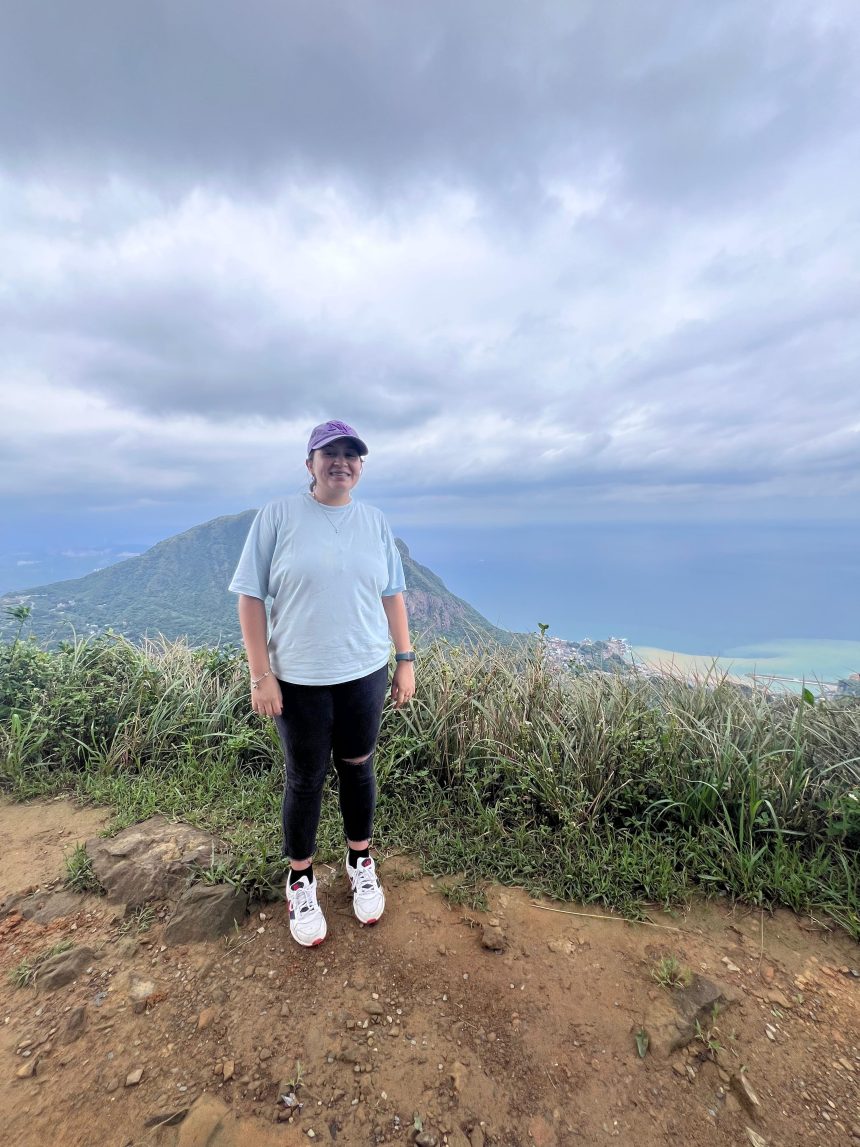
Orozco attended National Chengchi University in Taipei during her semester on exchange. Source: Laura Orozco
Taking the path from Virginia to Taipei
The one thing Orozco did know was that there was more to life than just her little town.
A Latin American government and politics class during her sophomore year of undergraduate studies would steer Orozco closer to her eventual master’s pursuit in international affairs, though it was a US foreign policy course in her junior year that prompted her interest in East Asia.
“My professor was really focused on Chinese foreign policy, so he made us read a couple of articles, and then he tied it into the US,” she says. “The following summer, I applied for an internship at the US Department of State, which really launched my whole focus in public service and international affairs.”
Come graduate school, and Orozco found herself researching how the Belt and Road Initiative, launched by Chinese President Xi Jinping in 2013, had expanded across Latin America. When the chance to study abroad came up, she was already writing papers about the initiative. There were programmes to study in Mexico and Argentina, but Orozco felt that her Spanish wasn’t fluent enough for an academic setting.
Then came the golden opportunity: Taiwan.

There are currently 8.2 million first-generation college students in the US. Source: Laura Orozco
In her third semester of graduate school, Orozco left the US for an exchange programme at National Chengchi University, conducted entirely in English. The university consistently ranks among the top 10 in Taiwan and is known for its programmes in the humanities, social sciences, and international politics. Orozco found a good mix of foreign and Taiwanese professors. Taipei is also known as a melting pot city, and with free Mandarin courses offered, she saw it as a good chance to expand her horizons.
“I’ve travelled to both of my parents’ countries, but I just knew that there’s just way more out there. I was like, ‘This can’t be it,’” she says. “Slowly, throughout high school, it just opened my mind a little bit to the fact that there’s more out there, that’s not my little town. The learning of cultures and languages is what stuck out to me; the diversity of things.”
Studying in Taiwan was the first time Orozco truly experienced what it means to be independent. The culture shocks manifested in rather small ways. Using the 24-hour time format instead of the 12-hour clock made her late to the first day of class. Seeing yellow watermelons for the first time with her mom. Having to use gestures and signs to communicate due to the language barrier.
It’s an experience that cannot be replicated, living under your parents’ roof.
“The nature was beautiful out there. I started picking up hobbies that I feel I would never have done if I didn’t have that time to just sit and think,” says Orozco. “My whole purpose was just to be a student — learning more about yourself in your own comfortable space, but it was uncomfortable at the same time.”