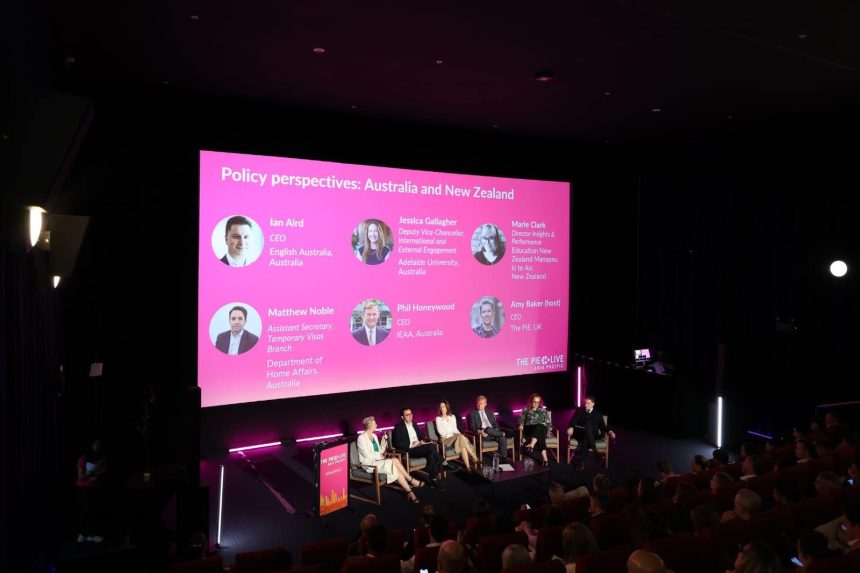
Australia’s evolving student visa system took centre stage at The PIE Live Asia Pacific, where Home Affairs defended its focus on quality and integrity as sector leaders warned uncertainty was making long-term planning increasingly difficult.
Speaking during a policy panel on Australia and New Zealand, Department of Home Affairs assistant secretary Matthew Noble argued that tighter visa outcomes reflected a sustained focus on quality rather than a shift in government policy.
Meanwhile, International Education Association of Australia (IEAA) CEO Phil Honeywood and Adelaide University deputy vice-chancellor (external engagement) Jessica Gallagher said greater consistency would be essential if Australia was to remain competitive as a study destination.
The discussion comes after months of reforms across Australia’s international education sector, including tighter integrity measures, a freeze on new overseas student registrations for private VET and ELICOS providers, higher visa charges and a National Planning Level (NPL) of 295,000 overseas student commencements for 2027.
The PIE News has also reported rising offshore refusal rates across South Asia and growing concern among universities that higher visa charges and increasingly subjective assessments are hurting Australia’s competitiveness.
Against that backdrop, Noble argued the department’s overall approach had remained consistent.
“There hasn’t actually been any change in policy. What we are looking at over this year is a bit of a correction that is here to stay in terms of that sustained focus on quality.”
Noble said increased scrutiny followed concerns that some applicants appeared to be using the student visa primarily as a pathway into Australia’s labour market rather than for genuine study.
While acknowledging that offshore higher education grant rates had fallen from around 86–87% to 78%, Noble stressed that overall international student numbers remained high and Australia’s grant rate remained strong compared with other major study destinations.
“We rely heavily on providers having processes in place, so then we can streamline where we don’t see those risk indicators, and therefore return some predictability into the system, which I know is obviously very valued by providers.”
He also rejected suggestions that Ministerial Direction 115 acted as a limit on student numbers, saying the department assessed “each and every application” individually and that the direction was “not a cap” but simply guided the order in which visa applications were processed.
“Refusals take a bit longer because we don’t take those decisions lightly… our overall average processing time for an offshore student visa is 14 days.”
For Honeywood, however, the central challenge facing providers was no longer the government’s allocation of student places but the unpredictability of visa outcomes.
“There’s a theory of an enrolment number allocation each year, and then it’s the reality that visas are just not being approved,” Honeywood said. “On the one hand, you’ve got our Prime Minister saying we’re turning the tap. At departmental level… it’s all about quality and integrity.”
He said the conflicting messages had left universities struggling to plan recruitment despite having indicative enrolment allocations, with some public institutions still sitting well below their expected numbers.
Honeywood argued visa uncertainty was also undermining Australia’s efforts to diversify recruitment, pointing to Latin America as an example.
“We’ve lost the entire Latin American market,” he said, arguing that students from countries such as Brazil and Colombia were no longer considering Australia because of the current visa environment. “Our government is saying to us, ‘You need to diversify away from China and India. You need to find new markets’… We’re in a real conundrum.”
Gallagher echoed calls for greater certainty, arguing that policy stability mattered well beyond student recruitment.
Launching Adelaide University following the merger of the University of Adelaide and the University of South Australia had coincided with one of the most turbulent policy environments the sector had experienced, Gallagher said, as the institution sought to establish a new brand while navigating higher visa fees, increased refusals and perceptions that Australia had become less welcoming.
“We’ve had this beautiful double whammy” of creating a new university while introducing an entirely new curriculum and brand at the same time as adapting to significant visa policy changes, she said. “In short, it’s been a wild ride so far.”
Gallagher said the challenge was particularly acute in South Australia, where skills shortages in defence, the energy transition and health sat alongside state ambitions to attract more international students.
“It’s all connected,” Gallagher said, arguing that the conversation should not be limited to student recruitment, with uncertainty also affecting research collaboration, student mobility, transnational education and broader institutional partnerships, while cautioning that TNE was “not a silver bullet”.
“We’ve really got to think about what are the best mechanisms to ensure that Australia remains relevant, attractive and competitive,” Gallagher said, arguing that this would require “different kinds of partnerships across all parts of the ecosystem”.
We’ve let ourselves down as a sector because we haven’t been prepared over the years to stand up and shout all the benefits
Phil Honeywood, International Education Association of Australia (IEAA)
The panel also examined recent reforms targeting education agents following Australia’s ban on commissions linked to onshore provider transfers.
Honeywood, who served on a working group advising the Department of Education on the reforms, argued some agencies had already found ways around the restrictions, citing scholarships, offshore commission payments and other financial arrangements.
Asked about visa refusals, Noble acknowledged Home Affairs did not “always get it right” and said the department welcomed feedback to improve its processes.
He added that officials had reached around 18,000 participants through integrity webinars over the past year and were working to provide more targeted, region-specific guidance.
Closing the discussion, Honeywood argued that Australia’s international education sector needed to make a stronger public case for its wider contribution to the country.
“We’ve let ourselves down as a sector because we haven’t been prepared over the years to stand up and shout all the benefits,” he said, pointing to international education’s contribution to soft diplomacy and the broader national interest.
Honeywood also questioned high refusal rates for VET students despite persistent national skills shortages.
“We’re saying no to VET, but we desperately need the skills at the same time,” he said.
Noble agreed that maintaining public confidence was essential, but said confidence ultimately depended on quality remaining central to both education provision and visa decision-making.
“For us, it’s all about quality. Quality being the driver, not only of education offerings but, of course, visa applications as well.”