Formula One has never been bigger. Between Netflix’sDrive to Survive pulling in a whole new generation of fans who care about Formula One drivers, the 2026 season delivering one of the tightest title fights in years, and F1 stars becoming genuine crossover celebrities, more people than ever are curious about the humans behind the helmets.
And specifically, what they were doing before they were doing 300 km/h for a living.
The answer, for most of the current grid, is: not a whole lot of traditional schooling. F1 is one of those “elite career” paths where leaving school at 14, 15, or 16 to go racing full-time is basically required. But a handful of drivers, past and present, have managed to balance genuinely impressive academic records alongside a racing career. Here’s the real breakdown.
Where the Formula One drivers of 2026 studied
1. Lewis Hamilton
Lewis Hamilton’s schooling story is one of the more well-documented in the sport. We’ve even written a separate piece on the guy.
He attended St John Henry Newman Catholic School in Stevenage, where he’s spoken candidly about experiencing racist bullying that made his school years, in his own words, some of the hardest of his life.
Then, McLaren boss Ron Dennis famously funded Hamilton’s early karting career on the condition that he kept excelling in school — which he did, going on to study for his GCSEs at CATS College in Cambridge, a private sixth-form college known for working with students juggling elite sport or performing careers alongside academics.
But he never went on to university, moving straight into single-seater racing as a teenager instead.
These days, Hamilton’s channelled that experience into advocacy — he founded Mission 44, a charity focused on making UK education more inclusive, and has met with the UK government directly on education reform.
2. Carlos Sainz
Carlos Sainz Jr. grew up in Madrid, attending the SEK-El Castillo International School, where his bilingual education gave him the fluent English that’s now a staple of his paddock interviews.
Like most drivers who show serious karting talent young, Sainz moved straight from school into full-time racing without going on to university — karting at six, racing internationally by his early teens, and into single-seaters by 17.
Worth noting: his father, Carlos Sainz Sr., the two-time World Rally Champion, actually started a law degree before dropping out in his second year after rallying took over. Racing genes and abandoned degrees, it turns out, run in the family.
3. Oscar Piastri
Piastri might be the current grid’s strongest case for “could’ve had a real backup plan.” He’s spoken openly about the subjects he focused on before racing consumed his schedule — maths, physics, and computer science — and has said outright that if he weren’t a driver, he’d most likely have become an engineer.
He also credits his STEM background as a genuine competitive edge, saying it gives him a real advantage in understanding what different car setup changes actually do under the hood, rather than just reacting to how the car feels.
4. George Russell
George Russell attended Wisbech Grammar School in Cambridgeshire before switching to homeschooling as his karting career ramped up — a familiar pattern for young drivers who reach a point where school timetables simply can’t flex around a European racing calendar.
Russell has since talked about how surprisingly transferable his old exam-prep mindset has been to his F1 career, comparing race weekend preparation to revising for a test: the same repetition, the same need to trust muscle memory when the pressure’s on.
5. Max Verstappen
Four-time World Champion Max Verstappen’s education is probably the most extreme example on the current grid of racing taking full priority.
Growing up between Belgium and the Netherlands, Verstappen was pulled from a conventional school schedule early and switched to a private tutor, eventually attending school just one day a week — an arrangement his father, ex-F1 driver Jos Verstappen, openly engineered so Max could race everywhere without missing track time.
Verstappen himself has said plainly that he never liked sitting in a classroom, and has admitted in interviews that he’s only read two books cover to cover in his life — Mark Webber’s autobiographyAussie Grit and one connected to football legend Johan Cruyff. Jos has defended the decision bluntly: if Max hadn’t shown the talent, he says, he’d have sent him straight back to school. He didn’t have to.
6. Charles Leclerc
Charles Leclerc’s schooling is a bit of an outlier among current Formula One drivers: by his own account, he was genuinely a strong student. Growing up in Monaco, he attended École de Fontvieille for primary school before moving on to the prestigious Lycée Albert 1er, a historic Monégasque secondary school that also counts Monaco’s reigning prince among its alumni.
Leclerc has said in interviews that starting a new school year never stressed him out, and that despite “a bit of mischief,” his grades stayed solid throughout. Like nearly everyone else on this list, though, he moved straight from school into the Ferrari Driver Academy pipeline rather than going on to university — proof that even the grid’s most conscientious student ultimately chose horsepower over higher education.
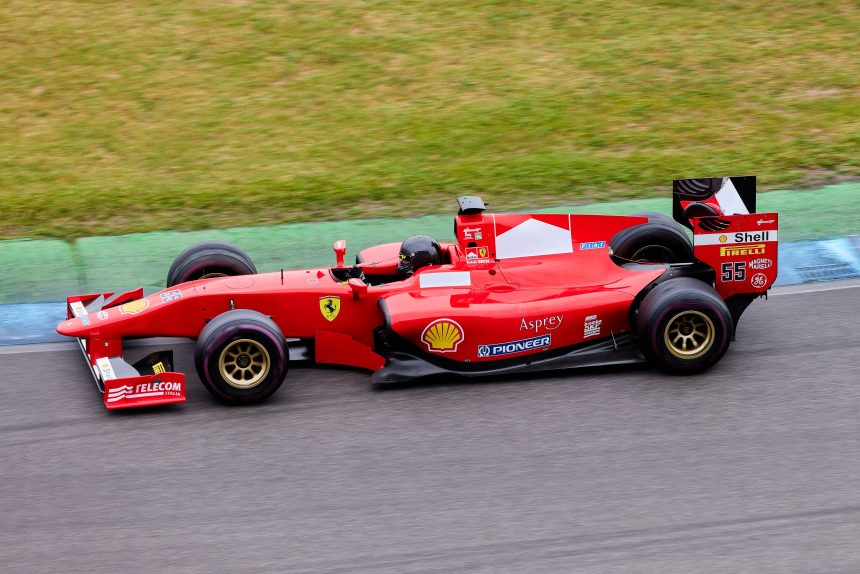
Formula One is a massive global sports and entertainment empire, generating US$3.87 billion in annual commercial revenue. Source: Philipp Fahlbusch via Pexels
Most educated Formula One drivers in history
While most current drivers left formal education behind early, F1’s history actually includes a handful of genuinely serious academics:
1. Jonathan Palmer
Arguably, one of the most academically qualified Formula One drivers that the world has ever been seen. Palmer is a fully qualified medical doctor, having completed his medical degree before racing in F1 for seven seasons in the 1980s. He later went on to found the MSA British Racing Drivers’ Club Superstars series and several UK race circuits.
2. Nico Rosberg
The 2016 World Champion was actually offered a place at Imperial College London to study Aeronautical Engineering, one of the world’s most competitive engineering courses. He turned it down to take up a seat in GP2 instead — though he later validated the offer in a different way, recording the highest score in Williams F1 team history on their internal Engineering Aptitude Test for new drivers.
3. Alexander Wurz
The Austrian former F1 driver and test driver was widely regarded in the paddock as one of the sharpest technical minds ever to sit in a cockpit, frequently praised by engineers for his data literacy and technical feedback, despite never pursuing a formal university path.
4. Damon Hill
1996 World Champion and son of double champion Graham Hill, Damon Hill left school with fewer academic qualifications but has spoken about how much he values education and later became a vocal supporter of motorsport engineering apprenticeship programmes in the UK.
Formula One drivers get a different kind of education
Formula One doesn’t really have one educational blueprint. For most drivers, karting talent gets spotted so early that formal schooling gets phased out by necessity. There’s simply no way to attend regular school while racing across three continents as a young teenager.
But the sport has never been anti-intellectual either: it’s arguably the most technical sport on earth, built on aerodynamics, data science, and split-second engineering decisions, which is exactly why guys like Rosberg, Palmer, and Piastri valued STEM subjects even while their formal education got cut short.
But today’s grid skews younger and drops out of formal schooling earlier than any previous generation. It’s tempting to chalk that up to racing simply becoming a more “respectable” career choice, but the real story is more structural than that.
Ferrari, Red Bull, and Mercedes now run full driver academies that scout, fund, and train talent from the karting stage onward. That kind of team-backed infrastructure barely existed a generation ago, when drivers largely found their own way up through privately funded junior series.
The sport professionalising and monetising talent identification so aggressively means that skipping traditional education has become the competitive default rather than the exception.
Even F1’s own technical leadership has wrestled with this personally: Red Bull’s chief technical officer, Adrian Newey, has spoken candidly about his worries as a parent watching his own son begin a racing career during his final years of compulsory schooling.
If anything, F1 makes a pretty strong case that the real education these drivers earn is on the track — reading data, understanding car balance, and making technical decisions in real time that would make most engineering graduates sweat.