The London Academy of Music and Dramatic Art (LAMDA) has been training and inspiring exceptional artists for more than 160 years. That’s a long time and a large group of graduates have gone on to become the who’s who across the performing arts sector and wider creative industries.
LAMDA’s vocational and practical courses played a role in their paths to success, but how exactly? Did their courses focus on just skills? (No, it’s more than that. It’s about self-awareness, authenticity, and discovering what makes your creative voice unique). How hands-on are they? (Expect lots of rehearsal rooms, productions, and showcases). And what’s this thing about an ensemble? (The ensemble is powerful and you’ll learn how to work as a team with actors, directors, and technicians).
You probably have more questions, which is why we went to LAMDA’s Barons Court campus, located in easy reach of London’s West End, to get the answers for you. Here we go:
LAMDA offers comprehensive vocational training for actors, directors, musical theatre performers, stage managers, technicians, and lighting and sound designers. Source: LAMDA
Why study at a drama school like LAMDA?
We offer industry-leading undergraduate, postgraduate, and short courses in Acting, Musical Theatre, Directing, and Production and Technical Arts. If you want to work professionally in the performing arts, these full-time courses and conservatoire training are a great route into the industry.
Our courses are vocational rather than academic, taught in small groups by tutors who still work in the industry. Training is intensive so it suits people ready to give it their full attention.
Depending on which course you train on, you’ll graduate with a familiarity of a rehearsal environment, production experience, and a showcase behind you. We support graduates even long after they’ve left campus. Alumni receive discounted rehearsal studio hire, theatre space, access to our Alumni Company, and many more benefits.
What is LAMDA’s “ensemble focus” all about?
Being part of an ensemble means training as a company rather than as individuals competing for attention. Drama is a collaborative art form and the training we give stresses the importance of working together to achieve excellence. For instance, actors rehearse with student directors, and productions are stage-managed, lit, and designed by students on our Production and Technical Arts course. You’ll learn what everyone else in the room does, which is how professional theatre, screen and audio productionworks.
What does LAMDA look for in applicants, and what happens at the audition?
We use the audition and the interview process as an opportunity to showcase individual strengths. We’re not looking for particular qualifications, grades, or backgrounds. We welcome applications from everyone. For example, our BA (Hons) Professional Acting course has no academic entry requirements — we’ll admit you based on your audition.
The audition or interview process can differ depending on where you’re based and what course you’re applying to, ranging from a self-tape in the first round, to in-person recalls in London or in North America.
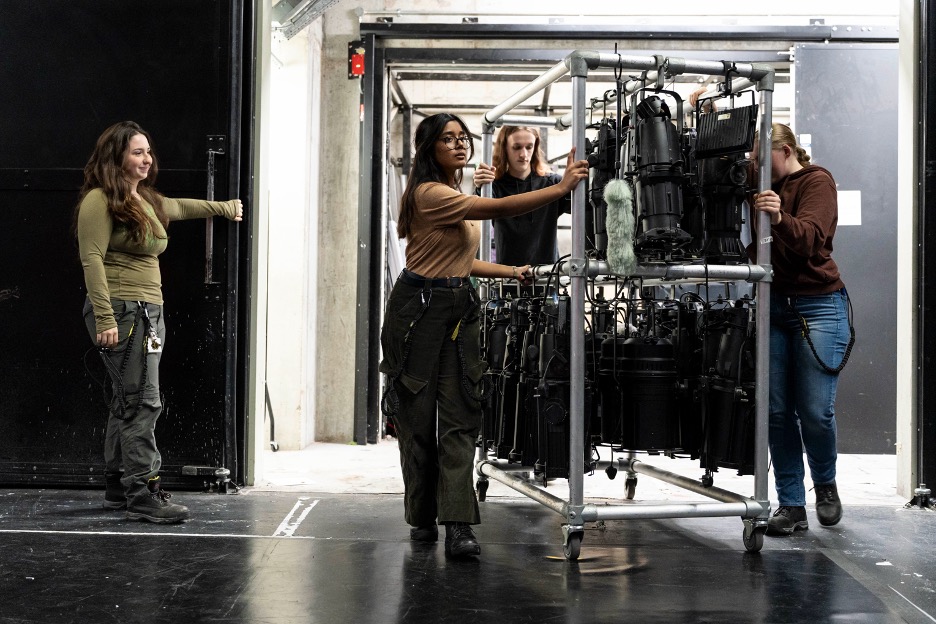
LAMDA offers a safe and welcoming environment where you can develop your craft, push your boundaries, and grow as an artist. Source: LAMDA
What is it like to train at a drama school? What support is available?
While it’s intensive, we ensure that every student and member of staff feels like they’re part of the LAMDA family throughout their time at the school and beyond. Our academic services team is always there to help with any support you need, including reasonable adjustments. We also have a dedicated wellbeing department, who can offer a safe and non-judgmental space to speak about mental health and wellbeing.
I’m an international student looking for funding options to study at LAMDA. Where can I find one suitable for me?
If you’re looking for financial support, start with the UK Council for International Student Affairs (UKCISA) and your home country’s education ministry or department. Both are useful sources of information on scholarships, government funding, and loans for overseas study. You can also explore LAMDA’s international student funding page for country-specific guidance and funding opportunities.
Students from the US may be eligible for the Federal Direct Loan Programme if they’re enrolled on a full-time course lasting at least one year. LAMDA also works with Sallie Mae and Earnest Loans for students applying for private student loans. Those applying for the MA Classical Acting course can apply for the Fulbright-John Wood LAMDA Award, which covers full tuition fees and provides a living stipend. LAMDA also recognises external awards, including Chevening Scholarships and Marshall Scholarships. Around one in four students at LAMDA receive scholarship support.
We also have a number of scholarships specifically to support international students. When applying for a scholarship directly to LAMDA you will be assessed against all scholarships that you are eligible for. We recognise that applying for funding is complex and students will receive a scholarship guide to help support them through the process. Demand is always greater than the funding we currently have available. We’re working to grow our scholarships programme so that financial circumstances are never a barrier for talented students from underrepresented backgrounds who want to train at LAMDA.
Where do LAMDA students live? Is there student accommodation?
Our campus is located in the theatrical capital of the world. It’s home to state-of-the-art facilities, such as the 220-seat professional Sainsbury Theatre and two black box theatres which provide flexible and accessible performance spaces. We also have screen and audio facilities including an LED Volume Studio, a Motion Capture Studio, and an Audio Recording Studio.
We are a short walk away from Barons Court tube station, near Hammersmith in London. Because we’re so well-connected, students can choose from a wealth of housing options available in the city. Most students live in private rental properties with those from their course in West London areas of Hammersmith and Fulham, Chiswick, Kensington, Ealing, Northfields, Earls Court and Acton. Others choose to live further out. On average, the commute time of our students is between five minutes to 45 minutes.
While we don’t provide student accommodation, we can offer advice and introduce you to other offer holders so you can connect with potential housemates. We’re also partnered with HYBR, an online marketplace for student accommodation that connects students directly with landlords and cuts out the need for traditional letting agents.