A “global mindset” can sound lofty. But it simply means the ability to step outside your own culture and accept that there is no one right way to do things.
That understanding is best forged in childhood and most effectively through conversation, curiosity and contact with people who look unlike us. Schools play a key role in this – in diverse campuses, children have a conducive environment to learn that their world is larger than their own experience. Other perspectives matter and that’s not only okay, but the way it should be.
In the International Journal of Intercultural Relations, a longitudinal study of 1,156 adolescents was conducted – 78.96% of participants belonging to the majority group, and 21.04% to migrant backgrounds. The study found that there is a positive link between school diversity climate and academic achievement. Perceived equal treatment by teachers increased their sense of belonging, and, in turn, social well-being.In Asia, international schools are uniquely placed to nurture this awareness. By bringing together students from different cultures and encouraging participation beyond academics, they prepare young people to navigate our complex and complicated world. If this is the kind of foundation you’re looking for, these four schools in Asia stand out.
Chatsworth International School was established in 1995, and has now found its home in Bukit Timah, right by Singapore’s only rainforest. Source: Chatsworth International School
Chatsworth International School
Walk through the gates of Chatsworth International School and the lesson begins before anyone opens a book. The campus itself does the teaching. Call it its greatest classroom. This may be one of the top International Baccalaureate (IB) schools in Singapore, but academics are not the sole reason graduates achieve a 100% pass rate. In the quiet between buildings, in the mix of accents and languages, students of more than 50 nationalities and teachers from over 20 countries form a special kind of community: one that empowers every child to inhabit a world larger than themselves.
Diverse looks aside, when teachers model openness and curiosity, students follow. From Kindergarten to the IB Diploma, students learn how to listen, how to disagree respectfully, and how to solve problems. For example, in the Unit of Inquiry (UOI), “Where we are in time and place,” Year 4 students get to explore art and how it gives insight into culture and history. It was about learning that one’s perspective matters and that others’ perspectives deserve attention too.
Then, there are the dialogues amongst students between lessons. Here, in corridors and courtyards, they are meaningful. Every chat is yet another way to learn to respect people who look unlike us, and every discussion is a practice in collaboration. Many students may be far from their home countries, having been months since they last spoke their native language. But just because everyone speaks in English here does not mean that the school’s commitment to developing fluency in others is negated. The IB Primary Years, Middle Years, and Diploma Programmes require students to take at least two languages, and this comes on top of its globally engaged curriculum. Chatsworth also offers a unique Mother Tongue Programme for secondary students with native or near native levels of their mother tongue with the teaching space and support within the existing school system.
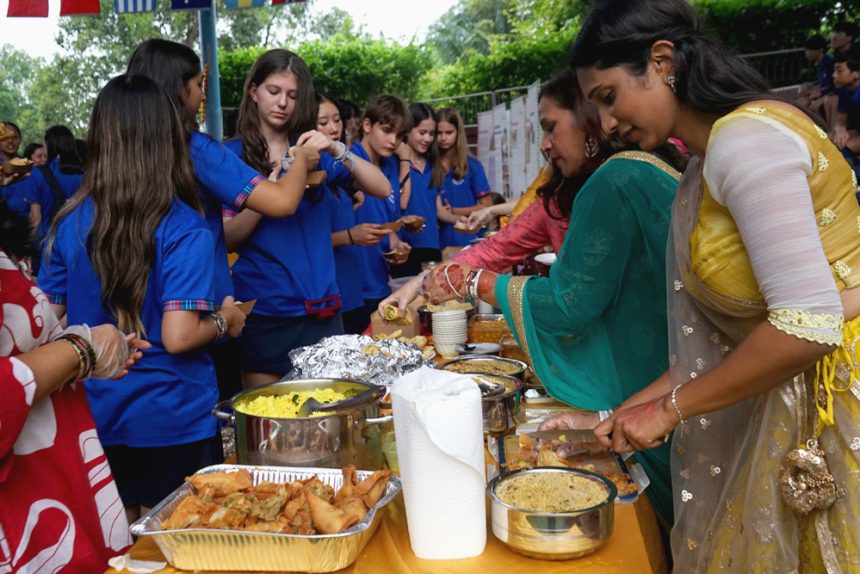
On par with such rigorous learning is celebration. Every year in October, the courtyard turns into a mini global village on Cultural Celebration Day. Students from nations across the globe pay homage to their home countries through dance, music, food, and art, proudly wearing their ethnic/culture attire. The Chatsworth Parent Group makes its own contribution by hosting the Food Festival, preparing cuisines from around the world to expand palates and point of views further.
For over three decades, Chatsworth has built a community where students feel seen and valued. The impact of that shows in what graduates achieve: they leave with more than just exceptional IB scores and offers from over 200 universities worldwide – they leave with the resilience, life skills, and lasting bonds that matter most.

Two features of Bangkok Patana School are instrumental to its success: a British-based, international curriculum and Bangkok’s bustling benefits. Source: Bangkok Patana School
Bangkok Patana School
As one of the most respected educational establishments in South East Asia, Bangkok Patana School knows what future-proof education is. From Foundation Stage right through Senior Studies, over 2,200 students from around 60 countries are nurtured to become lifelong learners who can adapt to an ever-changing world.
The school understands that every learner is on a unique journey. Each student needs and thrives on tailored training plans – it’s why differentiation is a big part of their approach to education. It is for this reason that the school offers two excellent programmes — the English National Curriculum and International Baccalaureate. With these, students are getting the best intellectual, physical and social preparation for their futures.
Of course, they aren’t alone. Teachers are committed to helping students reach their personal and academic goals, not just through simple direction, but also by working alongside them in open classroom environments. This encourages children to find meaning and value in their interests, which in turn gives them the confidence to share ideas and thoughts.
This practice extends beyond the classrooms. Student welfare is a key priority – the school provides a wide range of extra-curricular activities that offer a holistic approach to learning. This ensures that their students graduate as well-rounded individuals ready for higher education and to positively impact society.

MCM students engage in various experiences that broaden horizons and build confidence, such as public speaking. Source: Marlborough College Malaysia.
Marlborough College Malaysia
Amid Asia’s fast-evolving international education landscape, Marlborough College Malaysia (MCM), an independent day and boarding school, stands out for delivering what Singapore Tatler calls “the only authentic British boarding experience in Asia.” But its true legacy lies in the lives it touches — nurturing resilience, sparking curiosity, and instilling values that endure long after school days are over.
In Pre-Prep and Prep School, pupils are introduced to a diverse range of subjects, including Mandarin, music, ballet, swimming, and drama. The school regularly organises events that combine learning with fun as well. One example is the James Bond-themed Science Week, where students got to hear real-life wildlife encounters from Sarah Roberts, a global conservationist and author.
Senior School builds on this foundation, preparing students for IGCSEs before they progress to the International Baccalaureate (IB) Diploma in Sixth Form. Last November, 13 IB Geographers attended a lecture run by the Royal Geographical Society. Held at the British Club in Singapore, the lecture had Dr. Parag Khanna, a global strategy advisor and Founder & CEO of AlphaGeo, an AI-based geospatial predictive analytics platform, speaking about the future of human civilisation in our increasingly connected and mobile world.
Beyond academics, life at MCM is built on values that matter: compassion, companionship, and connection. Nowhere is this more evident than in the boarding community, where students shape their environment through leadership roles and active participation. Plus, with international award-winning pastoral care, the result is a boarding experience that feels like home.
But students don’t just dream about the future, they’re guided every step of the way to achieve it. The college offers a comprehensive university application programme, including a University Fair, Careers Fair, and regular talks by international university representatives. Alumni also return for Lunch and Learn sessions to share their journeys.
This highly personalised support has opened doors to some of the most competitive universities around the globe. Graduates are accepted into universities such as Oxford University in the UK and Harvard University in the US.

Source: British International School Ho Chi Minh City/Facebook
British International School Ho Chi Minh City
The British International School in Ho Chi Minh City (BIS HCMC) may be the largest of its kind in Vietnam, but that’s not the only thing that makes it large-scale. The school is one of 89 within the Nord Anglia Education system stationed across 37 countries worldwide. Students from the Early Years to Secondary School experience a balanced academic framework informed by the National Curriculum for England, which emphasises the development of 21st century skills.
Home to over 2,400 students from more than 55 countries, BIS HCMC has fostered an environment where striving for a peaceful and sustainable world has become the daily mantra. Its most engaging experience, after all, is the expedition programme. It’s designed to begin in Year 3 and to be followed through to Year 12. Students visit new environments and tackle new challenges. They may start with something simple like learning how to organise their belongings for a trip in Year 3, but by Year 12, they would’ve zipped through forests and skied across mountains.
While activities like these pave the way for skill development, it’s also an opportunity for students to engage with the community, whether on or off campus. They learn what it means to have a sense of camaraderie among peers and how to work with each other and the local communities. Experiences like these grow students into global citizens who act with integrity and respect.
Here, celebration of heritage and culture is just as important as learning. Back in February, students and teachers ushered in the Lunar New Year, known as Tết in Vietnam. There were traditional games, calligraphy, traditional dragon and lion dances, cultural shows, and musical performances featuring Vietnamese instruments.
*Some of the institutions featured in this article are commercial partners of Study International