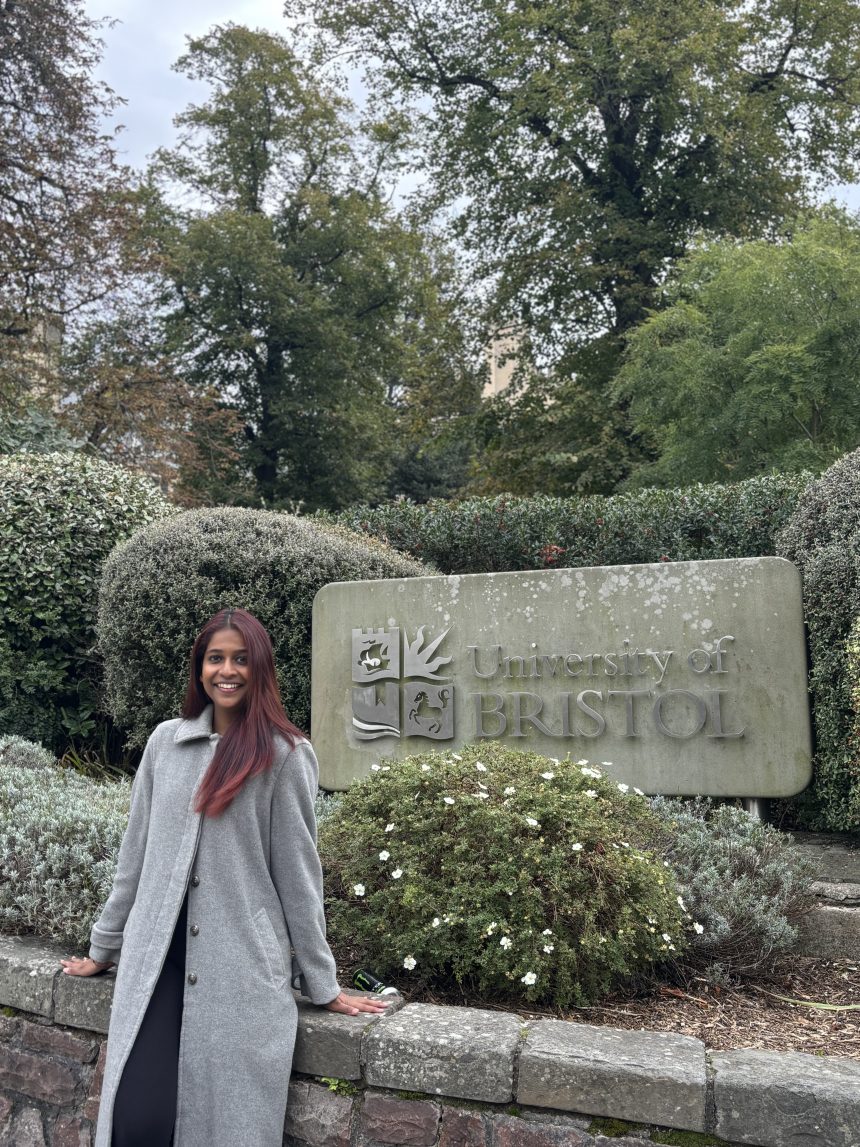
When Vilashini Saravanan is asked whether she has ever faced discrimination or obstacles because of her gender, people expect a certain kind of answer.
She is a woman of colour, raised by a single mother in Kuala Lumpur, now carving out space at the intersection of healthcare and engineering as a British Council Women in STEM scholarship recipient. She’s now working in the women’s health space, armed with her Master’s in Digital Health from the University of Bristol.
The obstacles, surely, must have been many.
“My answer, surprisingly, is no.”
It is a response that might raise eyebrows — but Saravanan is not naïve, and she is not dismissive. She is simply someone who has chosen to change the lens.
“You can’t go in thinking you don’t belong.”
Saravanan grew up watching what an empowered woman looked like. Her mother, who divorced when she was just four years old, built a household with no ceilings — one where her daughters were never made to feel that their gender was a limitation.
That foundation shaped everything. Saravanan went on to qualify as a pharmacist, her twin sister became a dentist, and today she is pursuing digital health studies under an engineering department that spans mechatronics and aerospace.
Women, she notes, are thriving in her cohort. There are plenty of womn in STEM now. The gap that once defined these fields is closing.
But Saravanan is clear that the environment alone does not determine outcomes. Mindset does.
“You as a woman going into the field, you can’t go in thinking you don’t belong. People will catch that, that lack of confidence,” she says. “You go in there because you know you want to do it, you want to learn it, and you go in there with a confidence that people can’t shake.”
This is not toxic positivity. It is a hard-won belief, built from experience. The barriers that hold many women back can often be the ones they have already built inside their own heads — the fear of failure, the assumption that they won’t be supported, the hesitation before they even try.
“I’ve experienced it,” she says. “There’s a lot of support.”
Everyone will face adversity, male or female. The question is whether you let the fear of it stop you before you begin.
The amount of women in STEM are slowly growing, with females constituting approximately 26% of the US STEM workforce, an increase from the 21% in 2016. Source: Vilashini Saravanan
Curate what you feed your brain
Saravanan is just as intentional about what she lets into her mind as she is about how she shows up in the world. In an era where social media can just as easily erode confidence as build it, she has a simple but powerful directive: curate your algorithm.
“I’m not going to pretend and say I haven’t seen an Indian girl thrive,” the Women in STEM scholar says. “I’ve seen multiple Indian girls thrive. I’ve seen so many women of colour of different abilities thrive. We have that. It’s our job to focus on that and not on the negatives.”
The stories are out there. The role models exist. But the digital world will only show you what you ask it to show you.
If your feed is full of reasons why women like you don’t succeed, you will come to believe it. If it is full of women who look like you doing extraordinary things, you will come to expect it.
Do it for you
There is a particular kind of pressure that comes with being a woman of colour in a high-achieving space. It’s the sense that you must represent something larger than yourself, that your success or failure reflects on an entire community.
Saravanan knows of that weight. But she has made a deliberate choice not to carry it.
She does not do things because she is a woman of colour. She didn’t go into digital health to prove a point. She didn’t become a Women in STEM scholar just to push the needle.
“I do it because I want to,” she says.
It is a subtle but important distinction. When your motivation is rooted in who you are rather than what you are trying to prove, it is sustainable. It is yours. And it cannot be taken from you by anyone who questions whether you belong.


Saravanan, a Women in STEM scholarship recipient, with some classmates. Source: Vilashini Saravanan
Holding the door open for others
Saravanan is, by her own admission, loud. Confident. The kind of person who speaks up in a room without hesitation. She knows not everyone is wired that way, but she thinks those who are have a responsibility.
“A lot of times, more often than not, men speak up first and talk over. I’m happy to speak up — and then open the space up.” She does it actively, turning to quieter women in the room and saying: by the way, didn’t you have something to say?
She extends the same thinking to the men in her life. It is easy for men to hear conversations about women’s empowerment and assume it has nothing to do with them. Saravanan makes sure the men around her know otherwise.
“Don’t be shy to speak to your partner, your dad, your male friends. Because the more you do it, the more you chip away at that uncomfortable feeling.” Those conversations, she says, are the first step. And if someone doesn’t respond well? “Then you have data about them.”
Her final piece of advice is this: stop waiting until you’re ready.
“A lot of people message me about the scholarship saying they’re not ready. That’s an illusion. We’re never going to be 100% ready before we do something,” she says.
In fact, she sees this as a form of procrastination dressed up as caution. The antidote is action. Apply for the Women in STEM scholarship, or any other ones too. If you don’t get it, email them and ask for feedback. Do the thing, then learn from it. Something she absorbed during her time in the UK reframed failure for her entirely: so what?
“So what if you reinvent yourself every five years? It’s one life. You did a degree, you don’t like it? Go into something else.”
She has the same mindset when it comes to job applications too. Where many women will read a requirements list and talk themselves out of applying, Saravanan doesn’t even read the requirements. She sees the role, and she applies.
Recruiters might remember you for a future role, too, even if you don’t fit the opening right now.
The founder of Menopause Asia once reached out to her simply because she had posted about her field of work on LinkedIn. You cannot predict which door will open. You just have to show up at them.
“No one is going to give you the key,” the Women in STEM scholar says. “You just have to enter.”