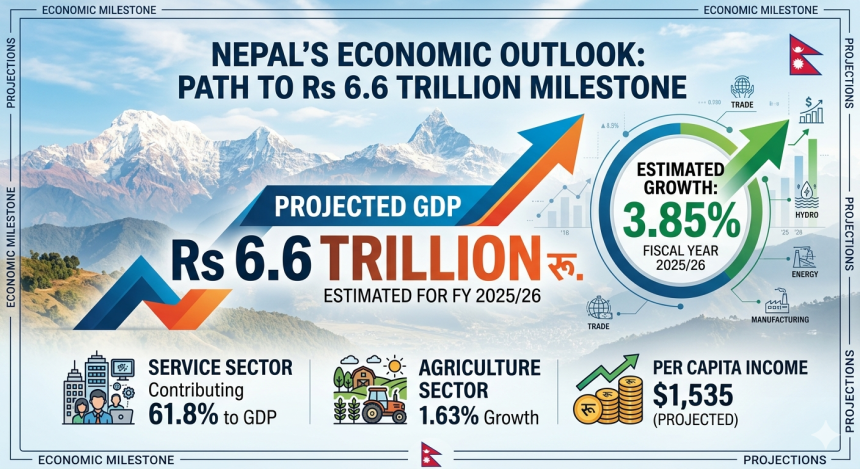
The Government of Nepal has projected that the size of the country’s economy will reach approximately NPR 6.6 trillion (in purchaser’s price term) in the current fiscal year 2025/26. For comparison, the revised estimate of the economy’s size in the previous fiscal year (2024/25) stands at NPR 6.199 trillion, while it was NPR 5.76 trillion in 2023/24.
According to the National Statistics Office, the Gross Domestic Product (GDP) is expected to reach this level by the end of the ongoing fiscal year. At basic price GDP will stay at NPR. 5.79 trillion.
The economic growth rate for the current fiscal year (2025/26) is projected at 3.85% at market prices, while the growth rate at basic prices is estimated at 3.68%. Evaluating the trend of GDP value in Basic Price and Purchaser’s Price seems increasing. Indicating the inflated value in future.
In the previous fiscal year, growth at basic prices is estimated at 3.80%, whereas in 2023/24, the economy grew by 3.38%.
Sector-wise Growth Outlook
Agriculture sector is projected to grow by 1.58%, a decline compared to 3.05% in the previous year. The current growth rate is lowest rate in last decade, in fiscal year 2015/16 ‘earthquake year’ agriculture sector grew by 0.04%.
Non-agriculture sector is projected to grow by 4.54%, slightly higher than last year’s 4.12%. In trend, after Covid – 19 shock this sector spike for two fiscal years than take correction on fiscal year 2022/23 than steadily growing.
The economy is broadly divided into three sectors:
- Primary sector: Projected growth of 1.63% %
- Secondary sector: Projected growth of 5.77%
- Service sector: Projected growth of 4.21%
Contribution to GDP
The expected contribution of each sector to GDP in the current fiscal year:
- Primary sector: 24.5% (This is in continuously declining trend)
- Secondary sector: 13.7% (This is in stagnation over the decade)
- Service sector: 61.8% (Increasing trend)
Industrial and Construction Sector Trends
The industrial sector has shown signs of improvement, driven by increased production in goods such as cement, edible oil, concrete, soybean oil, iron rods, tobacco products, wires, jute, and beer.
Higher imports of raw materials (such as coal, iron-related inputs, and industrial inputs) along with rising demand for finished goods have also contributed positively to industrial growth.
- The industrial sector’s contribution to GDP is projected at 5.72% and projected to gross value added growth rate by 2.83%.
- The construction sector is expected to contribute 5.52% to GDP and projected to gross value added growth rate by 2.21%.