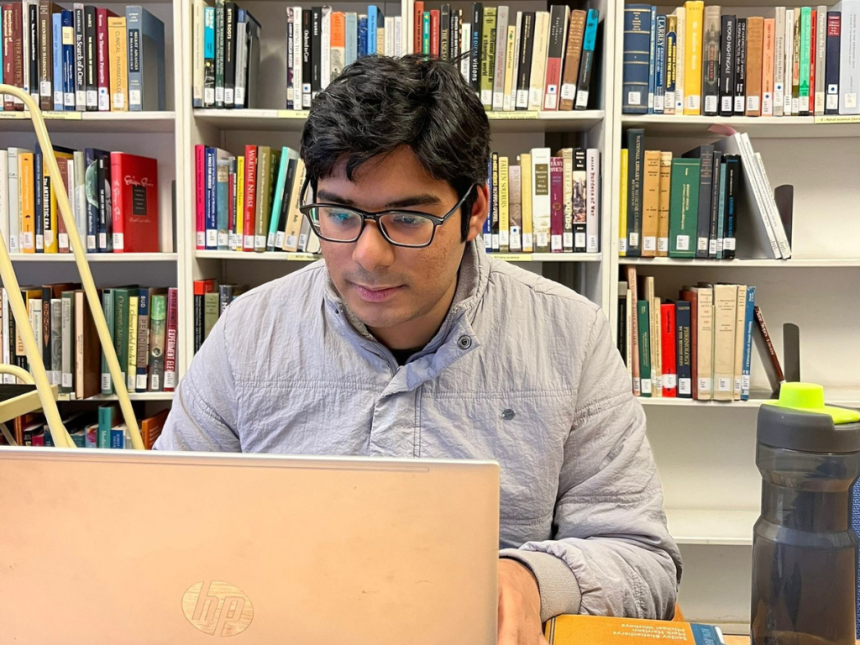
The COVID-19 pandemic took us all by surprise.
Six years since it happened, we can now assuredly say it was one of the deadliest pandemics of our time. 7.1 million lives have been lost to COVID since January 5, 2020. We’d hope that something of this scale wouldn’t happen again, not for a long while.
For many, these moments feel unprecedented — like history beginning and ending within our lifetimes. But for one PhD in History candidate, the present is only half the story.
Utsa Bose is dedicating five years of his life to looking back in the past to dig into a different outbreak, trying to understand how people once lived, feared, and survived.
Bose graduate from the University of Oxford with a Master’s in Modern South Asian Studies. Source: Utsa Bose
The fascination with plagues, pandemics, and epidemics
You’d think that the COVID-19 pandemic was what stirred the pot for Bose. You’re right, but it was more than that.
It ignited with one, quite simply, with one single page.
“I came across a reference to a plague in South Asia in a Bengali book,” he says. “It was a very short excerpt… just a page where they said, ‘then a plague arrived in the city’. There is a line which said people were more afraid of vaccinators, and that made people hide the affected. And that was it.”
With that, the story moved on. No explanation. No detail. Just a brief mention and a glimpse of fear.
However, it spoke to him and lingered in his mind.
Bose has never considered epidemics or how much the past is relevant to that discussion.
He was studying a Bachelor’s degree in English Literature (British and Commonwealth) at St. Stephen’s College, Delhi, when the COVID-19 Pandemic hit.
That made him realise that health isn’t only a science issue but a “human issue”. What started as a passing reference became a deeper question: How are epidemics remembered, written about, and most importantly, forgotten?
That’s when he decided to make a switch from English Literature to History.
In 2021, Bose enrolled into the University of Oxford to pursue a Master of Philosophy in Modern South Asian Studies, and later a PhD in History and Philosophy of Science and Technology.


The Calcutta plague of 1898 was part of the third global bubonic plague pandemic (1855–1960), which originated in Bombay in 1896. Source: Pexels/Arindam Chakraborty
So what happened in Calcutta in 1898?
Before our call, I had no idea Kolkata (formerly known as Calcutta) even had a plague. I mean, I’ve heard of the Black Death and the New World Smallpox, but that’s about it.
The plague, also known as the Third Plague Pandemic, first began in Yunnan, a province of China, in the 1850s. It spread to Hong Kong and Guangzhou in 1894, then to major port cities worldwide, with the most severe impact on India — first Bombay in 1896, then Calcutta in 1898.
Approximately 12 million people lost their lives worldwide. However, there weren’t many detailed mentions of Calcutta.
So, Bose is here to fill in the gaps.
Today, his research focuses on the late 19th and early 20th centuries, a period of rapid global change.
“People were still debating what causes diseases,” he explains. “At the same time, you have expanding networks and shipping routes. The movement of people was increasing.”
This was the age of the bacteriological revolution, when science was beginning to identify germs as a source of illness. But certainty was still out of reach.
“There were even debates about whether a pandemic had even broken out,” Bose says. “Do you believe what the press says or not? There’s also the debate about vaccine rollouts and competitions between countries producing vaccines.”
The question he’s answering: How did people respond?
“I’m interested in responses,” he shares. “How did people respond to it, and how did governments attempt to deal with it?”
But beneath it all lies something even deeper. His research explores trust, power, and decision-making in moments of crisis.
“This was one of the first times where vaccines were being rolled out, so the question of trust becomes central,” Bose says. “Did the people of Calcutta trust its government?”
Sometimes, they didn’t. Remember? Some hid the affected.


Bose completed his undergraduate degree from St. Stephen’s College, University of Delhi, with a B.A (Hons.) in English. Source: Utsa Bose
Why looking back might help us move forward
Studying past epidemics isn’t about drawing perfect parallels to today. It’s about widening the lens.
“One of the things during the COVID-19 pandemic was that it felt like a new thing,” Bose says. “But historically, it’s not.”
From smallpox to polio, outbreaks have long shaped human history. What changed is how we remember — or don’t remember — them.
“The idea of a world without mass outbreaks is a very new thing,” he shares.
That’s why Bose’s work matters beyond academia. Not everyone will read a 50-page thesis, but the questions it raises affect everyone.
Even just knowing that there was an epidemic at some point in history, people would often say, ‘I didn’t know that’ — like me.
Then there’s the biggest shift in perspective Bose’s research offers: a move away from seeing epidemics purely as moments of devastation.
“We tend to think about it as horrible, a devastation,” he says. “But I think of them as histories of life.”
The world revolves around history, the stories of the past, whether we like it or not.
Because even in the middle of a crisis, life doesn’t stop.
“Just like what happened in the COVID-19 pandemic, life goes on,” Bose shares. “People are still living, and people go through things. The past doesn’t have to be the present, but it can help us think about the present and the future.”
Back in 1898, a city filled with fear, people resisted, adapted, and carried on.
More than a century later, we’re still doing the same.