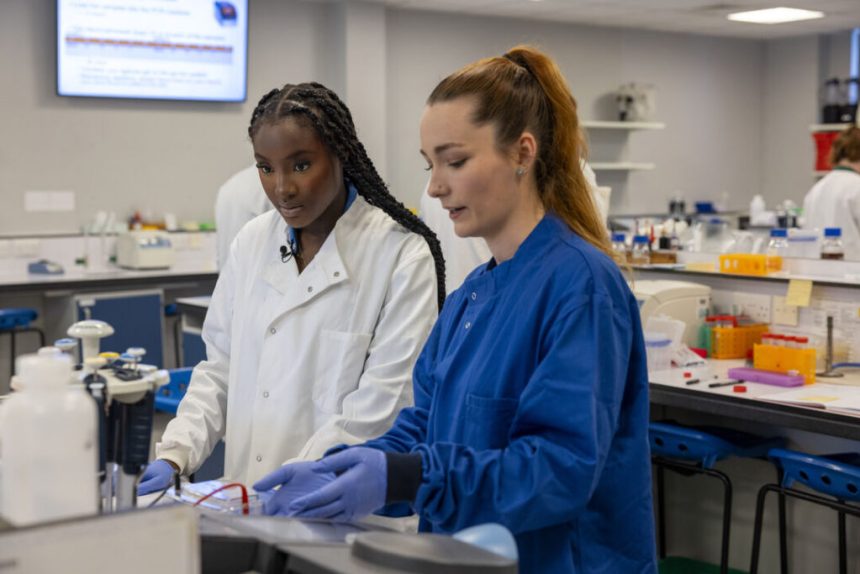
The job of a pharmacist looks very different now than it did a decade ago. Prescribing, working in clinical teams, optimising medicines for individual patients – these are all part of the role. The MPharm programme at the University of Greenwich’s Medway School of Pharmacy is built around that reality.
Below, four faculty members explain what that means in practice: how the programme is taught to build genuine clinical confidence, and why training across multiple disciplines – from drug development to patient care – is central to how the MPharm is designed.
The MPharm is a four-year degree, fully accredited by the General Pharmaceutical Council (GPhC), the independent regulator for pharmacy in Great Britain. The GPhC is responsible for setting and upholding the standards that pharmacy professionals must meet. Source: University of Greenwich
Learning that mirrors real practice
Knowing science is one thing. Applying it confidently with a real patient in front of you is another. This is why the school has invested heavily in simulated clinical environments that close that gap before you ever step into a placement.
Dr. Jo Dockwray, Lecturer in Clinical Skills and Professional Practice, joined Medway after years working as a medical doctor in the NHS and at the European School of Osteopathy. She was brought in specifically to redesign the clinical skills curriculum in response to updated GPhC guidelines – including the expansion of prescribing into undergraduate study. “This role particularly appealed to me because it combines clinical practice, education, and innovation in healthcare training,” she says.
Today, the facilities she works with include a ward area, an over-the-counter pharmacy space, consultation rooms, and an AI-enabled manikin for practising clinical and communication skills. “These environments allow students to prastice patient counselling, prescribing discussions, clinical assessments, and multidisciplinary communication in scenarios that closely reflect modern healthcare practice,” Dr. Dockwray says.
Dr. Media Zanganeh, Lecturer in Clinical and Professional Pharmacy Practice, takes the same approach. She had joined Medway after having seen its graduates up close. During her own training – an MPharm and PhD at the University of Brighton – she often encountered students and graduates from the school who stood out for their clinical knowledge, professionalism, and confidence.
Today, Dr. Zanganeh gets to work with them every day. Her classes include role-play activities in which students alternate between the pharmacist and patient roles, alongside workshops with trained actors. “Simulation-based learning helps students develop empathy and patient-centred consultation techniques in a safe but realistic environment,” she says.
Dr. Zanganeh grasps the importance of preparing students for clinical realities early. “The most rewarding part of my role is seeing students develop into confident, clinically ready healthcare professionals who go on to make a significant positive impact on patients’ lives and the wider community through compassionate, evidence-based care,” she says.
Senior Lecturer Andrew Lea, uses the flipped classroom model in subjects such as pharmacy law and clinical decision-making, freeing up time for more case discussions and scenario-based work. “These sessions give students the opportunity to practise responding to realistic situations in a supportive environment and help build confidence before placements and patient-facing roles,” he says.
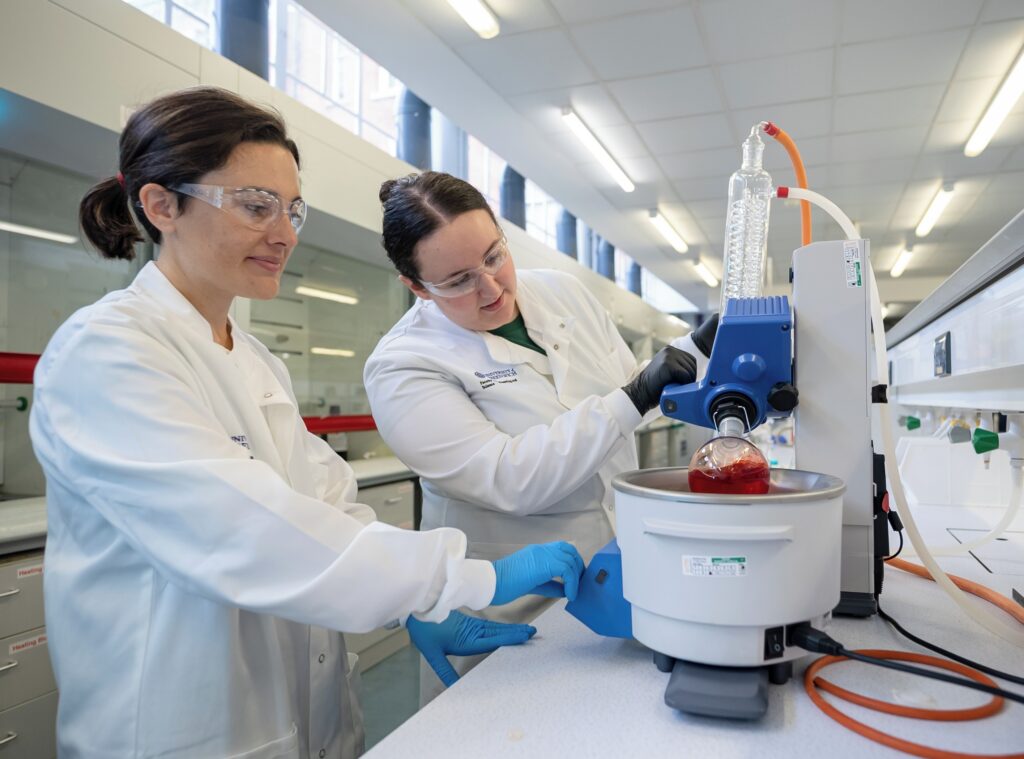
Medway School of Pharmacy’s patient-focused MPharm prepares you for practice through collaboration with patients, healthcare professionals, the NHS, and industry. Source: University of Greenwich
One MPharm programme, multiple disciplines
Dr. Sukvinder Kaur Bhamra‘s PhD took her into the homes and community pharmacies of South Asian diaspora communities across the UK. She was tracing how herbal medicines are used and applying DNA barcoding to verify whether the plants in those medicines were what they claimed to be.
Working across community settings and lab-based research, Dr. Bhamra saw how pharmacy draws on multiple disciplines to answer real-world healthcare questions
Now a senior lecturer, she uses this experience to help students see how each course in the MPharm connects into a coherent whole. “Biological sciences help students understand disease processes and how medicines work, while drug development provides insight into how medicines are discovered, formulated, and evaluated for safety and effectiveness,” she says. “Clinical practice then brings this knowledge into real-world patient care.”
That sense of disciplines stacking into one another is something Dr. Hatem Hassan, Lecturer in Pharmaceutics and Drug Delivery, understands from his own research background.
His PhD at King’s College London, focused on cancer vaccine delivery and immunotherapy at Guy’s Hospital, combined immunology, pharmaceutics, materials science and clinical insight. It’s an approach he now reflects in his teaching on nanotherapeutics, a field that itself sits at the intersection of multiple disciplines.
“Understanding how a drug behaves in the body requires knowledge of the underlying pathology, the chemistry and materials science that determine how it is formulated, and the biological mechanisms through which it is absorbed and delivered to its target site,” he says. “In practice, these disciplines are inseparable.”
By the time you complete the programme, you’ll know what medicine does, yes, but more importantly, you’ll understand why, and you’ll be equipped to make confident, evidence-based decisions around it.
Learn more about MPharm programme.
Follow Medway School of Pharmacy on Facebook, X, Instagram, LinkedIn, and YouTube