
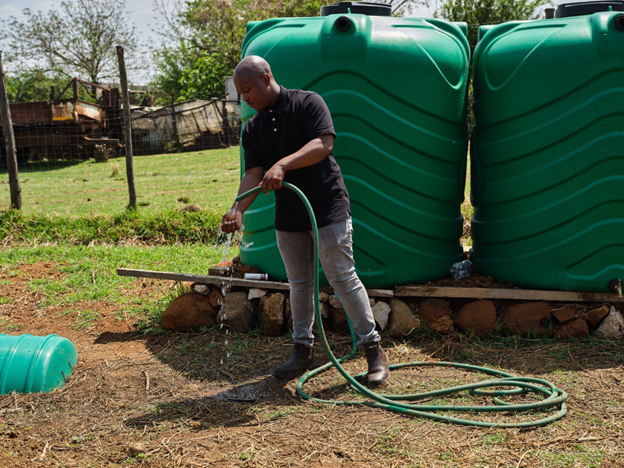
BeVisioneers fellow and startup founder Thabo Mngomezulu didn’t go to university abroad.
Hailing from South Africa, Mngomezulu graduated from Central Johannesburg College with a music performance diploma. He would go on to perform as a jazz session vocalist for ten years, until a global catastrophe hit: the COVID-19 pandemic.
Performance venues shut down, and he saw a decline in his career and income. “I just knew that I needed to do something other than music,” he says. That something would prove quite the career pivot.
Mngomezulu found his niche in turning organic waste to biogas.Kasi Gas, a startup which he founded alongside his business partner, is on “a mission to create a cleaner, greener future for rural South African communities.”
Coming from a small village himself, Mngomezulu knew firsthand that many rural communities in South African lacked sufficient energy for clean cooking — but he also knew that many living within those areas were ahead of the curve when it comes to organic farming.
Producing biogas is not only safer and healthier for the environment, but the byproduct is also a nutrient-rich fertiliser which rehabilitates damaged soil for subsistence farmers.
“I came across an article about biogas and that’s where it all started,” he says. “I started doing my research, making sure I do the relevant courses, because I wasn’t a business person. I knew nothing about entrepreneurship, so I had to do accelerators, cohorts, and things like that.
Landing a fellowship opportunity as an adult
Mngomezulu did not study abroad, but ten years into his career as a musician, starting from the ground up, he would discover global learning opportunities to make his pivot possible.
He enrolled into a rigorous 12-week accelerator based in Silicon Valley to learn the ropes of business. He was later accepted into another accelerator with the Sustainability Institute to sharpen his expertise on biogas.
After, he would get accepted into tech accelerator, practically by mistake — after all, his production had nothing to do with the tech industry.
“It’s called Founders Institute, which was very interesting because that’s when I learned how to pitch a one-, three-, and five-minute pitch. I didn’t think I was going to survive,” he says. “They invite billionaires and businesspeople and experts to rate their pitch — and they cut them off. When we started, there were many of us, but when we graduated there were 12 of us. I think that, for me, validated my idea.”
Still, Mngomezulu did not have enough resources on his hands to lift his cause off the ground. Despite presenting a clear business plan to local organisations in South Africa, many refused to fund something that remained an idea. They said he needed to create a prototype to prove his plan, but he didn’t have the capital to make that happen.
That’s when the the Mercedes-Benz Fellowship, known asbeVisioneers, entered his life. It supports individuals between the ages 16 to 28 who are looking to solve environmental problems in their local communities.
Based in Hamburg, Germany, BeVisioneers is a multi-year fellowship that operates in more than 55 countries. It takes you through one-on-one mentoring and venture coaching, hybrid learning programmes, and fully funded travel opportunities, as well as financial support and scholarships awards.
If you haven’t gotten the chance to study abroad, this fellowship is an excellent opportunity to build a global network of peers and professionals working towards the same goal.
BeVisioneers validated Mngomezulu’s idea, and gave him funding to be able to prototype.
“Once I was able to prototype and prove to the local organisations here in South Africa that this actually works, that’s when they started accepting my applications,” he says.
Through the fellowship, Mngomezulu got to visit Stuttgart, Germany, for the Global Summit and connect with 250 other planet-positive entrepreneurs.
“Engaging in meaningful conversations and sharing ideas in such a vibrant atmosphere left me inspired, energized, and deeply grateful for the support that made this possible,” he says.
How music and entrepreneurship overlaps
One might not expect Mngomezulu’s music and environmental work to overlap as much as it does. Naturally, the heart of the work itself could not be more different, but what remains the same is the need for a confident presentation.
“When you’re used to performing for people, sometimes they just pull up faces and you’re like, ‘Am I really singing well?”, he says. That experience has equipped Mngomezulu with thick skin that allows him to face rejection. “It’s quite difficult when you get rejected for wanting to learn…I didn’t take that well at first.”
The process of founding a startup is akin to singing in front of an unfamiliar crowd. Luckily for Mngomezulu, being a seasoned musician means already having a captivating stage presence — essential when pitching, networking, and speaking to investors. He wasn’t afraid of crowds, but more than that, he wasn’t afraid offailure.
“I was never afraid to fail or say, ‘I don’t know.’ A lot of people walk into rooms and they want to pretend they know everything,” the BeVisioneers fellow says. “As entrepreneurs, we take pride in the stuff we know and understand better. I wanted to be the opposite: going to rooms to listen more. I wasn’t afraid of mistakes. They happen — it’s part of your learning journey.”



This is the right blog for anyone who wants to find out about this topic. You realize so much its almost hard to argue with you (not that I actually would want…HaHa). You definitely put a new spin on a topic thats been written about for years. Great stuff, just great!