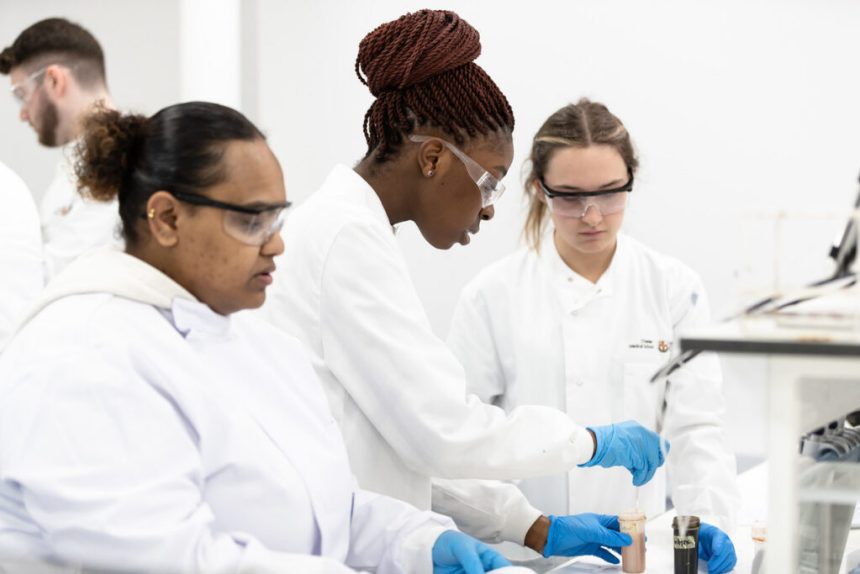
The food industry is facing a difficult balancing act. Consumers expect products that are healthier, safer, more sustainable, and affordable — yet rarely want to compromise on taste, quality, or convenience. Meeting those competing demands has transformed food science into one of the sector’s most important disciplines. The MSc Food Science and Innovation at the University of Chester was designed with these challenges in mind.
This public university in northwest England, with over 180 years of history in education, is home to a School of Allied and Public Health filled with applied science programmes built around industry demands — and this MSc is one of them. In just 12 months, it will equip you with the scientific knowledge and practical expertise you will need to navigate the complexities of modern food production, from manufacturing and processing to product development and innovation.
The MSc Food Science and Innovation is designed with industry experts, delivering a contemporary, industry-led curriculum. Source: University of Chester
What you will learn
Modules include Functional Foods and Bioactive Ingredients, Packaging Innovations, Food Rheology, Texture and Sensory Science, Food Security and Integrity, and Advances in Food Innovation. Rather than treating these as separate subjects, the curriculum builds a connected picture of how food moves from concept to shelf, and what can go wrong at every stage.
Throughout, you will develop practical expertise in food production, sensory evaluation, product formulation, and quality assurance while exploring the challenges facing today’s food manufacturers — food safety regulations, formulation challenges, and the commercial pressure to develop products that are both nutritionally functional and shelf-stable.
Learning culminates in an independent dissertation project that will see you tackling a genuine research or development challenge of your own. For 2025 graduate, Paul Abidakun, that meant developing and evaluating an omega-3-enriched plant-based mayonnaise using advanced liposomal delivery techniques. He ran shelf-life evaluations and conducted sensory trials at HTC Health, then analysed samples at Chester’s on-campus food facilities.
“This project sharpened my technical skills and deepened my love for research, problem-solving, and evidence-based product development,” he says.
Projects like Abidakun’s are supported by the University of Chester’s NoWFOOD Centre— a food manufacturing facility used by both students and industry partners. It includes a 10-booth sensory taste panel suite alongside development kitchens and food analytical laboratories — the same setup you’d find in a food company’s technical department.
Here, you will learn so much more than how products are made. You will learn how evidence informs decision-making, design sensory studies, interpret consumer feedback, evaluate product performance, and work with the analytical techniques that underpin modern food development and quality assurance.

Learn under experienced academics and practitioners who bring diverse perspectives and use varied teaching methods to meet your individual learning needs. Source: University of Chester
Who you will learn from
The academic team is a big part of why the programme works. Abidakun credits his lecturers – including Professor Weili Li, , and colleagues like Stewart Crofts and Ashley English – for helping him grow personally and professionally.
The impact extends beyond technical knowledge alone. Here, you are encouraged to think critically, challenge assumptions, and approach food innovation from both scientific and commercial perspectives.
That balance stood out to Shweta Vishwanath, who also graduated in 2025. “From innovative lectures to insights from pioneering ventures and food industry professionals, the programme gave me a deeper understanding of food innovation and product development, teaching me how to handle creativity with feasibility,” she says.
It’s an important distinction. Great ideas alone rarely succeed in the food industry. Products must be scientifically robust, commercially viable, scalable, and aligned with consumer expectations. Throughout the programme, you will learn to navigate these competing priorities and make decisions grounded in evidence.
Your learning experience is further enriched by guest lectures from food industry professionals and opportunities to engage with local industry partners. It’s a demanding path, yes, but that is often where the greatest growth happens.
“There were moments of self-doubt and days when everything felt overwhelming,” says Vishwanath. “But looking back, I realise it was never just about the degree, it was about growth, resilience, and becoming a stronger version of myself.”
Where it could take you
The opportunities for food science graduates are broad and growing. Overall employment of food scientists is projected to grow 6% from 2024 to 2034, faster than the average for all occupations. From food production and product development to quality assurance, food safety management, and research and development, careers span every stage of the food supply chain.
Thankfully, for Abidakun, the MSc has helped shape a clear vision for the future. “I am eager to contribute to the food industry through quality assurance, new product development, functional food innovation, and data-driven processing improvements,” he says.
“As I look ahead, I am excited to carry everything I’ve learned into the next phase of my career.
Learn more about the MSc Food Science and Innovation at the University of Chester.
Follow University of Chester on Facebook, Instagram, LinkedIn, YouTube, and TikTok