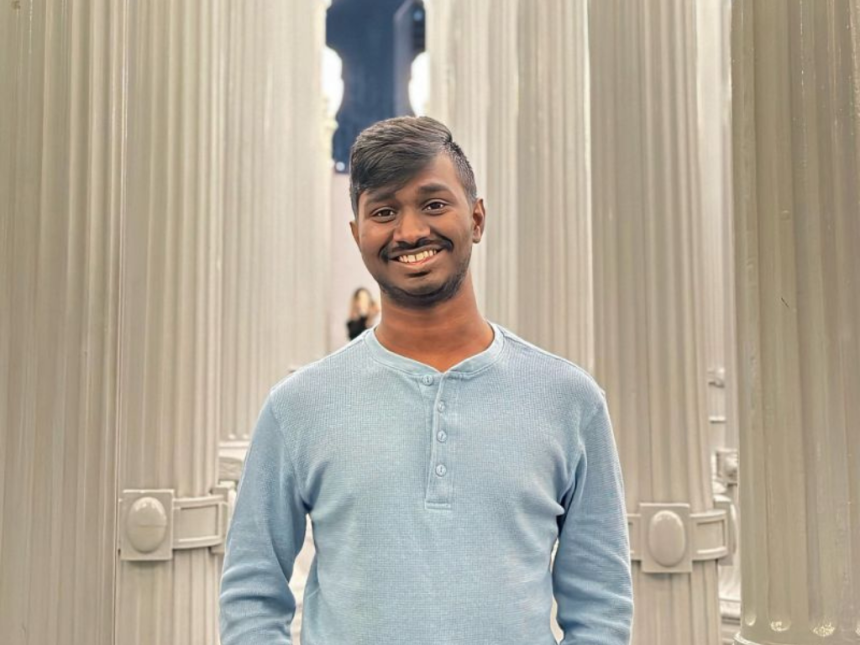
Venkata Naga Sai Kumar Bysani had US$60,000 to US$70,000 in debt. That was the cost of becoming an international student in the US.
“I couldn’t get a part-time job to pay for some of the tuition fees for a master’s degree and living expenses, so the debt was piling up,” he told Study International.
Every year, lakhs (hundreds of thousands) of Indian families pour their life savings into sending their children abroad. Many would mortgage their homes or take loans worth 40 to 50 lakhs (approximately US$44,621 to US$55,777) just so their children can receive a foreign degree, hoping they will secure a well-paying job.
Borrowing money was once considered a social stigma in India. Sia was initially hesitant to talk about his struggles with debt.
But over time, he came to realise that this was a part of his journey as an international student in the US.
Sai is from India, and he pursued a Bachelor’s degree in Electrical and Electronics Engineering at Amrita Vishwa Vidyapeetham. Source: Venkata Naga Sai Kumar Bysani
Sai had a choice – borrow money to become an international student in the US or pursue a master’s locally in India without going into debt.
“I always wanted to pursue my higher education abroad, and I considered the US as it’s known as the land of opportunities,” Sai explains. “Plus, being overseas means you’ll become independent. In India, it’s rare to have that; we’re very spoon-fed.”
So, to the US and into debt he went.
At the start of 2022, Sai joined the University of Connecticut’s master’s degree in Business Analytics and Project Management. He graduated in 16 months.
“I graduated early because it was the only way for my debt not to rack up,” he shares. “I wasn’t able to get an on-campus job as I was not on the main campus. The city I was in was expensive, my monthly expenses went up to US$2,500 a month.”

During his master’s degree, Sai completed an internship at the Lego Group as a Data Science Consultant. Source: Venkata Naga Sai Kumar Bysani
Being an international student in the US was a dream come true for Sia.
In between, however, he felt the pressure to repay his debt creeping.
The maths was clear to him during these moments — if he were to return to India, it would take him over a decade to pay it.
There were times he wanted to give it all up, but the more he thought about it, he knew he couldn’t.
Instead, he committed to a long-term plan — to work in the US to pay off his debt.
Sai participated in projects, competitions, hackathons, and networking to beef up his resume.
It worked. Today, he’s a Lead Data Analyst at BlueCross BlueShield of South Carolina, the largest insurance company in the state.
“Getting my master’s in the US was 200% worth it,” Sai says with a laugh. “If I had to do it all over again, even with the debt, I would. Most of all, my parents and sister were really supportive, and that kept me positive even when I was struggling as an international student in debt.”

Sai, alongside his mother, sister, and father. Source: Venkata Naga Sai Kumar Bysani
5 things you need to think about before becoming an international student in debt
With the support of his parents and sister, Sai did feel a slight relief from his financial burdens.
But that isn’t always the case for many international students, as there are quite a number whose parents don’t support them.
Sai acknowledges his privilege; however, he has a couple of things he hopes future international students would look out for before going abroad.
1. Don’t assume your parents and sponsor can pay for everything
Transparency is key.
“Check your finances with your parents or sponsors,” Sai shares. “Try your best to be open with them. Ask them if they’re able to afford US$30,000 to US$80,000 — assuming that you don’t have a scholarship.”
2. Choose where you study wisely
Where you can study can affect how much you will have to pay. For example, studying in New York, Massachusetts, Pennsylvania, or California can cost you considerably — they are the most expensive states to study and live in.
“If you’re studying in New York, your monthly expenses can skyrocket to anywhere between US$1,500 to US$2,500,” Sai shares. “But if you’re in states like Texas or Florida, expenses can be lower — as long as it’s not a hotspot.”
3. Apply early for scholarships
A scholarship is key if you want to reduce the burden of taking out a loan while studying abroad.
“Start applying to your university programme as early as eight to nine months because you’re more likely to get a scholarship than those who apply two to three months before the programme starts,” Sai notes.
4. Analyse the details of the loans
There are study abroad loans from banks or private organisations, but they usually come with a set of rules.
“Talk to a few banks and see what they can offer,” Sai says. “Some banks offer loans with less interest. Many financial agencies offer loans as well, but some of them may require you to list collateral. Interest rates can be about 12% to 15%, which is very expensive.”
5. Study the annual salaries of the jobs you want
There’s no doubt you’ll have to find ways to pay back your student debt, and the main way for you to do it is to earn good money.
“I spent a lot of time looking at how much I will possibly earn if I were to get a job in the US,” Sai shares. “Then I calculated it and saw how much of my loan I can pay off, and how quickly. If your salary is 70% of your debt, then it might take a long time for you to clear the debt.”