
The conversation around artificial intelligence and jobs tends to follow a familiar, unsettling script: Robots check you in, algorithms set your rate, chatbots handle complaints, and a human quietly becomes redundant.
The World Economic Forum’s Future of Jobs Survey 2025 found that 86% of employers expect AI to transform their businesses by 2030, with 41% anticipating workforce cuts. In hospitality – an industry built on human warmth – that prospect feels especially threatening.
But spend some time with Drsika Chopra, a Bachelor of Science in International Hospitality Management graduate (Class of 2026) at EHL Hospitality Business School, the world’s top-ranked hospitality school, and the fear starts to look like a misreading of the situation.
Born into the business
Drsika was raised in hospitality. Her father, Kapil Chopra, became the youngest President of the Oberoi Group before leaving at the height of his career to launch The Postcard Hotel, now one of India’s most awarded ultra-luxury experiential brands. Alongside it, he founded EazyDiner, India’s largest dining reservations platform.
Her mother, Leepakshi Chopra ran a hospitality PR firm and worked as a journalist before building a real estate investment portfolio.
Growing up in that household meant absorbing hospitality not as a job, but as a philosophy.
“Their hospitable nature became a way of life, permeating into the very essence of a welcoming home,” she says. “Be it intellectual tête-à-têtes over the dinner table about brand acquisitions and day-to-day life in a hotel, or simply the warmth and reverence with which they approached every seemingly mundane detail.”
That upbringing is exactly why her take on AI carries weight. She knows what great service feels like, and what gets lost when it disappears.
That instinct, once intuitive, has been sharpened at EHL into something more analytical. AI, she explains, has already embedded itself into hospitality in ways most guests never see.
“The bigger change is AI increasingly acting as an invisible intermediary – shaping pricing, recommendations, distribution, and even guest interactions,” Drsika says. “Revenue management systems adjust prices dynamically, platforms personalise itineraries in real time, and data models predict guest preferences before arrival.”
It’s a shift that Dr Omar Ballester, who teaches Leadership in the Age of AI at EHL, says every hospitality leader now has to reckon with. “The competitive advantage is not a dichotomy between the technology or the people, but rather understanding which value you create and for whom,” he says.
AI-first companies, he says, thrive on scale and learning – each interaction feeds an algorithm that improves the next. But that efficiency tends toward uniformity. Traditional service businesses, by contrast, trade in depth and trust – the kind that builds slowly and cannot be replicated at speed.
The smartest move, Dr Ballester argues, is learning to use both. That’s the space Drsika is most interested in.
Dr Omar Ballester runs his AI governance class with a card game, no screens. Source: Dr Omar Ballester
What gets lost when service becomes transactional
For Drsika, the real danger of AI in hospitality isn’t a wave of redundancies. It’s something subtler.
“Human touch in the age of AI has become a luxury,” she says. “With automation on the rise, the aspect of travel centred around local, authentic experiences has become increasingly rare and therefore cherished.”
When everything gets optimised, the small moments that make a stay memorable start to disappear. The staff member who notices a guest looks stressed before they say anything. The front desk team who remember a returning guest’s name. The unexpected gesture that turns a decent stay into one people talk about for years. Those things can’t be programmed. They can only be preserved by leaders who know where technology helps and where it gets in the way.
“Before the course, I tended to evaluate AI initiatives primarily through efficiency and scalability,” Drsika says. “What changed most for me was the idea that harm in AI is often structural rather than intentional. An algorithm may be mathematically accurate and still undermine trust or erode human agency.”
That shift in thinking, from efficiency-first to people-first, is exactly what EHL is trying to instil in its graduates.

Drsika entered EHL’s AI course measuring technology by efficiency. She left understanding that a mathematically accurate algorithm can still erode the trust hospitality runs on. Source: Drsika Chopra
Keeping humans in the loop
One of the most revealing windows into Drsika’s thinking is a project she led during EHL’s AI course. Called ‘In the Loop’, it was an early warning system designed to predict employee burnout and turnover in hospitality businesses.
The idea was simple: by the time someone hands in their notice, you’ve already lost them. The system used workplace data – collected with employee consent – to spot signs of disengagement early, so managers could step in with the right support before it was too late.
“The project reinforced that leading AI initiatives is less about the model itself and more about responsible system design, trust, and organisational adoption,” she says.
Dr Ballester sees the same truth emerge in his classroom every semester – and has formalised it into research. His recently published paper, Teaching AI governance in management education: A serious game for accountable decision-making under uncertainty, makes the case for learning-by-doing over passive instruction when it comes to AI governance.
He ran a fully online card game for this research, in which students play different roles within a company building an AI product. The debates it produces are some of the richest of the year. “The hardest challenges in AI are not primarily technical; they are human,” he says.
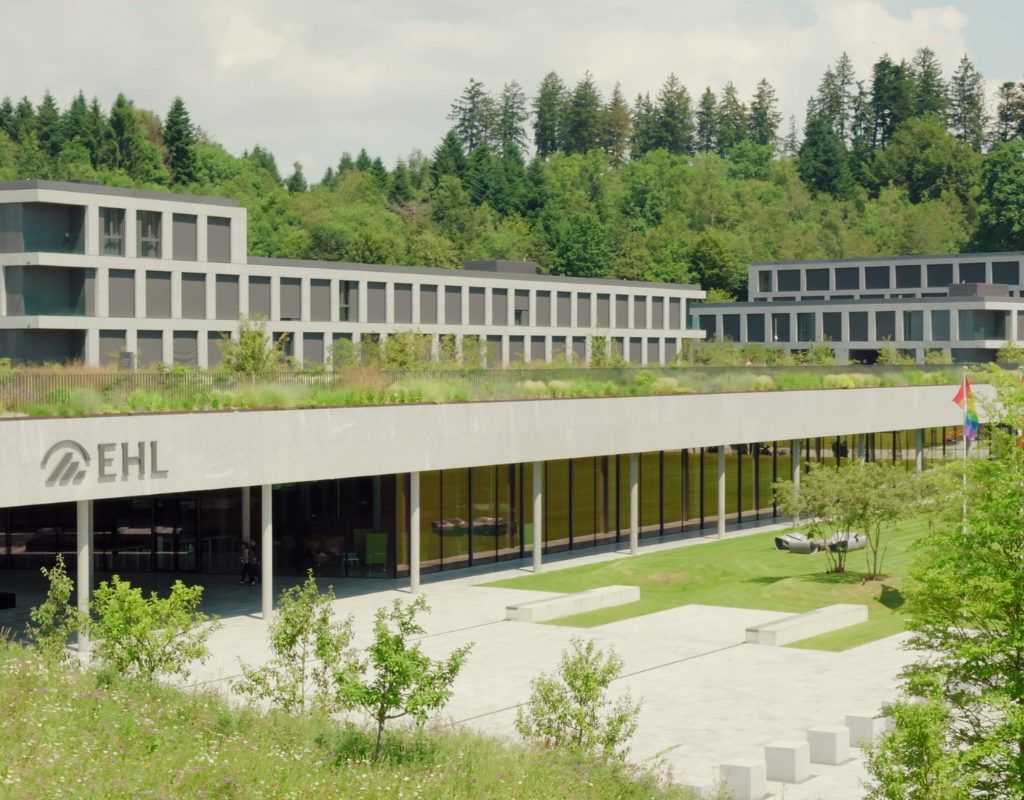
EHL has held the top spot in hospitality education for decades. Source: EHL Hospitality Business School
What happens when AI takes the weight off
Drsika’s argument really comes down to one simple idea. AI should take care of the things that exhaust people – the admin, the scheduling, the repetitive back-office tasks – so that staff have more energy for the things only they can do.
“EHL’s culture trains you to see hospitality as emotional design, so AI becomes a way to remove friction so staff can be more present with guests,” she says.
That question of presence is exactly where Dr Ballester anchors his teaching. Before every AI project, he asks his students the same question: whose life does this actually improve? “Experience before capacity, value before opportunity,” he says. “That simple reframing changes the entire trajectory of a project.”
For Drsika, raised watching her father build a brand around genuine human experience and her mother shape the stories that made hospitality feel personal, that question isn’t academic. It’s how she was brought up. The AI doesn’t replace the warmth she grew up around. Done right, it’s what keeps it alive.