Imagine this: It is finals week. You have an early morning exam tomorrow at 8 a.m., and it is 11 p.m. now. You have not started on anything and do not know how to study effectively.
Here’s what the newest research says about that exact moment. A Pew Research Centre survey from March 2025 found that 68% of US teens feel pressure to get good grades, with girls feeling it slightly more than boys (71% vs 65%). That pressure is a big reason so many students default to panic-mode cramming instead of something that actually works.
And something else actually works better. A Harvard-led trial published in Scientific Reports in 2025 found that students using a purpose-built AI tutor learned more than twice as much, in less time, than students sitting through an active-learning physics class.
The old advice to just push through the night? It doesn’t hold up anymore. So no, cramming still isn’t the answer, even though most students still reach for it.
A 2025 University of Edinburgh Study Hub review of cramming research cites data from the Chartered Institute of Education Assessors (CIEA), showing that 32% of British students admit to cramming, with the figure rising to 48% among students under 24. Cramming creates an illusion of knowledge — you recognise the material without being able to retrieve it under exam pressure, which is exactly when you need it most.
A well-spaced study plan beats a last-minute scramble. But not everyone studies the same way. Some people pull all-nighters and function fine. Some need a full eight hours to remember anything. Some have near-photographic recall; others need to work through material page by page.
If your current method isn’t cutting it, here are creative ways on how to study effectively — old and new — that are actually working for students in 2026.
TL;DR? Here’s the summary:
- This article lists eight evidence-backed study methods that can help you learn more effectively in 2026.
- Cramming may feel productive, but research shows it leads to poorer long-term recall than spaced learning.
- Active recall remains one of the most effective study techniques, especially when combined with methods like blurting, the Feynman technique, and the 3-2-1 method.
No matter how desperate you are, cramming is not how to study effectively.
Eight effective study methods that you can try in 2026
Active recall
As the name suggests, active recall involves actively recalling information you have studied previously. It works in three steps.
- You look through the information you are learning.
- You rephrase the content to your understanding.
- You check and compare your notes with the source to make sure you got it correct.
By active recall, you stimulate your brain to pull out whatever information you have learned instead of passively rewriting your notes.
Spice up your active recall by creating questions based on the topic you are learning, then testing yourself on those questions until you get it right.
4 active recall methods trending on TikTok right now
Read your notes three times until the material sinks in.
Say the content out loud two times, forcing yourself to recall it without looking.
Write everything you remember one time, with your notes closed. The “write it once” step doubles as a form of blurting — a memorisation method built entirely on retrieval rather than review.
Cover your notes completely, then write down everything you can remember about a topic on a blank page, without peeking.
Once you’ve exhausted your memory, open your notes and mark what you missed in a different colour.
Study only the gaps, then blurt again. Repeating this cycle narrows down exactly what your brain hasn’t locked in yet, instead of wasting time re-reading things you already know.

Instead of passively reviewing notes, active recall challenges you to test your memory and identify knowledge gaps. Source: Pexels
Pick a concept, then explain it out loud as if teaching someone with zero background in the subject, while sketching a mind map of the ideas as you talk.
When you hit a term you can’t explain simply, that’s the gap in your understanding.
Circle it, go back to the source material, then explain it again from scratch. The combination of verbalising and visualising catches gaps that silent reading misses.
A newer trend on #studytok has students uploading their class notes into an AI chatbot, then switching it to voice mode and asking it to quiz them hands-free — while walking, cooking, or commuting.
The chatbot pulls questions directly from the uploaded material and only from that material, so the recall stays tied to the actual syllabus instead of generic trivia.

A study by the University of Queensland revealed that the theory of extreme music and its various subgenres help to process anger.
Listening to “fast” music
When people say they study to tunes that help them focus, their choice of music is always relaxing beats by Lofi Girl.
But when the clock is ticking, and you have a paper due, relaxing beats may be the last option on your Spotify queue. This is what happened to a stressed-out woman on TikTok chasing her five-page essay due at midnight. Her studying method? Putting the Mario Kart theme song on blast.
Another option is to listen to metal music. Contrary to popular belief, heavy metal music makes you calmer, not angrier.
A study by the University of Queensland revealed that the theory of extreme music and its various subgenres help to process anger, enhancing positive emotions out of it. “The music helped them explore the full gamut of emotion they felt, but also left them feeling more active and inspired,” reads the study.

The rubber duck method is typically used by programmers to spot errors in their coding line, which can be one of the ways how to study effectively too.
Rubber duck debugging
Typically used by programmers to spot errors in their coding line, the rubber duck method can also be used in any studying process, no matter the subject.
The principle behind this technique is to verbalise and simplify your work out loud to an inanimate object, preferably a yellow rubber duck.
However, you do not just explain to it. You are telling the duck what you are trying to do and what you understand from what you have learned. This way, solutions become more apparent when you hear yourself explaining to a toy duck; overcomplications can become simplifications.

It is proven that a person will put in more effort to understand something better with the knowledge of having to explain it to someone else later, like your grandma.
Teach your grandma
If an unresponsive rubber duck is not helping you with your studies, try teaching it to your grandmother.
It is proven that a person will put in more effort to understand something better with the knowledge of having to explain it to someone else later. This psychological phenomenon is called the Protégé Effect.
To prove that you really understand what you have studied, try explaining it to someone who has no clue about the subject. That is where your grandmother comes in, or a niece, a nephew, or any five-year-old for that matter.
You will see that your understanding will deepen as you find the words to describe the details when they ask questions as simple as “huh?”
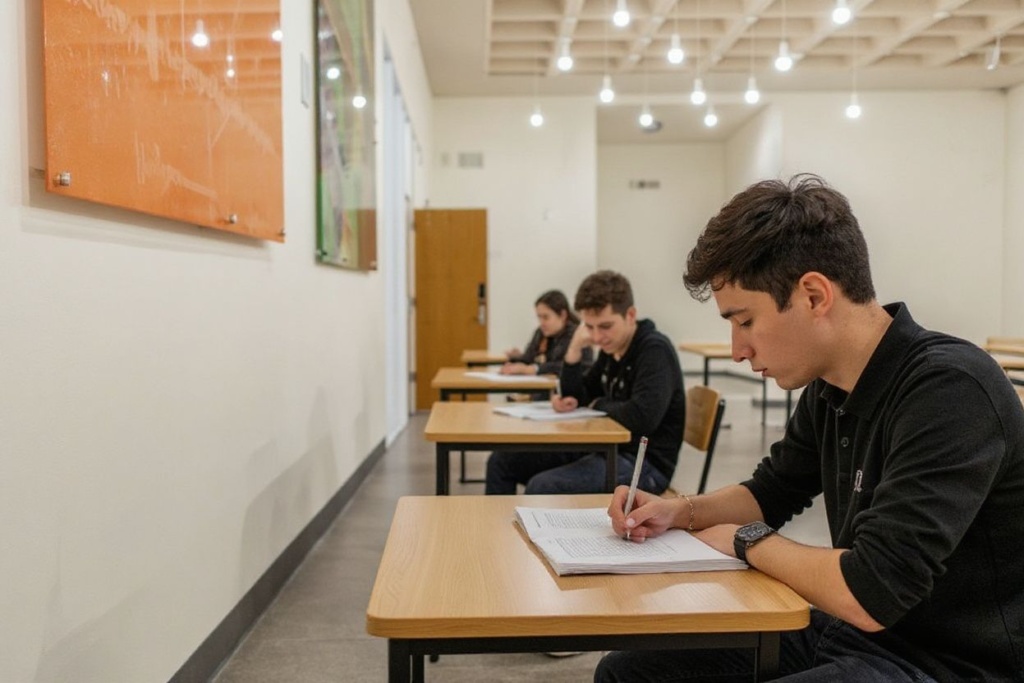
Whether the exam will take place in a classroom, examination hall, or studio, you will feel more at ease doing your papers in a familiar location.
Location, location, location
A change of scenery can help keep your studying process interesting rather than just staring at the same wall again.
If you are preparing for an exam that will be held in a specific place, go and study there. Whether it will take place in a classroom, examination hall, or studio, you will feel more at ease doing your papers in a familiar location.
In fact, there is a very good chance you will start to link objects in the room with certain facts, thoughts, or ideas from your studies. Just make sure that your brain recognises them.
Sing it out
There is a reason why the opening theme of the sitcom The Big Bang Theory is so popular. It turns the origins of our planet into a super catchy song, albeit in 161 beats per minute. If a topic as complicated as the birth of our planet can be a song, your studies can be too.
Try and make your study song as playful as possible. That way, you can easily recite it, linking to your studies.
Granted, you will not be able to cram every piece of information into one song — or else your song will be hours long. So, select important details and incorporate them into your study song. You can even change the lyrics of your favourite song according to your studies.

The Pomodoro (Italian for tomato) technique is a game-changer when it comes to studying.
Pomodoro technique
One big secret of how to study effectively is by using the Pomodoro (Italian for tomato) technique.
This popular time management method asks you to alternate focused work sessions with frequent short breaks to promote sustained concentration and avoid burnout.
To use the technique, you must first pick a task and set a 25-minute timer. Next, focus all your energy on that particular work until time is up without any distractions. For every 25 minutes, give yourself a 5-minute break, then repeat the same process until your task is done.
This way, it improves focus, minimises distractions, prevents burnout, promotes accountability, and boosts motivation – all the advantages you need to get the most out of your revisions.
Another way how to study effectively is by building a memory palace, which is an imaginary location in your mind where you store visual cues.
Build a Memory Palace
A memory palace is an imaginary location in your mind where you store visual cues.
The story goes that the poet Simonides of Ceos received a message that two men wanted to meet him outside the banquet hall where he was performing. When Simonides went outside, the roof caved in, killing all the guests. Unfortunately, nobody could identify the victims of this tragedy — except Simonides. By noting the memory of the places the guests were seated at, he accurately named each unrecognisable body, resulting in the first recorded art of memory.
To create your memory palace, choose a place you know well, like your home. Plan out every room and associate each with different study points. Make these rooms come alive by exaggerating with images and humour that will help.
Now, all you have to do is walk through your imaginary house and pull out information from memory when you “visit” each room.
Frequently asked questions (FAQ)
Is cramming ever effective?
It can get you through a single exam, but the information rarely sticks past test day. Your brain recognises the material without being able to pull it back up later, which is why cramming feels productive in the moment but leaves almost nothing behind a week out.
Can AI tools actually help you study, or do they just do the work for you?
It depends on how they’re used. The 2025 Harvard trial found that a carefully designed AI tutor — one built to guide students step-by-step rather than hand over answers — outperformed a live active-learning classroom. Using AI to generate quiz questions from your own notes fits that same model. Using it to write your essay for you doesn’t.
What’s the difference between active recall and just re-reading notes?
Re-reading puts the answer right in front of you, so your brain just has to recognise it, not produce it. That recognition creates a false sense of confidence, since familiar material feels learned even when you can’t explain it without the page open. Active recall removes that crutch by making you retrieve the answer from memory alone, closing the gap between how prepared you feel and how prepared you actually are for the exam.
Disclaimer: This article was last updated on July 15, 2026.