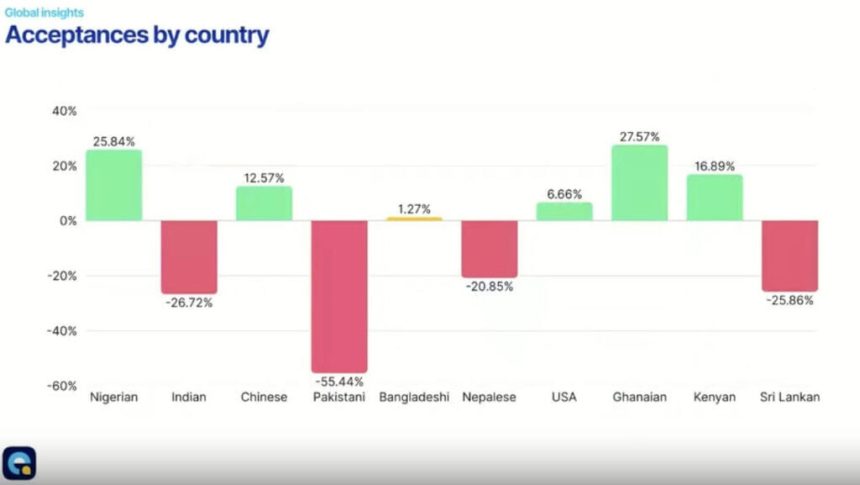
Data looking at the upcoming September intake revealed a drop in both CAS issuances and acceptances across several key sending markets, including Pakistan and India. Other major sending countries such as Nigeria and China present more of a mixed picture, with higher acceptances when compared with the same point last year but fewer CAS issued.
The data was revealed in an Enroly webinar earlier this month, showing that in the year to July 2026, overall CAS issuance is down just under 13% year on year (likely to move to 28% down by the end of September’s recruitment cycle), and acceptances down 30% year on year.
However, Enroly’s director of growth and partnerships Katie Layt pointed out that the true picture may change significantly by the end of the recruitment cycle.
And she also revealed that the “swing is huge institution to institution”, with around 30% of Enroly’s dataset actually tracking year-on-year increases – if just this cohort was measured, she said, the annual metrics would be up 50%
“The picture changes by mission group, type of university, geopgraphic location – there are big swings all over the place,” she said.
Pakistan is the “biggest decline we see for any market year on year”, down 55% on acceptances and 67% down on CAS issuance. Another major South Asian market, India, is aslo in decline, with acceptances down almost 27% and CAS issiance down 40%.
The picture changes by mission group, type of university, geopgraphic location – there are big swings all over the place
Katie Layt, Enroly
It follows a tricky time for the Pakistani market as several institutions pulled out of the country altogether, citing visa refusal concerns.
China, East Asia’s biggest sending market, is tracking up (12%) in terms of acceptances but CAS issuance is down 15%
Nigeria is registering as the biggest volume market on the Enroly platform, Layt revealed. While acceptances in Nigeria are up 26%, CAS issuance is down 13% “so a conversion challenge between those two is emerging”
Notable year-on-year increases in terms of acceptances could be seen in the US market (up 6%), France (up 58%), Spain (up 19%), Kuwait (up 168%) and Iraq (up 71%).

Meanwhile,16 markets across West and East Africa are showing growth. Ghana as the second largest African sending country is tracking 28% up year on year although Layt observed that growth has slowed as it was up 50% earlier in the recruitment cycle. She suggested this could reflect visa refusal pressures and risk mitigation as institutions grapple with stricter compliance requirements.
Kenya is up 17%, with Zimbabwe also showing growth, up 47%. In the MENA region, Egypt is up 28%, while countries subject to a study visa break over asylum concerns are on the decline – Cameroon is down 88%, and Myanmar is down 86%.
Despite visa refusal concerns as tigher BCA requirements bite, Enroly data suggests that visa refusals are actually tracking down year on year.
“At this early stage we’re sitting at a low number,” said Layt, with visa refusals to July 3 2026 almost 58% lower than they were at the same point last year.
She noted that this compared to a “really high” refusal rate in January, but warned that it is “early days in the cycle, so these figures will move”.

Further data revealed more about how students are finding their institutions of choice; directly or through an agent.
According to Enroly data, almost six in 10 students go through an agent, with the remainder finding a university direct.
And the data showed that the sector is still dominated by a few big agents, with the top 10 agents collectively managing about 25% of student acceptances.