Policy commentator Abul Rizvi had some strong words for Australia’s international education sector at The PIE Live Asia Pacific. Reflecting on the current political debate, he argued that the industry has already lost much of its social licence and is failing to respond with the seriousness the moment demands.
“It would appear the social license has been lost when the major polling political party is prepared to come out and say it will kill the industry,” he said. “The industry has lost a great deal of social license… What amazes me is that the industry seems completely incapable of putting its mind to doing that.”
For Rizvi – who is a former deputy secretary of the Department of Immigration – simply railing against government decisions is not a strategy.
“What the industry has to do is come up with its own proposal, its own package of measures that demonstrably deliver on the government’s objective to get net migration down to 225,000, and demonstrate the value of the industry to our long-term future. That is eminently doable.”
Similarly, International Education Association of Australia (IEAA) CEO Phil Honeywood told the Gold Coast audience: “It’s high time the sector came together for a real social licence campaign,” arguing that international education has been too quiet about its economic, skills and soft‑power benefits.
“We’ve let ourselves down as a sector because we haven’t been prepared to stand up and shout all the benefits we bring to our country,” he warned, adding that failing to do so leaves the field open to those who only ever talk about risks, not benefits.
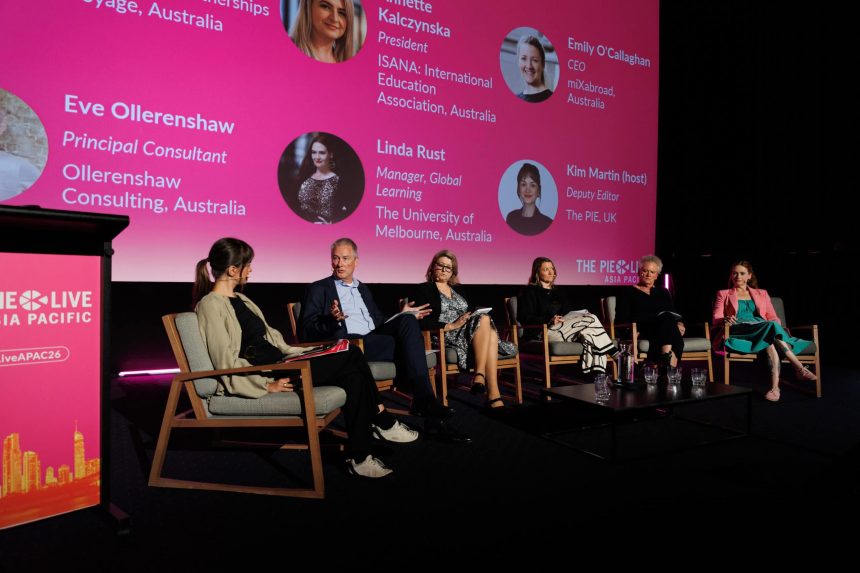
What followed, in a later panel on social licence, was a wide‑ranging discussion that unpacked just how fragile that licence has become – and what it might take to rebuild trust: moving beyond dollar‑heavy narratives, foregrounding student stories, and re‑anchoring international education in communities, legitimacy and trust.
“We look at social licence through two lenses. One is the lens of the student – am I wanted? And the second one is the community lens – do we want international students in Australia?,” explained Andrew Parker, partner, strategic accounts & partnerships at Voyage.
Voyage, a social listening platform focused solely on international education, is piloting what Parker describes as the first Australian model to measure social licence and establish a baseline, in partnership with Study New South Wales.
Using API feeds from major global social platforms, plus media and podcasts, the team is tracking unprompted conversations across 190+ countries.
Specifically on social licence, Australia is, as Parker put it, “least worst – the best house in a bad street” when you compare sentiment with the UK and Canada. “It is an asset for us to protect,” he stressed.
Quarter one showed a small improvement over Q4 2025, with Q2 expected to tick up slightly again. But, Parker warned, any sense of progress is fragile.
“Social license, by its very definition, is highly event driven… a racist incident, somebody making a comment on a train to a foreign student, or a government policy announcement is a trigger.”
The 1 July visa fee hike provided a live case study.
“We saw a 100% increase in social media mentions and a 190% increase in news coverage in the first two weeks of July compared to March. The sentiment was overwhelmingly negative.”
Crucially, the anger wasn’t just directed at Canberra, but also directed at students and the universities.
“What we’re seeing here is policy spilling out into community narratives, and it carries really significant reputational risk for Australia,” said Parker.
“Voices that started to appear in what were typically student-only subreddits were domestic voices, and those voices were overwhelmingly negative… When those hostile voices start to infiltrate student spaces, that is a leading indicator of increasing reputation risk for Australia.”
Sharing the stage with Parker, Eve Ollerenshaw, principal consultant at Ollerenshaw Consulting, explained: “For me, social license is about three things: legitimacy, credibility, and trust. You can’t have one without the other… but the outcome of getting it right is something really powerful for both the consumer as well as the institution as well as communities.”
“There are a lot of really loud voices out there that are really very, very conservative and that is manipulating markets that have never been manipulated before for purposes that are quite ulterior to education.”
“The loudest voice isn’t always the one we need to hear… There’s an extreme right wing component in social media these days that does incredibly well out of selling fear.
“The loudest voice isn’t always the one we need to hear… There’s an extreme right wing component in social media these days that does incredibly well out of selling fear.
Eve Ollerenshaw
“Do our community have the effective skills to filter what we need to hear, what we should hear versus what we are hearing? It is a very, very weird time,” she added.
Emily O’Callaghan, CEO of miXabroad, argued that providers are still leaning too heavily on economic messaging – language that simply doesn’t resonate with the communities whose support they need.
Referring to post-Covid research she helped steer, O’Callaghan noted: “Framing international students as economically valuable or as talent didn’t resonate… as much as the students actually telling their stories themselves, connecting with peers and having that shared experience.”
For Linda Rust, manager, global Learning at the University of Melbourne, social licence is lived locally.
“When students come into Australia, they’re really wanting to make that connection locally… with other students, but also with the local community, and really kind of build a place for them.”
Universities, she argued, have a specific responsibility: “It’s difficult for students coming here with no networks… universities have such a big role to play in facilitating this because they’re the ones with the connections into community that can assist.”
Rust highlighted one student-led initiative, Being a Melbournian, where international students and older local residents built relationships through a structured semester-long program.
“Both groups experience loneliness… and their experiences coming together and sharing their cultures really made an impact on everyone in that program.”
Annette Kalczynska, President of ISANA: International Education Association, stressed that practitioners are already working at the frontline – but often against structural constraints.
“Our members are seeing students on an everyday basis… they are hearing a lot of good things about being in Australia, but also they are facing roadblocks… classes are separated… there is no interaction between domestic and international students.”
ISANA members, she said, are continually trying to create connection and agency.
“We are trying to connect them with volunteering opportunities, making them mentors… providing leadership opportunities, connecting them with short-term and long-term employment.”
But she was blunt about resourcing gaps. “If [a counsellor] was able to see all the students who needed help, they would have to work 24 hours a day… Universities should play more of a role as community connectors… if they’re going to rethink their strategy and how they react to particular student experiences.”