Printing a coronary artery in a lab one day, then walking into an internship at the Mayo Clinic to apply machine learning models to real patient data. That’s exactly where Parth Burujwale finds himself as an MS in Artificial Intelligence Engineering (MSAIE) student at Carnegie Mellon University (CMU)’s Department of Biomedical Engineering (BME).
“The program has been one of the most rewarding experiences of my academic journey,” he says.
That MSAIE training would prove pivotal during his internship at Mayo Clinic, where he applies AI and machine learning to real-world healthcare challenges. His goal is to become an AI/ML research engineer creating intelligent technologies for healthcare, and he’s already gaining the experience to make that happen.
CMU students are at the forefront of creating some of the most exciting new technologies today. But it’s also an inward journey. Hima Ravindra signed up for the MS in Biomedical Engineering to grow as an engineer and a leader. Through the program, she served as a BME Student Ambassador, connecting with prospective students and shaping the community she’d joined.
She also became a teaching assistant for the same courses she’d once ranked as her top choices. Her work then extended past CMU’s own labs, into collaborations with clinicians at the University of Pittsburgh Medical Center. It’s a path the program actively encourages, pointing students toward opportunities at its partnering medical centers.
Now an engineer at a major medical technology company, she credits that mix of technical training and cross-institutional exposure for preparing her to move straight into industry.
“These experiences allowed me to apply engineering principles to real-world healthcare challenges, expand my professional network, and gain a deeper understanding of the medical device industry.”
The MS in Artificial Intelligence Engineering in Biomedical Engineering equips students with AI and biomedical engineering expertise to develop innovative healthcare solutions. Source: Carnegie Mellon University
Inside CMU’s bioprinting labs
Step inside Carnegie Mellon’s biomedical engineering labs and you’ll find students working on technologies that could redefine healthcare. One lab is printing living tissue. Another is developing AI for medicine. Elsewhere, researchers are advancing implanted cellular therapies that produce drugs on demand and non-invasive neurotechnology to treat neurologic disorders. These are a few of the core research areas you’ll gain exposure in and contribute to.
Take bioprinting, for example. Professor Adam Feinberg has helped shape the field for more than a decade. He has authored over 45 peer-reviewed publications and holds more than 20 U.S. patents and patent applications. Under his leadership, the lab developed Freeform Reversible Embedding of Suspended Hydrogels (FRESH), a breakthrough 3D bioprinting technique that enables scientists to print soft, living tissue using collagen and other natural proteins. The technology has been used to create heart valves; a beating, neonatal ventricle; and more recently, vascularized pancreatic tissue for people with Type 1 diabetes.
You can learn these exact techniques through courses in Biomaterials, Tissue Engineering, Bioprinting and Biofabrication before applying them in research projects of your own — a level of hands-on training that’s rare even among top engineering programs.
That’s how Mary Bessell got her start. Now a Ph.D. student in the Feinberg Group, she built her first bioprinter while taking classes, using the opportunity to reverse-engineer the hardware and develop a spirulina-alginate bioink. By the time she began her doctorate, she had already printed everything from hollow tubes to a coronary artery model and a tri-leaflet heart valve. “The coursework provided the scientific framework, while the projects allowed me to apply those concepts in a research setting,” she says.
The transition from classroom to research happened quickly. During one project, a California heat wave changed the printability of her materials, forcing her to troubleshoot and rethink her approach. That experience taught her to solve problems like a researcher — skills she now applies to her work on a bioprinted booster liver to treat acute liver failure.
CMU graduate Erica Comber followed a similar trajectory. Now a biomedical engineer at United Therapeutics, working on one of the world’s first bioprinted lungs, she credits her preparation to the breadth of Biomedical Engineering at CMU. “Classes that prepared me for my role at United Therapeutics covered topics such as 3D printing, medical devices, cardiovascular mechanics, and stem cell engineering,” she says.
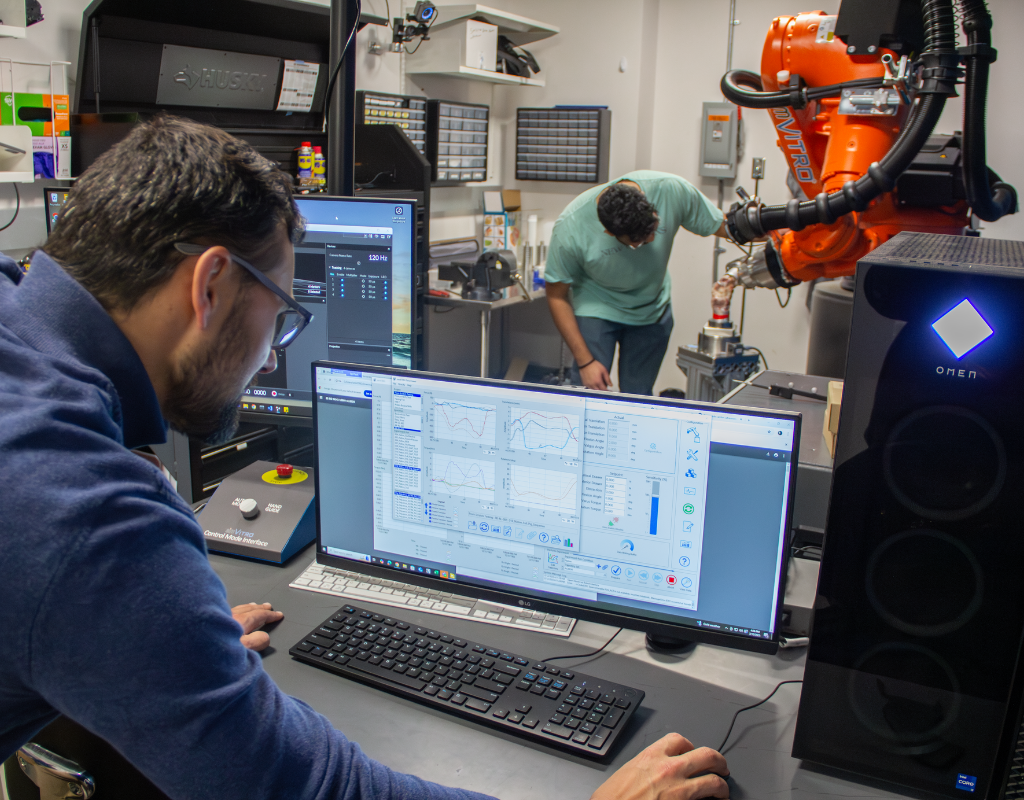
Biomedical Engineering research at Carnegie Mellon University brings together experts from different fields to create new medical technologies and improve healthcare. Source: Carnegie Mellon University
Where AI meets biomedical engineering
Bioprinting is one of several research strands at CMU BME, with neurotechnology and cellular pharmacies among a wide range of other options. AI runs through all of them — and for students who want it as their primary focus, there’s a degree built around it. Burujwale’s program, the MSAIE, pairs deep AI coursework with a biomedical research placement, so you’ll graduate with a technical foundation and a body of original research behind you.
What’s more, you’ll work alongside faculty members who are pushing biomedical AI into new territory. One of the newest additions is Assistant Professor Michelle Li, who joins CMU BME this fall from Harvard Medical School. Her research on contextual AI models is already influencing how rare diseases get diagnosed and how drug targets get identified at single-cell resolution.
Meanwhile, Professor Tzahi Cohen-Karni‘s lab builds implanted “cellular pharmacies,” engineered cell systems that manufacture drugs from inside the body. His team recently co-developed a system called HOBIT that solves one of the field’s biggest obstacles: keeping those cells supplied with enough oxygen to survive.
Professor Bin He‘s lab works on safe and accessible alternatives to surgically implanted brain-computer interfaces (BCIs). His team was the first to show that a person could fly a drone or control a robotic arm purely by thinking about it, using a non-invasive BCI. More recently, his group has studied how focused ultrasound can prime brain activity, opening a path toward treating chronic pain and neurological disorders without surgery or pharmaceuticals.
From bioprinted heart valves to drone-flying BCIs, students at CMU work on a broad range of revolutionary biomedical technologies. You’ll be exposed to real problems and given the tools to solve them.
Learn more about the Department of Biomedical Engineering.
Follow Carnegie Mellon University’s Department of Biomedical Engineering on Facebook and Instagram.