For generations, the route to a British boarding school education for affluent Indian families was a familiar one: board a flight to the UK. Today, Britain is increasingly coming to India instead.
Over the past few years, some of the UK’s best-known independent schools – including Harrow, Wellington and Shrewsbury – have established Indian campuses, drawn by rising household incomes, demand for globally recognised qualifications and education reforms.
Yet exporting a school involves far more than offering Cambridge or International Baccalaureate qualifications; these institutions are attempting to transplant educational philosophies shaped over centuries. Their reputations rest not only on academic achievement, but on approaches to boarding, pastoral care, sport, the arts and character development – ideas now being tested in a very different educational landscape.
They are also entering a competitive market. India already has a rich boarding school tradition, with institutions such as The Doon School, Mayo College and Woodstock School alongside a growing number of international schools. Heritage alone is unlikely to be enough.
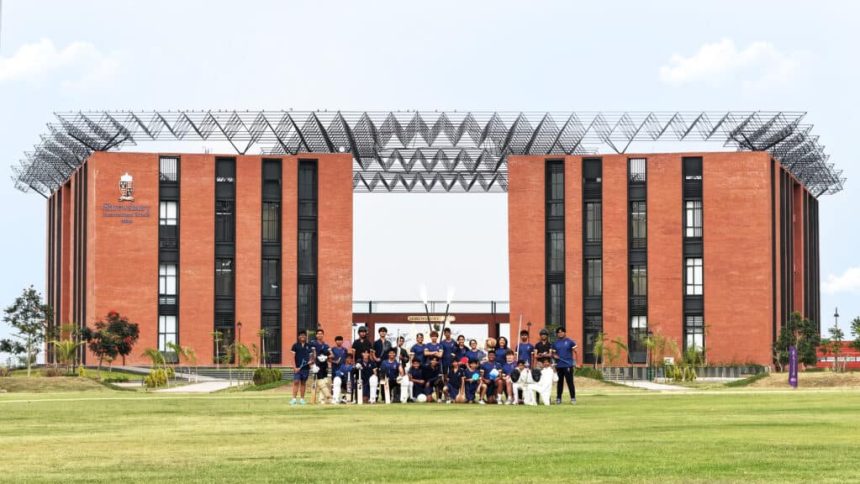
Against that backdrop, Shrewsbury International School India welcomed its first pupils in Bhopal last year, with founding headmaster Dominic Tomalin describing the aim as adaptation rather than recreating its 474-year-old parent school in England.
“It has to feel Indian.”
The idea surfaces repeatedly during conversations on campus, whether discussing classrooms, boarding houses or theatre productions. “We’re not trying to recreate England in India. The philosophy remains the philosophy, but how it is expressed has to reflect the community we’re serving,” stated Tomalin.
It points to a challenge facing Britain’s newest international campuses: buildings, uniforms and curricula can be replicated, but a school’s identity is harder to transplant.
We’re not trying to recreate England in India. The philosophy remains the philosophy, but how it is expressed has to reflect the community we’re serving
Dominic Tomalin, Shrewsbury International School India
For Abhishek Mohan Gupta, founder and president of the board of management, that is one reason the school was established in Bhopal rather than one of India’s largesr cities. “We wanted to create a fully residential campus from the ground up. That required space, but it also required thinking about what kind of community we wanted to build.”
Neither Gupta nor Tomalin is eager to judge success too early. “Education is a slow change-maker. Schools develop their character over many years,” stated Gupta.
Deputy headmaster – strategy and school development, Oliver Russell, agrees. “People often talk first about buildings. But schools are ultimately defined by relationships, traditions and culture. Those things can’t simply be built; they develop.”
That long-term view sits against a premium education market often focused on university destinations, facilities and immediate outcomes. Shrewsbury argues those indicators should emerge from the foundations of a school rather than define them.
The classroom is where that proposition faces its first real test. Much of what Shrewsbury describes as distinctive – enquiry-led learning, broad subject choice and an emphasis on independent thinking – is familiar within British independent education. Introducing those approaches in India, however, means navigating a system where examination performance and university admissions continue to shape many families’ expectations.
Deputy head – academic Stephanie Oldridge says one of the biggest challenges has been convincing parents that learning can look different without becoming less academically ambitious. “Parents naturally compare it with the education they experienced. That’s completely understandable. But we are preparing children for a world that is changing rapidly.”
Lessons centre on discussion, investigation and problem-solving, encouraging pupils to question, debate and reach their own conclusions. “It’s less about standing at the front and giving students the answers. Our role is helping them develop the confidence to find those answers themselves,” she stated.
“We’re absolutely ambitious academically. The difference is that we believe students perform better when they genuinely understand what they’re learning rather than simply memorising it.”
Head of English and girls’ housemistress Deepti Kumar sees the emergence of artificial intelligence as another reason schools need to rethink their role. “AI is here, and education has to engage with it thoughtfully. Our responsibility is to help pupils understand how to use these tools critically, ethically and responsibly.”
At the same time, Kumar insists an international education should not come at the expense of cultural identity. “Pupils should engage deeply with Indian literature and history, alongside the literature, ideas and perspectives of the wider world.”
That balance between global outlook and local relevance brings the story back to Tomalin’s insistence that the school must “feel Indian”. It also raises a more difficult question for British schools expanding overseas: how much can they change while remaining recognisable as the institutions whose names they carry?
The tension extends well beyond academics.
For deputy head – pastoral, Peter Willett, boarding is not simply accommodation but an extension of education. “People sometimes think boarding is where students sleep. It’s much more than that.”
The lessons, he argues, come through everyday life: “Living with other people, learning responsibility, resolving disagreements, looking after younger students – those are all part of growing up.”
Residential education, of course, is hardly unfamiliar in India, so Shrewsbury is entering a landscape with traditions of its own rather than introducing a new concept.
“We’re creating something new. We’re drawing on the heritage and philosophy of Shrewsbury School while allowing the school here to develop its own identity in India.”
For pupils, there are early signs of what that might look like. Several describe Design and Technology as a favourite subject because it encourages experimentation, while others say restrictions on social media have resulted in stronger friendships.
Asked whether the school feels British or Indian, one pupil pauses. “It’s a blend. Both cultures have adapted.” For a school only a year into its journey, the answer is necessarily tentative.
Beyond the boarding houses, another part of the proposition comes into view. Premium schools increasingly compete not simply on curriculum but on the wider experience they offer, and Shrewsbury’s campus has more than 20 sports, ranging from cricket, football and swimming to fencing, indoor rowing, horse riding, golf and scuba diving.

For director of sport Ashutosh Bisht, however, sport is another form of education rather than simply an exercise in performance. “If students go on to represent India, that’s fantastic. But that’s never the only goal. The life lessons matter just as much as the technical skills.”
Gavin Oldridge, teacher of physical education and assistant housemaster, shares that view. “If young people never experience setbacks, they don’t get the opportunity to learn how to deal with them.”

A similar emphasis runs through the performing arts. The Sidney Centre for the Performing Arts, a purpose-built facility for music, drama and fine arts, opened on campus in June 2026. For director of performing arts Tansy Troy, what happens inside it should also draw on the school’s surroundings.
“If we’re building a school here, then that culture shouldn’t sit outside the campus gates – it should become part of what students experience.”
Across conversations with staff, the intention was rarely framed as recreating Britain, but as finding a local expression for longstanding educational principles. Whether that approach succeeds will ultimately be decided by families, while technology is adding another dimension to what they may expect from a school.
“If knowledge is available instantly, schools have to ask themselves what students genuinely need from us,” Tomalin says.
His answer returns to ideas heard throughout the visit: judgement, curiosity, creativity, relationships and character. None are uniquely British, nor exclusive to international schools; the question is whether Shrewsbury can bring them together in a way that feels distinctive in an already sophisticated market.
For now, any verdict would be premature. The school’s first cohort is still small, with its next intake beginning in September 2026. Traditions are only beginning to emerge, and the qualities that define a boarding school – its culture, rituals and reputation – cannot be manufactured overnight.
As Britain’s independent schools continue to establish campuses across India, the more interesting question may not be whether they can recreate the institutions they left behind, but whether they can build something recognisably their own while genuinely belonging to the communities they now serve.