Imagine experiencing homelessness as just a child. Then imagine the one place that was supposed to believe in you — your football club — deciding you weren’t worth the investment.
That’s the story of Tyrone Mings. Before he was an England international and an Aston Villa stalwart, he was a kid sharing a room with his mum and three sisters in a homeless shelter, and a teenager told by a top academy that he simply wasn’t good enough.
But what he did next — pushing through non-league football, a stint as a mortgage advisor, and, crucially, a scholarship at one of Britain’s most elite private schools — is a reminder that rejection is rarely the end of the story.
Experiencing homelessness growing up
Mings doesn’t remember the exact age it happened, but the disruption stayed with him. His mother had just come out of a difficult relationship, and with nowhere else to go, the family — Mings, his mum Dawn, and his three sisters — ended up sharing a single room with two bunk beds and a sofa in a homeless shelter for the best part of a year.
Speaking to the Telegraph, he described the conditions: “communal washing area, communal showers, it was awful.” It was, he added, not a nice experience for a kid who was still in primary school.
It’s the kind of backdrop that could derail anyone. Once the family moved into stable social housing, football became Mings’s outlet. And eventually, it was his way out.
Looking back on it as an adult, supporting Prince William’s Homewards homelessness campaign in 2023, Mings didn’t frame the experience as purely bleak: he’s said that “definitely positives came out of it,” crediting his family’s love and support for making up for the lack of stability at the time.
Joining private schooling
Tyrone Mings joined Southampton’s academy in 2001, aged 8, and spent seven years working his way up through one of the most productive academies in English football — the same one that produced Alan Shearer and Gareth Bale.
But in 2009, at 15, he was released, because Southampton didn’t believe he had the physical stature to make it as a professional.
“I remember between 6 and 7 up until about 13, I was one of the biggest,” Mings told England Football. “But then at 13 or 14 everyone else started developing into teenagers and young adults, and I didn’t really develop physically until I was about 17 or 18, which was ridiculously late when I look back at who we would play against in the academies.”
For most kids, being cut by a Premier League academy at 15 would be the end of the football dream. For Mings, it became the pivot point. He enrolled at Millfield School in Somerset on a football scholarship, staying for two years through sixth form.
Millfield isn’t just any school. It’s one of the UK’s most prestigious co-educational institutions, sitting on a 240-plus-acre campus with facilities most professional clubs would envy. For a kid who’d spent part of his childhood in a shelter, getting into a private school on a scholarship must’ve been a huge turning point.
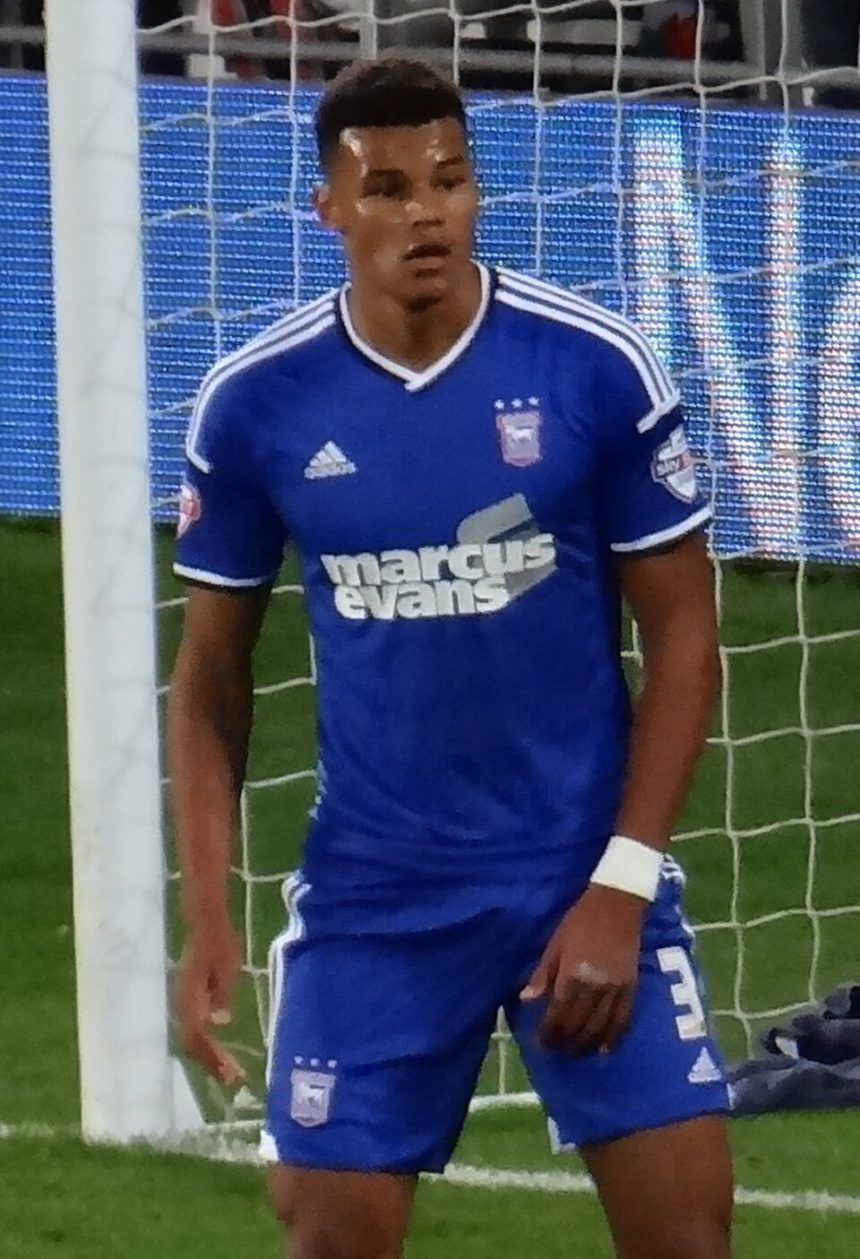
Tyrone Mings playing for Ipswich Town in 2014. Source: Jon Candy via Wiki Commons
Grinding it out in non-league football
Millfield didn’t lead straight back into professional football, either. Tyrone Mings left school and dropped into non-league football with Yate Town, then Chippenham Town. To pay the bills, he pulled pints at a pub in Chippenham and, eventually, took a job as a mortgage advisor — a world away from the academy pitches he’d grown up on.
It wasn’t glamorous. He didn’t even have a car for a while, and getting to non-league fixtures around Wiltshire was its own logistical battle. But it was on that Chippenham pitch that his next break appeared, care of a teammate rather than a scout.
Mings’s Chippenham teammate happened to be Toby Osman, son of Russell Osman, a former England defender, then working as academy manager at Ipswich Town. Toby recommended Mings to his dad, which led to a trial against a Nike Academy side.
Mings impressed enough that Ipswich manager Mick McCarthy decided to sign him almost immediately, reportedly telling staff, “We’ll sign him now” after watching him for barely two minutes. The fee: £10,000 (around US$13,491 today) — a bargain-bin gamble that Ipswich would go on to call one of the best pieces of business in the club’s recent history.
Mings made his Ipswich debut in May 2013 and spent his first season and a half as a squad player before getting his shot in 2014, when first-choice left-back Aaron Cresswell was sold to West Ham. He grabbed the opportunity, winning the Championship Player of the Month award that September and helping Ipswich reach the play-offs in 2014–15. By June 2015, Bournemouth had signed him for a reported £8m (around US$10 million today).
Setbacks, Aston Villa, and an England shirt
Bournemouth wasn’t a smooth ride. Tyrone Mings suffered a serious knee ligament injury just six minutes into his Premier League debut, ruling him out for 15 months, followed by a stress fracture in his back that kept him out for another eight or nine.
It’s the kind of run of misfortune that ends careers — but Mings has since said he wouldn’t change any of it, believing the setbacks made him a better player and a better person.
A loan move to Aston Villa in January 2019 turned things around. He helped the club win promotion to the Premier League via the play-offs, then signed permanently for a club-record £26.5m that summer (around US$35.75 million).
His England debut followed in October 2019, against Bulgaria — a match remembered as much for Mings’s composure in the face of racist abuse from sections of the crowd as for the scoreline. England manager Gareth Southgate later credited that maturity directly to Mings’s background, saying his “journey to becoming an England player is very different to most of the boys” who came through standard academy pathways.
Since then, Mings has captained Aston Villa, started at EURO 2020, and become an outspoken advocate on homelessness. In 2021, Bath Spa University awarded him an honorary doctorate in recognition of his work in youth development.
The lesson
It’s clear that having the right support, like Millfield, at the right time can set you up for success. Beyond the access to a world-class education and premier facilities, it’s about having an institution believe in you.
For Tyrone Mings, private schooling was that institution. It could be anything else for your journey. But there’s no doubt that private schools
If you’re interested in exploring more private schools, we’ve got a handy list of the best private high schools in the US or perhaps the most prestigious boarding schools in the world.