On her birthday three years ago, Kudzaishe Gondora graduated with a Master of Global Affairs from the University of Toronto (U of T), Canada’s #1 rated university. “This is an incredible and crucial time to be exploring and understanding global affairs,” she said. “There is a need for work to be done. But beyond that, there’s a deeper need to understand the world we want to impact and how to truly mobilise change, in a way that’s sustainable.”
In the two years Gondora spent at the Munk School of Global Affairs & Public Policy, she had done just that. She served as President of the Master of Global Affairs Student Association, directed the Munk School Black Students’ Association, sat on the Anti-Racism Action Table, and held a position on the Graduate Education Council. When she graduated, she became the first-ever recipient of the school’s Excellence for Community Building Award and delivered the valedictory address.
These roles “both challenged and molded” Gondora. In her address, she said: “To the class of 2023 — future leaders, politicians, entrepreneurs, and global changers — I am so glad to let you know today that what the Munk experience has put inside of you is something that cannot be diminished or taken away from you.”
Today, Gondora contributes to a new university programme that equips leaders to succeed in fast-paced settings. She previously worked as a grants finance manager at World Vision Canada, overseeing a multi-million-dollar portfolio of UN agency-funded projects across three continents, leading Global Affairs Canada initiativesand holding responsibility for financial strategy, data governance, and regulatory compliance.
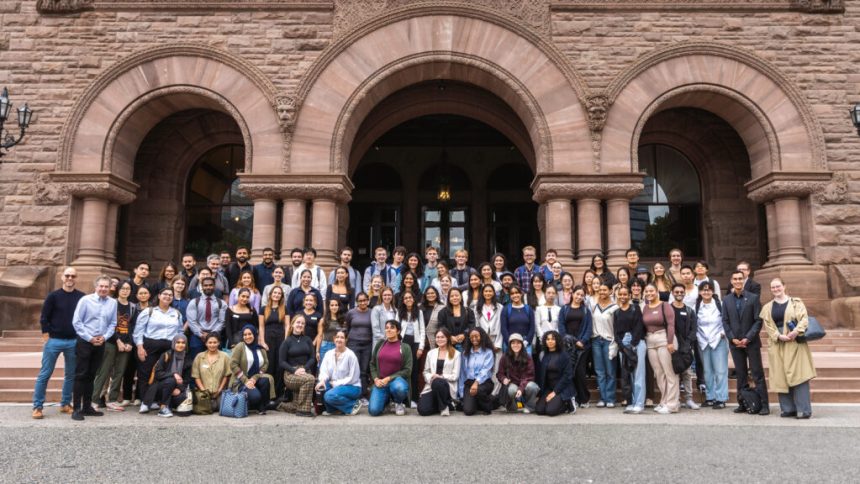
At Munk School of Global Affairs & Public Policy, students earn a professional master’s degree while building practical, transferable skills through experiential learning. Source: University of Toronto
A degree built on practice
Stories like Gondora’s are common among the Munk School’s Master of Global Affairs (MGA). The MGA and Master of Public Policy (MPP) are two-year professional degrees built around a simple idea: policy is best learned by doing.
And MGA and MPP students do a lot. Every student completes a mandatory summer internship in global affairs or policy-relevant roles between their first and second years. In their second year, students get matched with Munk School Fellows, a roster that includes former diplomats, public servants, journalists, and business leaders who mentor students one-on-one.
Then there are case competitions. Offered throughout the year, these test a student’s quantitative and qualitative analysis and ability to defending their recommendations in front of expert judges. Some competitions are organised by the Munk School itself through initiatives such as Policy at Munk and Urban. Others pit its students against peers across the U of T, in competition such as SHIFT, an annual public sector competition run with KPMG that places cross-programme teams from Munk, the Rotman School, and the Faculty of Information on live policy cases.
Those seeking to specialise can take part in Student Leadership Initiatives. These are opportunities a subject area of interest while designing activities for fellow students, such as pro-bono consulting, AI Policy Group, Environmental Working Group, Munk School Black Students Association, Equity, Diversity and Public Policy, and more.
Overall, it’s a prolific list of opportunities. “We had fantastic professors, and we had fantastic opportunities, but the fact that I got to work on such complex issues in real life with my cohort was fantastic,” said XXX, another Munk School graduate.
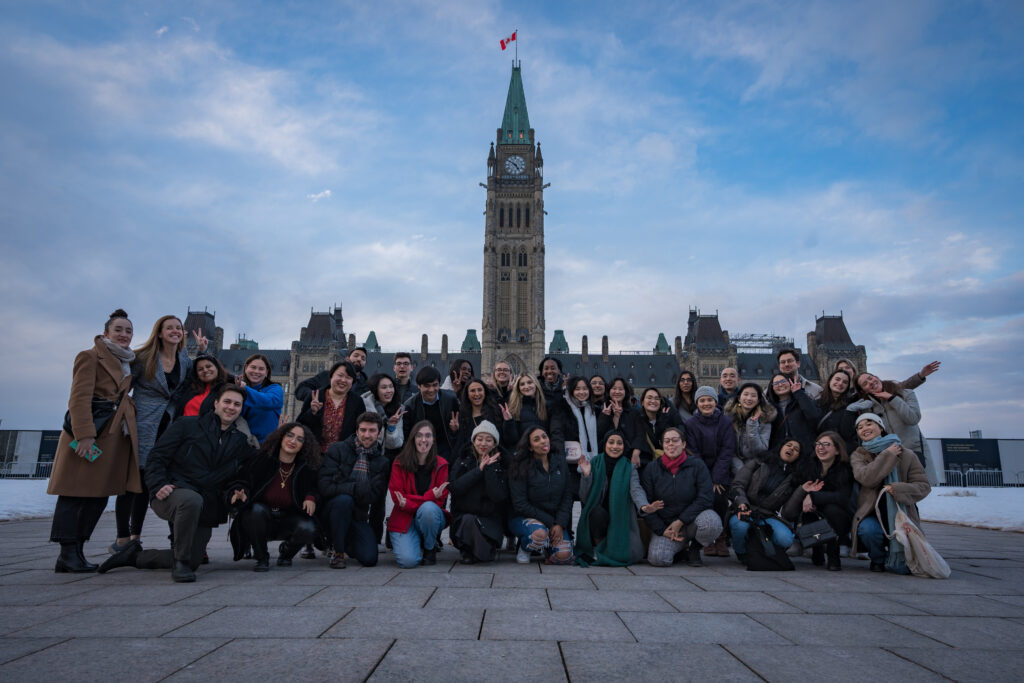
The Munk School of Global Affairs & Public Policy equips students with the skills to tackle the world’s most pressing challenges. Source: University of Toronto
A global classroom
The school is part of the Global Public Policy Network (GPPN), a partnership of eight leading policy schools worldwide. Members include Columbia University, the London School of Economics and Political Science (LSE), Sciences Po, and the Lee Kuan Yew School of Public Policy, among others. The network gives students access to research collaborations, dual-degree pathways, and an annual conference where they present policy solutions to deans and faculty from every member institution.
MGA students who keep a first-year GPA of 3.5 or above can apply to study abroad in the first semester of the second year. Reserved placements are available through partner schools, including dual-degree destinations in Singapore, London, Paris, and other cities. In some cases, students can combine their exchange with the programme’s mandatory summer internship if both take place in the same location.
Field courses provide even more ways for students to see the world. In February 2026, MPP students in the Comparative Urban Governance course travelled to London to study the city’s supportive housing system firsthand. They met with staff from the Greater London Authority and frontline housing organisations to examine how funding structures and service delivery shape outcomes on the ground, and what lessons could be applied in Toronto.
“Our time in London once again demonstrated the value of experiential learning,” said Prof. Gabriel Eidelman. “These encounters enriched discussion throughout the trip, whether in formal sessions, over shared meals, or during the many in-between moments that often become the most memorable parts of an intensive course like this.”
Learn more about the Munk School of Global Affairs & Public Policy.
Follow Munk School of Global Affairs & Public Policy on Facebook, X, Instagram, LinkedIn, and YouTube.