For all the progress medicine has made, fixing global healthcare remains one of the defining struggles of our time. No nation and no single discipline can solve it on their own.
Thermo Fisher Scientific’s 2026 Pulse Survey, which gathered insights from 150 industry leaders worldwide, reveals the challenges shaping global drug development. 41% are holding back amid regulatory and economic uncertainty. Another 71% say clinical trial designs are more complex than they need to be, while 54% are feeling greater competitive pressure as execution struggles to keep up with scientific progress. These pressures are pushing the industry to rethink how things are done, from smarter clinical trial designs and artificial intelligence (AI) to more patient-focused approaches.
For pharmacy professionals, the message is clear: these shifts demand a profound shift in mindset. It is no longer enough to be an expert in local dispensing or national regulations. Here are three universities to understand cross-border supply chains, navigate international health equity, and champion equitable access to breakthrough therapies.
Master of Global Medicines Development graduates can work in pharmaceutical and biotech companies, global health organisations, regulatory bodies, research, consulting, international supply chain management, and more. Source: UNC Eshelman School of Pharmacy
University of North Carolina at Chapel Hill
The University of North Carolina at Chapel Hill is home to the #1 pharmacy school in the US. Over in Australia, Monash University is ranked #2 in the world for pharmacy and pharmacology. In 2026, these two schools brought their expertise together for the first-of-its-kind Master of Global Medicines Development (MGMD). The goal is to train pharmaceutical leaders to develop, evaluate, and deliver medicines that can make an impact around the world.
Your first 12 months will be spent at Monash University’s Parkville campus in Melbourne. But your learning won’t be limited to one university — or one country. Classes are conducted by faculty at both Monash and the UNC Eshelman School of Pharmacy, including people with decades of experience in biotech and pharmaceuticals. They take you through the drug discovery and development lifecycle, while assignments based on real industry case studies give you the chance to put what you learn into practice. Come third semester, your experience becomes even more global: complete your internship in Melbourne or head to North Carolina’s Research Triangle Park to gain experience in one of the US’s leading life sciences hubs.
As you explore how new therapies move from discovery to patients, you’ll learn to connect scientific, regulatory, commercial, and public health perspectives, building the kind of cross-disciplinary thinking needed to tackle complex challenges on a global scale.
“You’ll have the awareness, knowledge, skills, and passion to make an impact in global health,” shares Dr. Tony Hughes, Monash Course Director for the MGMD. Associate Professor Stephen Eckel, UNC-Chapel Hill Course Director for the MGMD, adds, “Graduates from this programme are ready to step into leadership, coordination, and administration roles in global pharmaceutical companies, regulatory bodies, public health organisations, and more.
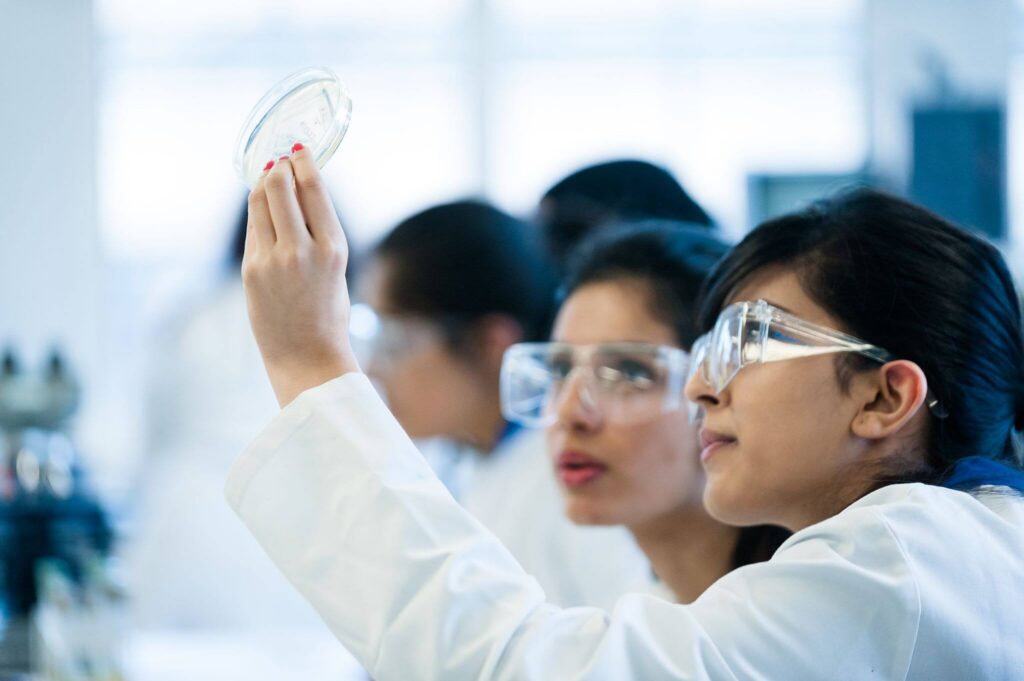
Whether you’re in clinical research, regulatory affairs, or commercial operations, KCL’s Global Medicines Development MSc helps you bring safe, effective treatments to patients. Source: King’s College London
King’s College London
There’s a reason more than 5,000 students choose King’s College London’s Faculty of Life Sciences & Medicine. Ranked #9 in the world for Life Sciences & Medicine in the QS World University Rankings 2026, the faculty brings students together with more than 550 scientists and educators. Add partnerships with major NHS hospitals, including Guy’s, King’s College, and St Thomas’, and you have plenty of opportunities to learn in an academic setting closely connected to the city’s central healthcare hubs.
If you’re already working in pharmaceuticals or healthcare, the online, part-time Global Medicines Development MSc is one way to take your expertise further. Grounded in the PharmaTrain curriculum, the programme connects you with experts who are pioneering vaccines, biopharmaceuticals, and cell and gene therapies. You’ll gain insight into the entire medicine development journey, from early-stage research to post-approval monitoring and patient access, and how the traditional process is being challenged, especially by gene and cell therapies.
Then there are the skills that help you make things happen at work. Through practical problem-solving, you’ll get better at communicating ideas, making decisions, and leading others. By graduation, you’ll be able to critically evaluate and adapt to global regulatory requirements and understand what advances in drug development mean for healthcare markets and patient access worldwide. There are opportunities to further build your professional credentials too, including through the Diploma in Pharmaceutical Medicine.

National University of Singapore, ranked #1 in Asia and #8 in the world, is home to Asia’s leading medical school. Source: National University of Singapore
National University of Singapore
Singapore is quickly becoming a biotech powerhouse, but with growth comes its own challenges. One of the biggest is finding people with pharmaceutical, toxicology, clinical development, and regulatory expertise to keep that progress going. The Master of Science in Medical Pharmacology (MSc PHC) at the National University of Singapore’s (NUS) Yong Loo Lin School of Medicine was designed with this in mind. You’ll go through the drug development journey, from discovery to market approval, while exploring the global principles that shape pharmacovigilance, regulatory compliance, and safety assurance.
You can tailor your studies to your career goals through four specialisations: Clinical Pharmacology, Translational Pharmacology, Pharmacology Education, or Regulatory Pharmacology. Each specialisation has been developed with industry input, combining interdisciplinary knowledge with practical experience and innovation. You’ll learn from faculty and industry experts, use cutting-edge facilities, and apply your skills to real-world challenges through collaborative capstone projects. With a focus on ethical practices and leadership, these experiences can prepare you for roles such as clinical investigator, clinical pharmacologist, pharmaceutical patient educator, regulatory affairs specialist, and toxicologist.
“I offer my strong and enthusiastic support for the master’s programme in Medical Pharmacology at the NUS Yong Loo Lin School of Medicine,” shares Harvey F. Lodish, Professor of Biology and Biological Engineering at MIT and founding member of the Whitehead Institute. “The development of totally new types of courses in pharmacology that explain the entire cycle of development of these new biotherapeutics is essential to training the new generation of pharmacological scientists.”
*Some of the institutions featured in this article are commercial partners of Study International