
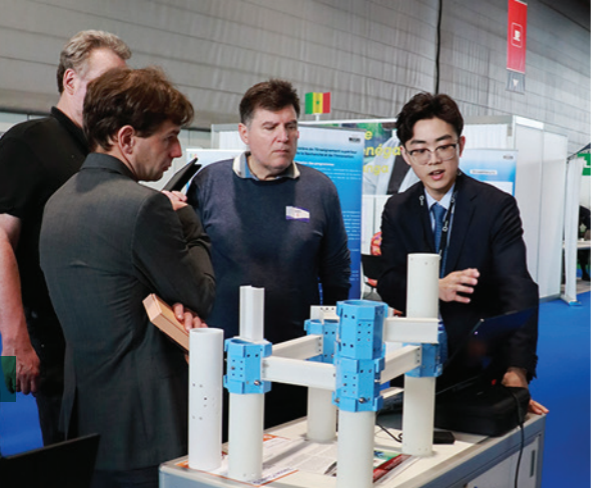
The end of high school comes with one big question: what should you study next? If maths, science and technology are subjects you enjoy, civil engineering is one answer. But the cities you’ll live and work in tomorrow could look very different from the ones you know today.
“Society is demanding greener, more resilient infrastructure that addresses climate change and resource constraints. This makes civil engineering one of the most dynamic and impactful professions today,” shares Professor Wei Pan.
He’s worked in building design and project management for over 30 years. Now, he brings his expertise to future engineers as Head of the Department of Civil Engineering at The University of Hong Kong (HKU).
Established in 1912, HKU has spent over a century nurturing civil engineering leaders and contributing to communities in Hong Kong and beyond. That long history has helped build the expertise and resources that make up the university today, ranked #11 globally and #1 in Asia. The department is ranked #20 in the world, with strong employer reputation, high innovation and research impact.
Join its BEng in Civil Engineering programme and you’ll get to learn from and work with the world’s leading experts in this field.
“HKU’s Department of Civil Engineering actively shapes the future of the industry through research innovation and educational leadership,” shares Professor Pan. “Our faculty members work closely with government agencies, industry partners, and international collaborators to develop solutions for smart construction, digital project delivery, modular integrated construction (MiC), transportation systems, climate resilience, environmental engineering, and advanced materials.”
The department regularly shares opportunities with students, from seminars and job openings to international programmes. Source: The University of Hong Kong, Department of Civil Engineering
Civil engineering goes digital
One of the biggest changes happening in construction right now is digital transformation. Engineers are using AI to automate parts of the design process, improve construction planning, manage safety, and make better decisions using data.
Digital twins, real-time virtual replica of a physical object or system used to simulate and optimise performance, are helping engineers manage complex infrastructure and environmental treatment systems throughout their lifecycle.
Robotics and autonomous systems are taking on more tasks in construction, while advanced sensors and Internet of Things (IoT) technologies make it possible to monitor structures and infrastructure in real time.
As these technologies become more common, students need opportunities to learn how to use them. That’s why the department has started introducing targeted electives, including AI applications in civil engineering.
“Students gain hands-on experience with Building Information Modelling (BIM), computational design, data analytics, digital project management, sensing technologies, construction robotics, and automation tools. They are also taught how digital workflows integrate across the entire project lifecycle, from design, manufacturing, and construction to operation and maintenance,” says Professor Pan.
“Through project-based learning, industry collaborations, and capstone projects, students develop both technical competence and the adaptability needed for a rapidly evolving industry.”
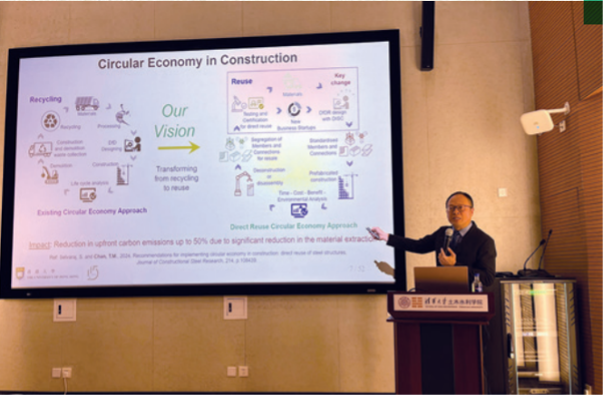
Undergraduate study starts with the fundamentals, giving you a foundation to work with faculty actively engaged in higher-level research. Source: The University of Hong Kong, Department of Civil Engineering
Innovation with positive impact
Innovation means little if it comes at the expense of the cities it is meant to serve. At HKU, students learn to build resilient infrastructures and foster an environment where safety and sustainability are paramount.
“Professors frequently highlight the environmental impact of engineering materials, such as the massive carbon footprint associated with concrete production and its contribution to global emissions,” shares Kenny Owen Chandra, a civil engineering student from Indonesia.
You can see this in practice through the Modular Integrated Construction (MiC) management module, developed by Professor Pan with the Development Bureau of the Government of the Hong Kong SAR. “Learning how entire building sections are prefabricated off-site and assembled like modular units on-site was a great example of how modern construction techniques are evolving to improve efficiency,” adds Chandra.
Every student is required to complete an internship as well. For Chandra, the experience revealed two important lessons.
“Firstly, basic digital literacy and understanding how to apply AI tools are rapidly becoming baseline expectations across companies,” he says. “Secondly, I realised how much geography dictates engineering demand. For instance, Hong Kong’s mountainous terrain creates a high demand for skilled geotechnical and soil engineers to handle slope stability, whereas other regions might see surges in infrastructure built around tech or data facilities. Understanding regional demands helps you align your career strategy with where the actual opportunities are.”
Graduating in 2028, Chandra hopes to pursue project management, a direction he might not have imagined earlier in his degree. “Taking project and management-oriented modules at HKU was a real eye-opener,” he says. “It showed me the operational scale of the field and helped me realise that civil engineers do far more than calculate loads. They manage complex systems that directly shape infrastructure and economic growth.”
Follow The University of Hong Kong’s Department of Civil Engineering on Facebook