To earn the title “Professor”, the path is usually long.
- Get a PhD, teach as an associate professor.
- Climb the academic ladder.
- Build a solid research track record.
“Professor” Jiang did none of that.
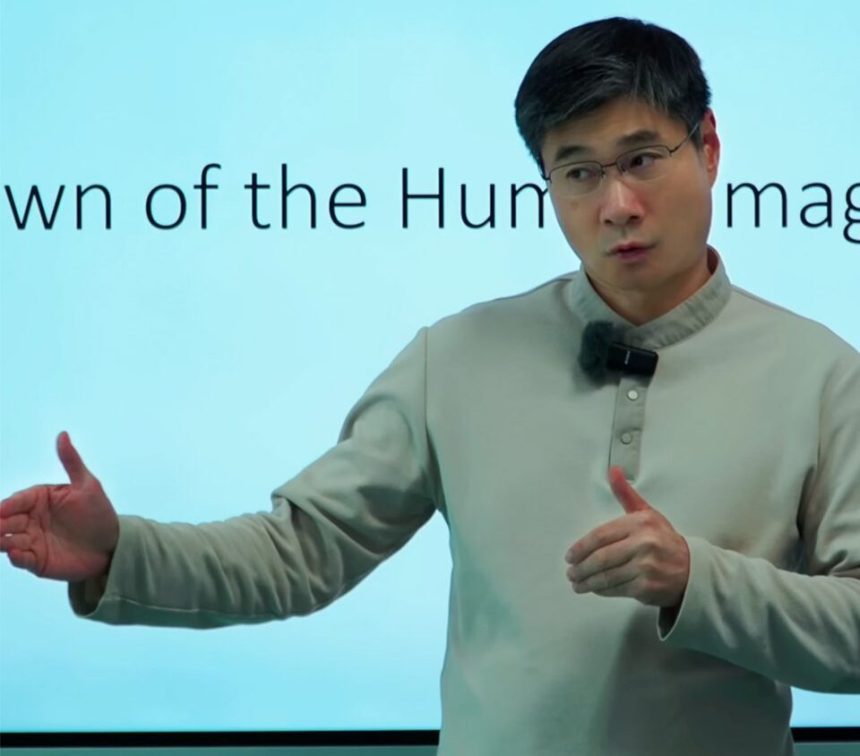
Instead, he became the world’s most-watched YouTuber lecturer, teaching western philosophy, English literature, and geopolitical forecasting to millions online.
The thing is, Jiang became known in 2024, gaining recognition for his two predictions: that Trump would win in 2024, and that the US-Iran military confrontation would follow.
He was right. Trump became president. A coincidence, perhaps? Well, in 2026, the second prediction came true.
Despite his predictions, those who aren’t interested in politics have likely never heard of him.
Today, he has over 2.17 million YouTube subscribers and 68,452,086 total views at the time of writing — outpacing creators who’ve spent a decade building their careers.
So, who exactly is “Professor” Jiang? Where did the title come from? Why is he such a compelling educator that millions watch him?
Who is ‘Professor’ Jiang?
Search his name, and four labels will appear: Chinese-Canadian educator. YouTuber. Commentator. Conspiracy theorist.
But before all that, he was simply Jiang Xueqin.
Born in 1976 in Guangdong, China’s most populous and wealthiest province, Jiang grew up in a family of educators. His father was a high school teacher. But everything changed when, at age six, his family moved to Canada after the Cultural Revolution, the decade-long political campaign led by Mao Zedong.
They settled in Toronto, and life there wasn’t easy.
“My family was poor,” he says in aYouTube video. “But I worked really hard.”
In an interview withGita Wirjawan, an entrepreneur and former Indonesian Minister of Trade, Jiang described himself as a “sensitive” yet “actively curious” child.
He struggled with a speech impediment. As an immigrant, he was often mocked for his oversized hand-me-down clothes and even his haircut, which his father did at home.
His father, once a respected teacher, became a dishwasher. Unable to speak English fluently, he faced racism. That frustration followed him home, sometimes erupting into violence.
“My dad was a very violent and angry man,” Jiang recalls. “He had status and prestige back in China, and loved his job. But this was during the Cultural Revolution, and when it ended in 1976, he looked for opportunities to move abroad to build better opportunities for his children.”
Growing up in that environment, Jiang developed a single goal: get out and pursue an education abroad.
The education of ‘Professor’ Jiang
At 16, Jiang began applying to universities outside of Canada. He aimed high: Yale, Harvard, MIT, and Princeton.
“Apparently, the Ivy Leagues were taking in promising students at the time,” he shares with Wirjawan. “I was not at that point. I was just 16. I was reading cartoons, not many books. But I was intent on getting out of Canada, so I repackaged myself.”
He built himself into a “plausible candidate”. He joined a soccer team (the easiest option for a self-described “non-athletic person”), started reading intensively, crammed for the SATs, and took the hardest courses available.
The rejection letters came quickly. Harvard. Princeton. MIT.
He assumed Yale would be next, and he was prepared to attend the University of Waterloo instead, one of Canada’s top universities.
Then came a small envelope from Yale. He thought it was another rejection.
It wasn’t.
Yale accepted him. He even received a scholarship. In disbelief, he called the admissions office to confirm if it was real.
When he joined Yale, he first pursued particle physics. This move was inspired by Richard Feynman, an American theoretical physicist. But over time, he realised it wasn’t the right fit.
“I was not cut out to become a particle physicist,” he admits to Wirjawan.
So, he switched over to a Bachelor of Arts in English Literature instead.
It was an extreme shift, and Jiang knows it.
Back in Toronto, English literature had always been a part of the curriculum, but it never resonated with him.
“As a Chinese immigrant, the authors — like Monroe and Margaret Atwood — are not talking to you,” he explains. “I didn’t connect with their stories. I didn’t care about the protagonists. That turned me off.”
Yale changed that.
As a liberal arts school, it encouraged students to explore widely across the humanities, sciences, and social sciences. Jiang took literature classes again. This time, something clicked.
“I fell in love.”
He graduated in 1999.
YouTube, education, and 2.17 million followers
Despite attending one of the world’s top universities, Jiang often felt like an outsider. Many of his peers had powerful networks and connections. He had none, which led him to miss out on opportunities. He never blamed them, though; it is what it is.
In the late 1990s, he taught at the Affiliated High School of Peking University while trying to build a career in journalism.
It didn’t go well.
According to Sixth Tone, Jiang struggled to keep a journalism job for more than six months, during which one lasted just one month before termination. He dismissed smaller outlets as beneath him, yet was rejected by major publications like The New Yorker.
Eventually, he fell into a deep depression.
His turning point came in 2008, when he was invited to teach and help reform Shenzhen Middle School in China. He returned to his homeland and immersed himself in education, teaching across multiple levels, including at the university level.
Founding of his YouTube channel
Four years ago, Jiang took on a role helping students prepare to study abroad. But due to COVID, schools needed teachers, so he stepped in to teach AP English.
His students loved reading, but lacked historical context.
So, Jiang did something unusual: he built a programme that taught the entire history of the US — from the Ice Age to what he calls the “American Empire”.
That idea became something bigger.
He launched “Predictive History”, the YouTube channel that would solidify his fame and “Professor” title.
In the past, YouTube was where people turned to learn for free, for example, how to play a guitar or how to change a car tyre. Today, it has become a platform students use to learn about education subjects like history, maths, and English.
“Khan Academy” and “Crash Course” were among the first YouTube channels to pave the way for online education, and now “Professor Jiang” is part of the list.
This may be a great stepping stone for people to become interested in the subject he teaches and to motivate them to learn and pursue it once they start their higher education.