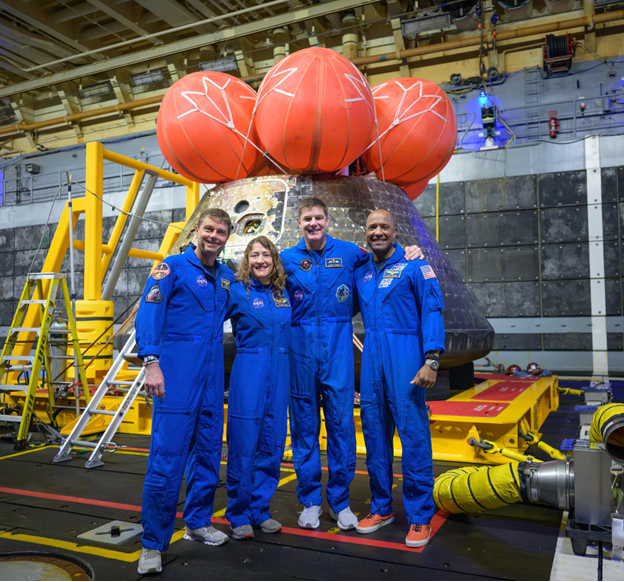
The moon is located 384,400 kilometres from Earth, which feels like it’d take an eternity to reach. But on April 1, 2026 — at 6:35 p.m. Eastern Daylight Time — a group of four astronauts had launched into space on a mission called the Artemis II, and reminded humanity that even the challenges that span as wide as the galaxy are, in fact, within our reach.
NASA’s Artemis II was a 10-day mission in which four astronauts were flown around the moon on the Orion spacecraft, marking the first human lunar flyby in more than 50 years. Aboard the ship were NASA astronauts Reid Wiseman, Victor Glover, and Christina Koch, and Canadian Space Agency astronaut Jeremy Hansen.
It goes without saying: the mission was a success. The four astronauts returned on April 10, 2026, at 8:07 p.m. EDT, with an experience that only a few out of the seven billion people living on Earth can relate to. When the Sun eclipsed behind the Moon, mission commander Wiseman had looked at pilot Glover and said: “I don’t think humanity has evolved to the point of being able to comprehend what we’re looking at right now.”
You can learn more about the specs of the mission here.
Koch, mission specialist on Artemis II, says, “Every time I’ve been waking up or in the first few days, I thought I was floating … and I had to convince myself I wasn’t.” The astronaut was surprised when the shirt she was holding fell to the ground.
As the crew witnessed the far side of the moon, the media — the public — was watching them too. What has captivated viewers, particularly on X, is the humility and emotion with which the four astronauts speak about their experience with you; poignant words that remind you this otherworldly mission was accomplished by mere people.
“I found it really refreshing to see how people have followed the mission,” says specialist Hansen. “What I have seen has brought me more joy and more hope for our future.”
Here are 12 moving quotes from the Artemis II mission
1. “If you can’t take love to the stars, then what are we even doing?” – Amit Kshatriya, NASA Associate Administrator
2. “Find your fulfilment. Find what you can do the slowest, for the longest and still absolutely love it, and go in that direction.” – Christina Koch, NASA Astronaut
3. “Really get comfortable asking questions, and then listening to their peers, but also to their mentors.” – Victor Glover, NASA Astronaut
4. “The sense I had was this sense of fragility and feeling small, infinitesimally small, but yet this very powerful feeling as a human being, like as a group.” – Jeremy Hansen, Canadian Space Agency Astronaut
5. “Earth was just this lifeboat hanging undisturbingly in the universe … Planet Earth — you are a crew.” – Christina Koch, NASA Astronaut
6. “Be gritty, or resilient. To be a lifelong learner, and to be a good teammate.” – Victor Glover, NASA Astronaut
7. “We don’t always do great things, we’re not always in our integrity, but our default is to be good and to be good to one another.” – Jeremy Hansen, Canadian Space Agency Astronaut
8. “You have to go do things … You have to go do really hard, really challenging things.” – Reid Wiseman, NASA Astronaut
9. “Support those around you.” – Christina Koch, NASA Astronaut
10. “When you look up here, we are a mirror reflecting you. If you like what you see – look a little deeper. This is you.” – Jeremy Hansen, Canadian Space Agency Astronaut
11. “We have got to get our hands out there and engaged.” – Reid Wiseman, NASA Astronaut
12. “You’re on a spaceship called Earth that was created to give us a place to live in the universe, in the cosmos.” – Victor Glover, NASA Astronaut
Bonus 13th quote from the Artemis II mission:
“I have two Microsoft Outlooks, and neither one of those are working.” – Reid Wiseman, NASA Astronaut
What students can learn from the Artemis II astronauts
Before the technical jargon that comes with being an astronaut, the main thing that students can take away from the Artemis II crew is that teamwork, patience, and humility go a long way.
Behind the four astronauts sent into space, the mission was made possible by the systematic operation of hundreds of people “tracking their every move.” It is only through collaboration and the wholesome camaraderie between Koch, Glover, Hansen, and Reid that the Orion managed to travel approximately 1,118,793 kilometres over 10 days. Their synergy achieved what was previously unimagined.
With the sacrifices our fellow humans put in, we get to advance day by day. Every single one of us has a role to play in this crew known as planet Earth.