When Raphaël Bartoux started his Master in Management at ESCP Business School, he didn’t consider himself particularly technical. His background was in economics and mathematics, and he assumed AI was someone else’s problem to solve. But he didn’t think that for long. “The professionals who will matter in the next decade are not those who simply know that AI exists, but those who can actually use it, build it, and adapt as it keeps changing,” he says.
That conviction led him to co-found the ESCP AI Society and begin building his own tools – interview-preparation software and email-drafting assistants – driven by the belief that the only real way to learn was by getting his hands dirty.
His story captures exactly the kind of leader ESCP Business School is deliberately trying to nurture. Founded in 1819, with students from over 140 nationalities across six European campuses, the school has spent years rethinking what the next generation of managers actually needs. Its current strategic plan, Bold & United, is built around one core premise: the world needs versatile talents – people who can navigate uncertainty while holding multiple areas of expertise and connecting ideas across fields to create real impact.
The school calls this a “W-shaped” mindset. The QS World Future Skills Index puts the global skills gap at 87%, and closing it requires leaders who operate comfortably across domains and can steer organisations through sustained, layered complexity – precisely the kind of graduate ESCP is building.
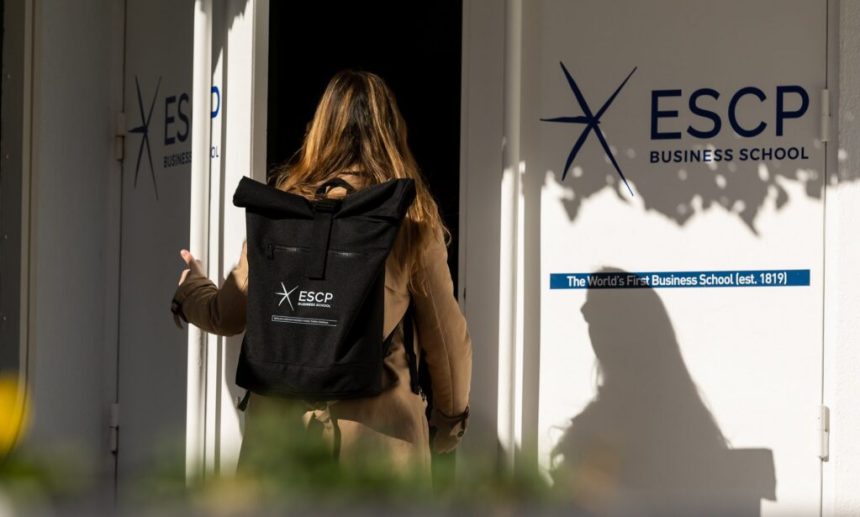
ESCP Business School integrates AI into its academic and business programmes through specialised courses focused on practical, real-world applications. Source: ESCP Business School
Where technology meets responsibility
Knowing how to use the tools is only half the job. One of the most pressing crossroads for today’s leaders sits at the intersection of technology and management: ethical application. It’s knowing what AI can do, whether it should, and how to align innovation with human values.
ESCP has taken concrete steps at that intersection. Partnerships with OpenAI and Hugging Face give every student and faculty member direct access to leading AI tools, with the explicit goal of helping students use AI and contribute to building it. Programmes like the MSc in Business Analytics & AI, alongside deeptech specialisations across curricula, treat technology as a core leadership competency. In 2027, ESCP will launch a School of Technology dedicated to AI, big data, cybersecurity, and digital sciences.
For Professor Cédric Denis-Rémis, the Dean of the ESCP School of Technology and Executive Vice-President for Executive Education and Corporate Relations, the direction is clear: “The convergence of management and technology has become essential,” he says. “Joining ESCP today means contributing to a European academic project that places this convergence at the heart of its development.”
That urgency is already visible among students. As firms like Blackstone, Goldman Sachs, and Anthropic deploy AI agents directly into business operations, Bartoux believes these companies will increasingly hire those who contribute to technology. “Beyond the partnerships, what stands out is the culture: professors who treat AI as a tool worth mastering critically, and an administration that has been a genuine ally to student initiatives in this space,” he says.
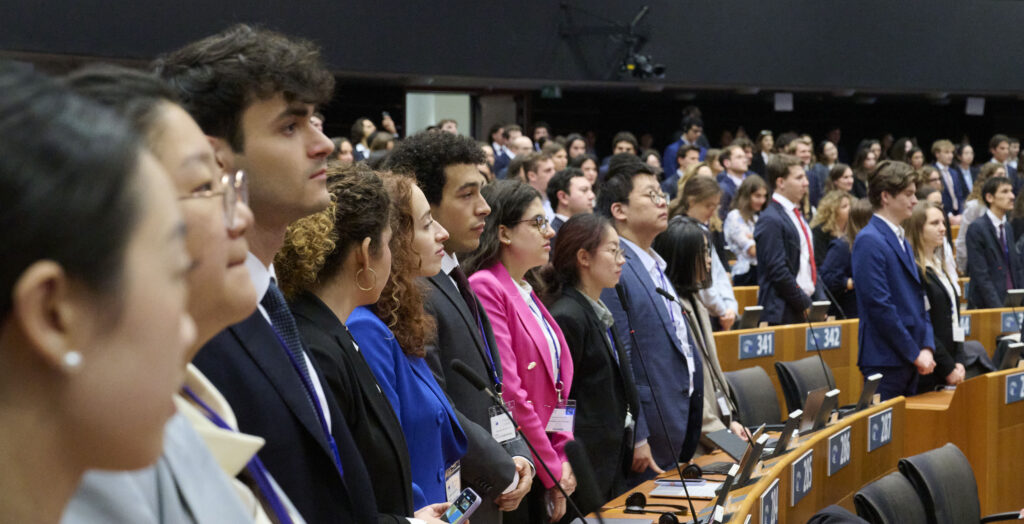
ESCP sees geopolitics as central to leadership and, through its future School of Governance (2029), prepares students for a volatile, fragmented world. Source: ESCP Business School
When the world shifts, leaders must too
Technology is only part of the picture. The other is geopolitics, and in a world of rising tensions and accelerating economic shifts, understanding it has become as essential to leadership as ever.
Professor Vanessa Strauss-Kahn, co-director of the ESCP Geopolitics Institute, has long argued that diverse, multicultural environments sharpen the kind of judgment that global leadership demands. “The creativity, multiculturalism, and motivation of the students make it an enriching experience for all,” she says.
That exposure is built into ESCP’s operations. It has six campuses across Europe, a diverse student body, and a curriculum that regularly engages with governance and global affairs. The Designing Europe initiative brings roughly 1,350 first-year Master’s in Management students into the European Parliament for a full EU vote-simulation. And by 2029, ESCP will open a School of Governance, aiming to become Europe’s answer to the Kennedy School of Government.
Students like this vision. Justine Dukmedjian, President of the ESCP International Politics Society, sees it at every event her society runs: “Across classes and programmes, dozens, if not hundreds, of students at ESCP are truly interested in geopolitics, with a striking amount of knowledge and sharp reflection,” she says.
The academic offering has grown rapidly, but for Dukmedjian, the direction must be held. “A profound understanding of geopolitics might prove strategic if not vital in an ever-changing, interconnected world – for all students, not only those originally drawn to it,” she says.
Learn more about ESCP Business School.
Follow the ESCP Business School on Facebook, LinkedIn, YouTube, Instagram, and TikTok.