
Henry Nwankwo graduated top of his medical school class in Nigeria – valedictorian with an MBBS and the first student in his university’s history to earn a distinction in internal medicine. He spent years in clinical practice managing patients with cardiometabolic conditions. And still, he felt there was more to understand about cardiovascular health than all he’s seen and done at the bedside.
So he made a deliberate decision. He signed up for the MSc Cardiovascular Health and Rehabilitation at the University of Chester – a programme built for healthcare professionals and graduates who want to specialise in cardiac rehabilitation, prevention, and heart health at both an individual and population level.
“The programme’s rigour and clinical grounding made it stand out,” Nwankwo says. “And being awarded a Commonwealth Shared Scholarship to pursue it here felt like both a privilege and a responsibility.”
Designed for healthcare professionals and graduates, this MSc programme prepares you for multidisciplinary roles in cardiac rehabilitation and prevention. Source: University of Chester
A programme built around where the field is heading
Cardiovascular disease is the leading cause of death globally, and the demand for specialists who understand treatment, rehabilitation, prevention, and population-level outcomes is growing fast. This MSc was developed in direct response to that gap.
The 12-month programme is aligned with the British Association for Cardiovascular Prevention and Rehabilitation (BACPR) standards and core components, the benchmark for cardiac rehabilitation practice in the UK and a framework recognised internationally. That alignment means when you graduate, you’re entering the field grounded in the same clinical standards employers and health systems worldwide are working to – whether you plan to work in the NHS or take your qualification back home.
The curriculum is built around the competencies the field is actively hiring for. You’ll develop deep expertise in cardiac rehabilitation and secondary prevention, sharpen your approach to exercise prescription for cardiovascular conditions, and develop a strong grounding in behaviour change and patient adherence. Each area builds toward the kind of multidisciplinary practice that defines modern cardiac care.
That multidisciplinary perspective extends to the people who teach you. The programme is delivered by specialists drawn from across cardiology, physiotherapy, nursing, exercise science, and public health – among others – ensuring the knowledge you graduate with reflects current clinical practice rather than any single specialism.
“Studying at Chester has exceeded my expectations,” Nwankwo says. “The teaching is intellectually stimulating, blending exercise science, nutrition, and research methods across disciplines. What truly made the experience exceptional was the consistently supportive and student-focused guidance from my programme leader, lecturers, and tutors.”
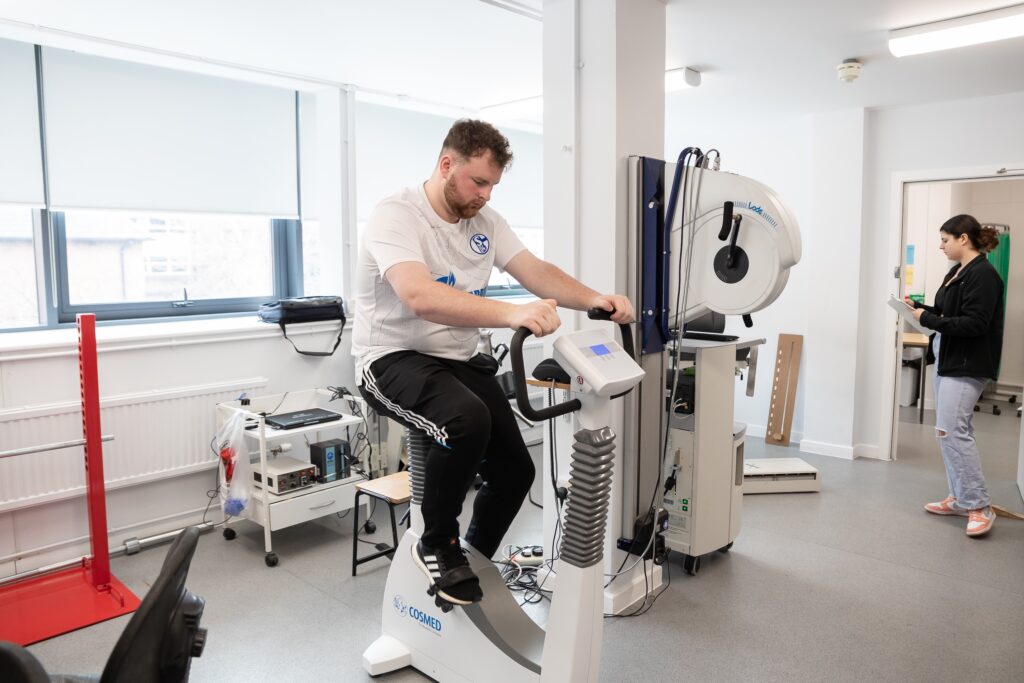
The MSc programme includes many opportunities for practical laboratory sessions. Source: University of Chester
What studying here actually looks like
Modules run in intensive three-day teaching blocks combined with supported independent study, giving you the structure of a full postgraduate degree without requiring you to step away from work. For international students, the model also allows for travel home between blocks without disrupting your progress. That flexibility is by design – and it’s part of why the cohort draws such a wide range of professionals, from early-career graduates making their first move into specialisation to practitioners like Nwankwo seeking expertise mid-career.
The MSc includes the option to complete a placement in a cardiac rehabilitation unit. This is where you can see how multidisciplinary teams actually put patients first and how the evidence you’ve studied translates into direct patient outcomes. And you’ll get to do this with a diverse cohort of doctors, nurses, physiotherapists, cardiac sonographers, perfusionists, and technicians from across the world.
“That mix of professional backgrounds and global perspectives has fundamentally shaped how I think about cardiac health and rehabilitation, revealing dimensions of the field I would never have encountered in a purely medical environment,” he says.
That depth carries through to academic work as well. Nwankwo’s dissertation – a systematic review on psychosocial outcomes of cardiac rehabilitation in working-age adults – has sharpened his appreciation for evidence-based practice.
A qualification with global reach
Studying in the UK means getting exposure to one of the world’s most established healthcare systems. The NHS sets clinical standards for cardiac rehabilitation that are referenced internationally, and the experience you gain here is directly relevant to your future career.
A UK postgraduate qualification in this field is recognised worldwide, with clear pathways to employment in hospitals, rehabilitation services, community healthcare, and public health after graduation.
Nwankwo is proof of what that combination of academic rigour, clinical grounding, and global perspective can produce. His future plans centre on a career in cardiology – bridging clinical practice with academic work around underserved populations and cardiovascular equity. His advice to any healthcare professional considering the programme at the University of Chester is straightforward. “Come, the investment is worth it,” he says.
Learn more about MSc Cardiovascular Health and Rehabilitation.
Follow University of Chester on Facebook, Instagram, LinkedIn, YouTube, and TikTok