Originally from Iran, Farzin Sadehlari came to Edmonton, the capital city of the Canadian province of Alberta, with a specific problem: how to extract the critical minerals powering the clean energy transition without costing the planet more than it saves. He found his answer at the University of Alberta‘s Department of Chemical and Materials Engineering (CME), where his PhD work focuses on Green Emulsion Liquid Membrane technology, a cleaner alternative to conventional metal extraction. He’s now designing a system that could scale the process for industrial use.
“The collaborative research environment and the opportunity to work on projects addressing sustainability and critical mineral processing challenges are what drew me here,” he says. “The advanced research facilities, interdisciplinary collaboration, and strong industry connections made CME an ideal place.”
The University of Alberta’s Chemical and Materials Engineering department is globally recognised for its strong teaching culture and competitive research. Source: University of Alberta
A research engine with global reach
CME’s graduate community of around 250 PhD, MSc, and MEng students — more than half pursuing doctoral degrees – is backed by over CA$20 million in external funding annually. This is spread across six focus areas: energy and energy transition, sustainable development, smart processing, dual-use technologies, health, and food and biological engineering. That funding enables every thesis-based graduate student to receive a research assistantship, and all 150 postdoctoral scholars and research associates are fellowship-supported.
And with that comes prolific research output. CME publishes over 500 journal articles per year – averaging 12 high-impact publications per faculty member. In citation impact, the department ranks #1 in Canada for Chemical Engineering and tied #3 for Materials Science and Engineering (Shanghai Ranking – Academic Ranking of World Universities), while its Chemical Process Control option holds #2 globally by citation impact. On reputation, QS Rankings by Subject 2026 places CME at #3-4 in Canada for Chemical Engineering.
Faculty accolades accompany these rankings. There are three Royal Society of Canada fellows, eight Canadian Academy of Engineering fellows, and 10 major Professional Society fellows. As many as 26% of faculty are women.
Research that is applied in industry
The projects underway at CME tackle real challenges facing Alberta’s industries. Carlos Henao, an oil and gas engineer from Colombia, is studying what happens inside the steam generators used in SAGD (Steam-Assisted Gravity Drainage) operations — a method used to extract oil from Alberta’s oil sands. Specifically, he’s looking at how factors like flow rate, acidity, and turbulence affect a thin protective coating called magnetite that forms inside those generators and keeps them from corroding. Better understanding that coating means oil sands operators can fine-tune their processes and generate steam more efficiently.
Hossein Mohammadghasemi, a doctoral candidate from Tehran, works where data science meets industrial process control. He focuses on the Primary Separation Vessel — a large tank in oil sands processing where bitumen gets separated from sand and water — building computer models that predict how much bitumen gets recovered and where losses happen. “My work primarily falls under smart processing and digital twin development in the energy sector,” he says.
The tools he develops are built for engineers and managers who need to make faster, better-informed decisions about live industrial systems.
What ties all three students together is how much they’ve each grown through collaboration beyond their immediate research groups. Mohammadghasemi meets monthly with industrial partners through his group, Process Data Analytics and Smart Automation. Henao served on the organising committee for the Faculty of Engineering Graduate Research Symposium, working alongside students from across the faculty. Meanwhile, Sadehlari regularly draws on conversations with researchers in hydrometallurgy and process systems engineering to sharpen the direction of his own work.

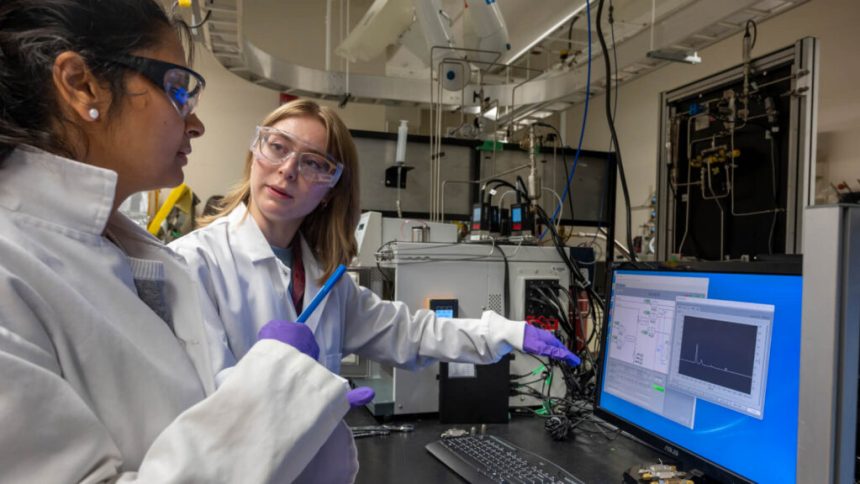
The Department of Chemical and Materials Engineering at the University of Alberta is a leader in education, research, and innovation, especially in energy and biotechnology. Source: University of Alberta
Learning by doing
CME puts hands-on learning at the centre of its graduate programmes. Courses are built around real processes — the chemical engineering of coffee, the materials engineering of chocolate — and students learn through open-ended design challenges, competitions, clubs, and industry visits. What’s more, a Smart Plant Automation facility, built on an industrial-quality distributed control system for chemical plants, is being shaped into a course, with scanning-electron microscopy (SEM) teaching lab and fermentation and biotechnology teaching lab also coming soon.
Professors make the most of these teaching facilities and other research equipment. Coming from industry, they can and have the experience to bring theory to life. Professor Vinay Prasad, for example, contributed to the design of what is now the world’s largest refinery before moving into academia. In his Coffee in Chemical Engineering lab, every stage from bean to cup connects to a core engineering concept. On day one, students are already applying material balances to a drip coffee maker.
“Students work in teams to design the best roasting, grinding, and brewing process,” Professor Prasad says. “They’re challenged to be creative and have confidence in their intuition.”
The thinking behind this is practical. “Companies used to offer a lot of specialised in-house training to new employees,” Professor Prasad says. “That’s less prevalent now, which makes hands-on learning a key competitive advantage in launching your career.”
3-1-1 partnership programmes with selected international universities empower students to amass even more experience. These links bring in global students and connect graduates to wider networks, the kind of environment that drew students like Sadehlari, Henao, and Mohammadghasemi from across multiple countries and engineering backgrounds.
Learn more abouttheDepartment of Chemical and Materials Engineering.
Follow University of Alberta on Facebook, Instagram, X, LinkedIn, TikTok, and YouTube