The appetite for board games has never been stronger. The global board games market was valued at approximately US$15.83 billion in 2025 and is projected to nearly double to $39.34 billion by 2034 — proof that humanity’s love of games is far from fading.
But gaming has been part of human civilisation for over 5,000 years, dating back to early societies. Long before Scrabble, Catan, or Monopoly crowded the shelves of toy stores, people were already gathering around boards to compete and connect. Even when original rules are lost, historians have reconstructed many of these games so they can still be played today.
The best part? Ancient games provide insights into the cultures, values, and daily lives of people from the past. They are an essential part of a culture’s heritage. Preserving and understanding these games helps to maintain cultural identity and traditions, even as societies evolve and video games take centre stage.
TL;DR? Here’s the summary:
- This article lists the 10 oldest games in the world and where each originated from.
- Board games are over 5,000 years old and predate modern games by millennia.
- Ancient games like Senet and others were used for strategy, bonding, and learning.
10 best oldest games in the world that will shock you
1. The Royal Game of Ur
The Royal Game of Ur is one of the oldest board games, originating in ancient Mesopotamia around 4,600 years ago. Indeed, boards found at the Royal Tombs of Ur in modern-day Iraq date to approximately 2600–2400 BC.
Around 177 BC, a Babylonian astronomer inscribed the instructions for the game onto a cuneiform tablet.
In this game, two participants compete to guide their pieces from one side of the board to the opposite.
Interestingly, the central squares of the board served a dual purpose, being employed not only for gameplay but also for fortune-telling.
These reconstructed rules have been utilised to develop contemporary versions of the game, some of which are available online on the British Museum’s Mesopotamia website.
To win, players raced their opponent to the opposite end of the board, moving pieces accordingly.
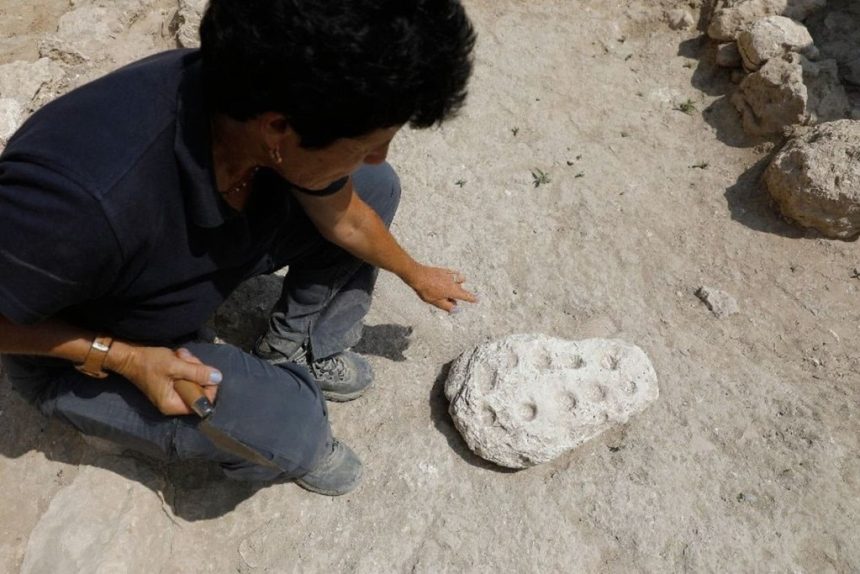
Mancala is among the oldest games in the world, with archaeological evidence reaching back perhaps as far as 6000 B.C.E. in Jordan.
2. Mancala
Mancala is an ancient pastime with a storied history across diverse cultures and regions spanning centuries. The game exhibits numerous adaptations, its origins tracing to ancient Africa and the Middle East.
In the game of Mancala, players sit across from one another, positioned along the elongated side of the board. The game typically starts by placing four stones in each pit, giving each player 24 stones in total. Players take turns distributing and capturing stones, aiming to collect more than their opponent.
The exact origins of Mancala are difficult to pinpoint due to its widespread use and the lack of written records. Different cultures have their versions of the game with varying rules and names, such as “Wari” in West Africa, “Kalah” in North America, “Bao” in East Africa, and “Congkak” in Malaysia.
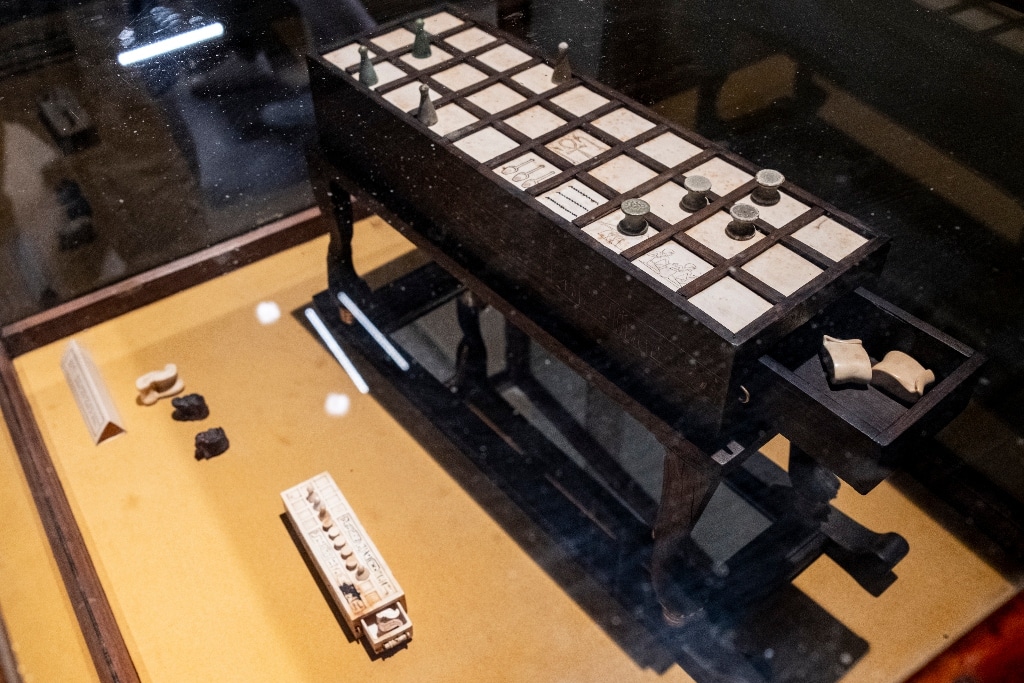
The Senet game board of Tutankhamun rests on a stand with animal-shaped legs attached to sledge runners.
3. Senet
Originating around 3100 BC, Senet is one of the earliest documented board games.
It is played on a board of 30 squares arranged in three rows of 10. In a head-to-head contest, two players move their pieces across the board, aiming to move all of them to the end. Instead of dice, players cast sticks or bones to determine how many squares they advance.
With a history stretching back over 4600 years, Senet secured its status as the premier game during Ancient Egypt. However, its significance transcended mere entertainment for the Egyptians of antiquity, representing their personal pursuit of immortality in the afterlife.
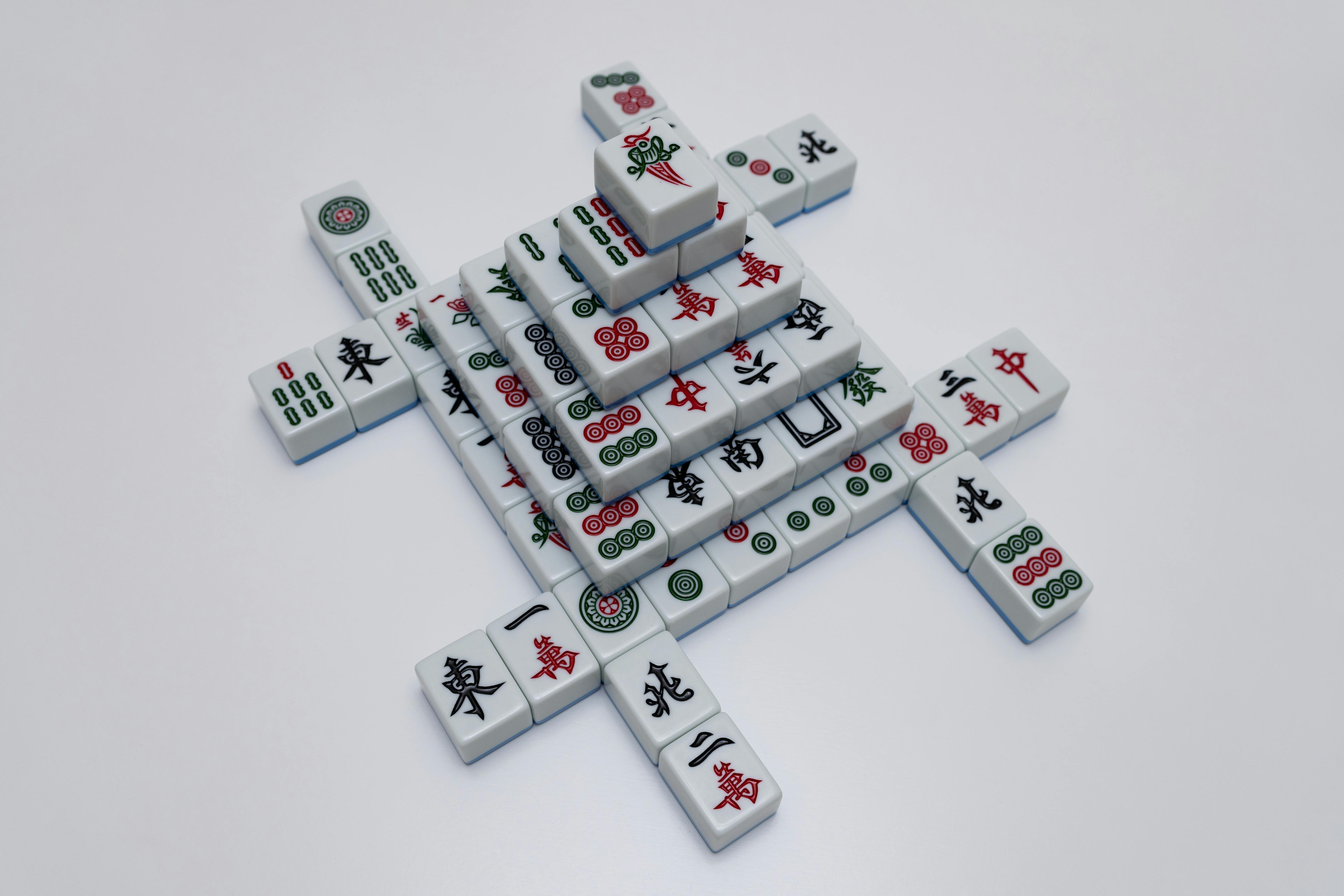
Mahjong is a tile-based game. Source: Mahmoud Yahyaoui ia Pexels
4. Mehen
Mehen is another board game from Ancient Egypt, and it is believed to be the earliest example of a multi-player board game.
Evidence of this game’s existence spans from the Predynastic Period to the end of the Old Kingdom. The discovery of Mehen was found within King Peribsen’s tomb, dating back to 2770 – 2650 BCE.
Mehen is a coiled serpent deity, safeguarding the sun god Ra during their nightly voyage through the underworld within his enormous coils.
The game pieces come in two forms: small spheres similar to marble and ivory pieces in the shapes of lions and lionesses. Mehen’s exact rules and gameplay are unknown, but historians believe that up to six people could play it.
5. Chess
Chess is one of the oldest games in the world, originating in India,initially known as “Chaturanga” during the Gupta Empire’s reign.
The earliest clear references of Chaturanga appear during the Gupta Empire in 6th century AD northern India. This version incorporated “four divisions of the military”: infantry, cavalry, elephantry, and chariotry, which evolved into the modern pawn, knight, bishop, and rook pieces.
Persians who encountered the game in ancient India named it “Shatranj.” Its popularity extended even to the British.
As with many early games, Chess rules evolved as they spread globally, culminating in the modern rules formulated in Europe around the 15th century.
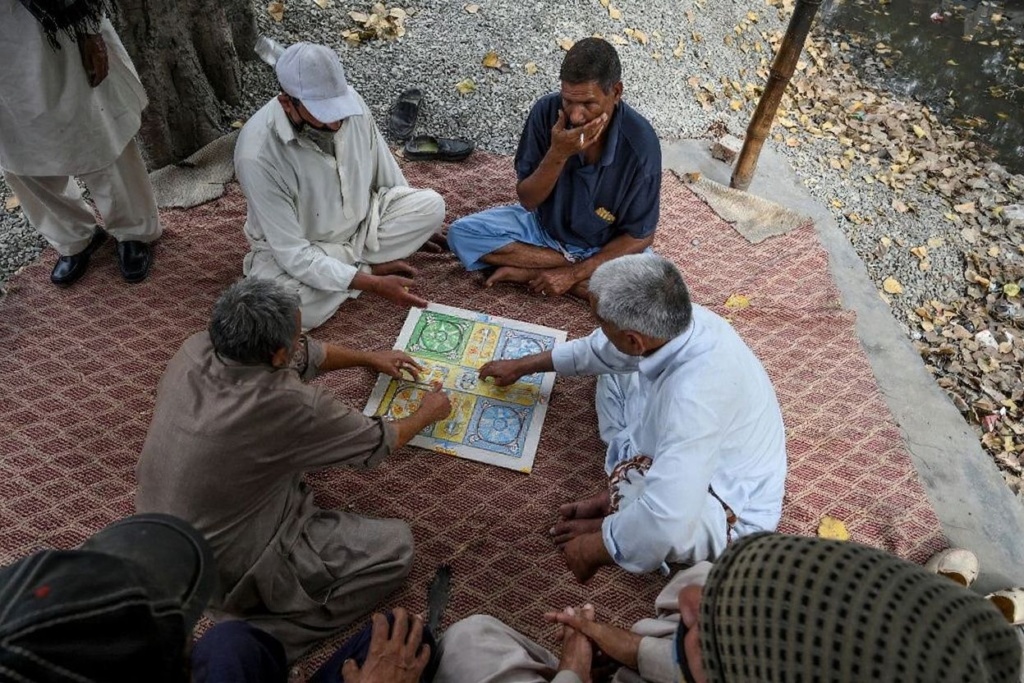
Ludo is a simplification of the Indian game Pachisi invented at the end of the nineteenth century.
6. Ludo
Ludo, another ancient game with Indian origins, was formerly known as “Pachisi.”
In India, the board was often fashioned from cloth or jute. A depiction of Pachisi appears in the Ajanta caves in Maharashtra, underscoring its popularity in the Medieval Era.
Historical records also indicate that this game was played in the caves of Ellora. The Mughal emperors, particularly Akbar, favoured Ludo.
The British then adapted the game, using cubic dice and a dice cup, and patented it as “Ludo” in 1896 in England.
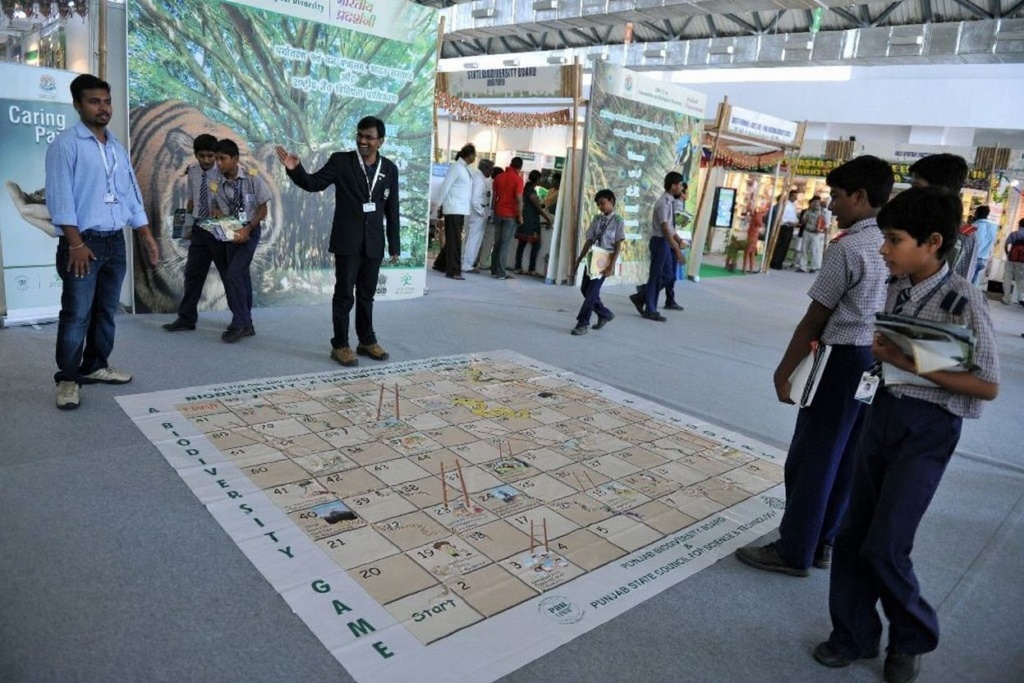
The board game, today called Snakes and Ladders, originated in ancient India, where it was known as Moksha Patamu.
7. Snakes and Ladders
Yes, Snakes and Ladders is actually one of the oldest games in the world. Well, in ancient India, the game was known as Moksha Patam, Mokshapat, and Parama Padam.
Crafted by the 13th-century saint Gyandev, this game of virtues and vices served as an educational tool within Hindu Dharma, imparting moral lessons to children.
Snakes depicted vices, while ladders symbolised virtues. While the game underwent changes over time, its essence remained unchanged: if you do good deeds, you go to heaven; if you do bad deeds, you are reborn.
Similar to Ludo, “Snakes and Ladders” gained international popularity after being introduced by the British.
8. Ludus Latrunculorum
Ludus Latrunculorum was a strategic game designed for two players to assess their military prowess. Played on grids of varying sizes, the most extensive example featured a 17-by-18 square configuration.
The earliest recorded mention of Ludus Latrunculorum dates back to the first century BC, when the Roman writer Varro described its pieces, crafted from coloured glass or precious stones.
9. Nine Men’s Morris
One of the oldest games in the world is Nine Men’s Morris, which is so old that no one knows exactly when or where it originated.
It was discovered engraved on the roofing slabs of the Kurna temple in Egypt, estimated to date to around 1400 BCE.
Comparable to contemporary checkers, Nine Men’s Morris involved players moving their squad of nine “men,” each represented by distinct pieces across a gridded playfield. The formation of a “mill,” a row of three men, permitted a player to capture an adversary’s piece.
Nine Men’s Morris has been found in countries worldwide, including Greece, Norway, Ireland, France, Germany, and England. The game was particularly popular in medieval Europe, even earning mention in Shakespeare’s play “A Midsummer Night’s Dream.”
Nine Men’s Morris is still widely played today, and its rules have not changed much since they were first recorded.
10. Go
Go is one of the oldest and most strategically complex games ever devised. It is believed to date back to at least 500 BCE, with some estimates suggesting an origin as early as 2000 BCE.
Played on a grid board (typically 19×19 lines), two players take turns placing black and white stones, aiming to surround and capture more territory than their opponent. Go’s rules are simple but that’s what makes it beautiful.
Go spread from China to Korea and Japan, where it became deeply embedded in culture over centuries. It remains one of the most widely played strategy games in the world today, with an estimated 40 to 60 million players globally.
In 2016, it became the centre of a landmark moment in artificial intelligence history when Google DeepMind’s AlphaGo defeated world champion Lee Sedol — an achievement many AI researchers had predicted was decades away.
11. Hounds and Jackals (Game of 58 Holes)
Hounds and Jackals — also known as the “Game of 58 Holes” — is one of the oldest known board games in the world.
Recent archaeological findingshave rewritten our understanding of where it came from. Traditionally believed to have originated in ancient Egypt during the second millennium BCE, a 2024 study published in the European Journal of Archaeology revealed that boards of the game found carved into rocks on Azerbaijan’s Absheron Peninsula date to the late third to early second millennium BCE.
This suggests the game may have been older, and originated in the South Caucasus or broader southwestern Asia rather than Egypt.
The game takes its colourful name from playing pieces that sometimes featured carved animal heads — jackals on one side, hounds on the other. It was played for centuries, from the middle of the Bronze Age through the Iron Age, and evidence of it has been found across a broad region stretching from India through Mesopotamia to the Eastern Mediterranean.
12. Mahjong
Mahjong’s presence on this list is a little debated.
Scholarly consensus firmly places its origins in mid-19th century China — approximately the 1850s — during the final decades of the Qing Dynasty, developed in the coastal regions around Ningbo, Shanghai, and Nanjing.
However, there are popular myths attributing it to Confucius or to ancient Chinese dynasties is a marketing creation that took hold when the game was introduced to Western audiences in the 1920s. It is not thousands of years old.
Mahjong is a tile-based game that involves strategy, skill, and a little bit of luck. Mahjong is similar to the popular card game rummy. It is typically played by four players, though variations exist for different numbers of players.
The game involves:
- Drawing and discarding tiles.
- Forming specific combinations or patterns.
- Trying to complete a winning hand.
The game aims to get all 14 of your tiles into four sets and one pair.
At a glance: The 10 oldest games in the world and their origin
| Game | Origin |
| Royal Game of Ur | Mesopotamia |
| Mancala | Africa & Middle East |
| Senet | Ancient Egypt |
| Mahjong | China |
| Mehen | Ancient Egypt |
| Chess | India |
| Ludo | India |
| Snakes & Ladders | India |
| Ludus Latrunculorum | Roman Empire |
| Nine Men’s Morris | Unknown |
| Go | Ancient China |
| Hounds and Jackals | Possibly southwestern Asia |
Frequently asked questions about the oldest games in the world
What is the single oldest confirmed board game in the world?
Amongst the oldest games in the world, the Royal Game of Ur is estimated to be the oldest, with boards recovered from the Royal Tombs of Ur in modern-day Iraq dated to approximately 2600–2400 BC.
It is also notable for being the oldest playable game — thanks to Irving Finkel of the British Museum deciphering the rules from an ancient cuneiform tablet, it can still be played exactly as it was thousands of years ago.
Why do so many oldest games in the world come from India?
India has an extraordinarily rich tradition of game design that fed into some of the world’s most enduring games — Chess (Chaturanga), Ludo (Pachisi), and Snakes and Ladders (Moksha Patam) all trace their roots there.
Scholars believe this is partly due to India’s tradition of using games as tools for teaching philosophy, military strategy, and moral lessons, embedding them deeply into cultural and religious practice. The subcontinent’s position as a hub of trade also helped spread these games rapidly across Asia, Persia, and Europe.
Are any of the oldest games in the world playable online today?
Yes — several are. The Royal Game of Ur can be played at the British Museum’s online resource. Chess is globally available across platforms including Chess.com.
Go has thriving digital communities and apps worldwide. Mancala has dozens of digital versions. Even Senet has been reconstructed for online play based on archaeological evidence. These ancient games have proven surprisingly adaptable to the digital age.
Disclaimer: This article was last updated on June 26, 2026.