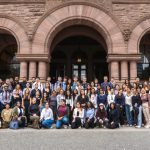
A 22-day protest by international graduates challenging post-study work permit refusals has ended in Calgary after immigration officers identified 12 attendees as “possibly inadmissible” to Canada.
The northeast Calgary demonstration was attended largely by Indian graduates of Portage College-linked programs who say they paid substantial fees believing their courses qualified them for a Post-Graduation Work Permit (PGWP), which allows eligible graduates to work in Canada after their studies.
Calgary Police Service attended the site on August 12 following complaints that parts of the pavement were being blocked and pedestrians impeded.
Officers requested identification from people who had erected tents and other structures on city property, then contacted the Canada Border Services Agency (CBSA) after concerns arose over the documents provided. Police said no criminal offences had occurred.
CBSA was initially asked to verify four people but expanded its checks to 20 attendees after finding two were not compliant with their immigration status. It identified 12 as “possibly inadmissible” under Canada’s Immigration and Refugee Protection Act and asked them to attend follow-up interviews.
The agency has not disclosed whether the 12 attended the interviews or whether any enforcement orders have since been issued, but said those subject to immigration enforcement action have access to due process.
Calgary immigration lawyer Jatin Shory, who is representing around a dozen students challenging their PGWP refusals in federal court, told CBC that people found to be without status could be issued exclusion orders and required to leave Canada. An exclusion order generally prevents an individual from returning to the country for one year.
The Portage College student union estimates that around 1,500 graduates have been affected by refusals involving programs delivered through partnerships between the Alberta public college and private providers, including the Canadian Institute of Osteopathic Therapy in Calgary and Campbell College in Edmonton.
In 2024, Immigration, Refugees and Citizenship Canada (IRCC) restricted PGWP eligibility for students in programs delivered through public-private partnerships, bringing the original September 1 cutoff forward to May 15.
Students who began such programs before May 15, 2024 could remain eligible, provided they met all other PGWP requirements. Many of the affected graduates enrolled before the cutoff and therefore expected to qualify, but IRCC refused their applications on the separate basis that their programs were non-credit.
On June 24, 2026, IRCC updated its online guidance to state explicitly that non-credit programmes were ineligible, apart from certain flight-school courses. The department maintains that the update clarified an existing requirement rather than introducing a new rule.
“It has always been the case that non-credit [programs] are not entitled to these PGWP[s], so we’ve not changed any eligibility for that,” immigration minister Lena Diab said at a July 28 press conference.
Students and their representatives dispute that account, arguing that previous guidance did not clearly exclude non-credit programmes. Some had already enrolled, paid their fees and applied for work permits before the June update appeared.
According to media reports, affected students paid between CAD$15,000 and CAD$25,000 for their education, with some relying on family savings, loans or money raised through property sales.
Students also say they received written assurances from Portage College that those enrolled before May 15, 2024 would be eligible to apply. They point to graduates from the same programs whose PGWPs had previously been approved.
Portage College has said its understanding was that students enrolled in its non-credit public-private partnership programs before the cutoff could apply for PGWPs, based on the information available at the time and the way applications had historically been processed by IRCC.
The college said it was seeking clarification from the federal department, while emphasising that it does not control immigration decisions. It encouraged affected graduates to consult licensed immigration lawyers or regulated advisers.
IRCC has urged prospective students to verify that both their institution and chosen program are PGWP-eligible, stressing that graduating from a designated learning institution does not automatically qualify them for the permit.
Where there is room for international students, the terms are simple. Earn your education, then return home to build a life with it
Danielle Smith, Alberta premier
The Calgary demonstration included a hunger strike, while related protests were also held in Edmonton. By August 13, the Calgary site had been cleared.
The action follows repeated protests by international graduates as Canada has tightened its immigration system through study permit caps and changes to post-study work and permanent residence pathways.
In 2024, Indian graduates demonstrated after the government ended a temporary policy allowing certain PGWP holders to extend their permits by up to 18 months. The current dispute concerns graduates whose initial PGWP applications were refused, rather than people seeking extensions to existing permits.
Alberta premier Danielle Smith said international students whose visas had expired and who had not secured permanent residence should leave the country.
“A student visa is a temporary document to study in Canada. That was always understood,” Smith said in a post on X. “Where there is room for international students, the terms are simple. Earn your education, then return home to build a life with it.”