The US outbound market is correcting, not collapsing
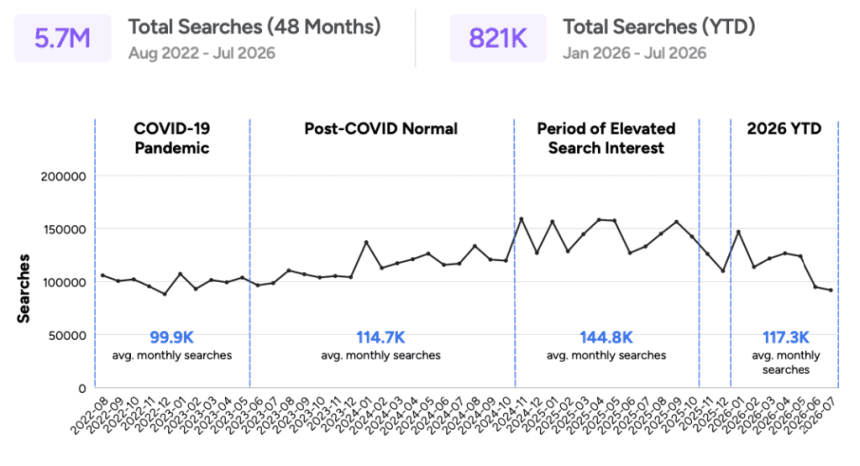
Search interest in overseas study peaked in November 2024 – coinciding with Donald Trump’s re-election – and remained elevated for around a year. In 2026, it has eased back — but not to pre-2024 levels.
Average monthly searches across 17 destinations were 144.8K during the period of elevated interest, compared with 117,300 in 2026 year-to-date. The post-Covid normal was 114,700.
“The US is a large and shifting source market, and 2026 is a year of correction rather than crisis,” according to Voyage.

If 2026 stabilises around current levels, the US could be establishing a new, higher normal for outbound study interest rather than simply reverting to the pre-2024 pattern.
Japan has overtaken the UK, while South Korea has overtaken Germany
Between January and July 2026, Japan became the second most searched study destination among US students, overtaking the UK. South Korea also surpassed Germany, moving into fourth place.
Neither destination achieved this through outright growth. Search volumes across the top ten destinations were down year on year.

Japan was down 11.2%, compared with a 29.9% decline for the UK. South Korea was down 13.8%, compared with 21.7% for Germany.
“Canada remains dominant and resilient, while the Anglophone incumbents built on the highest volumes are declining fastest… the destinations gaining relative share are East Asian, and Japan’s rise is the clearest competitive signal,” according to the report.
The reasons students are looking abroad are more diverse and increasingly unrelated to rankings
The social data identifies six distinct prospective-student profiles in the US market: the Career Migrant, Escape-Driven Relocator, Prestige Strategist, Funding Chaser, Experience Seeker and Heritage Reconnector. They are not mutually exclusive, but represent different centres of gravity in student motivation and rankings are only central to one of them.

The Prestige Strategist is explicitly focused on credential value, rankings and whether a foreign qualification will be recognised by US employers. But the other profiles are motivated by very different considerations: migration, affordability and funding, safety and quality of life, social experience, or cultural and family connections.
That broader picture is also visible in the themes dominating student conversations. US prospective students over-index on Government & Policy, Student Logistics, Quality of Life and Community, while Education Outcomes and Services & Support sit below the global prospective-student benchmark.
Different students are looking abroad for fundamentally different reasons and the fastest-growing motivations in the market are not necessarily about university rankings or academic prestige.