
If you’re considering studying engineering in the US, you need to know three key things before applying: what you can study, what skills you’ll develop, and how they translate into career readiness.
In this article, students of Clarkson University’s Wallace H. Coulter School of Engineering and Applied Sciences answer these three big questions – and many more – with first-hand experience.
Engineering Management undergraduate Richard Zhang is developing an app. MS in Electrical & Computer Engineering (ECE) student Art Nguyen has hands-on experience in FPGA research, while PhD in Environmental Science and Engineering candidate Victor Manuel Melgarejo Cazares researches ball milling — a grinding technique that breaks down per- and polyfluoroalkyl substances (PFAS), the “forever chemicals” that build up in contaminated soil.
Below, they break down what the coursework actually demands, how hands-on research works in practice, and how to prepare for both top career prospects and graduate study.
Richard Zhang says Clarkson University stands out for its direct access to professors and a close-knit community. Source: Clarkson University
Richard Zhang, International Student from Scottland: Engineering & Management
Is an Engineering Management degree a good choice?
Yes, it is a great choice for any student. Engineering Management combines technical knowledge with business and entrepreneurial thinking, giving students a broader perspective when solving problems. This versatility can help them stand out to employers, especially as AI and advanced computing continue to reshape industries.
What do they teach in Engineering Management and what are the career prospects like for graduates?
You can expect courses in science and mathematics on the engineering side, alongside project management, operations, and entrepreneurship on the business side. In your junior and senior years, you can choose more specialised courses based on your interests.
Career prospects span a wide spectrum. Graduates have pursued engineering-focused roles, such as project management at General Dynamics, a global aerospace and defence company, as well as moved into business roles in areas like startups and sales.
This is certainly a wide spectrum with everything in between, so I think this degree is extremely versatile. In the duration of the degree at Clarkson, you will get to know what you enjoy more and tailor the degree to your interests or career goals.
What exactly do Engineering Management majors do?
Engineering management majors connect a company’s broader vision and business goals with the teams responsible for delivering them. Tim Cook is a strong example. By aligning Steve Jobs’s vision with efficient supply chains and business operations, he helped turn Apple’s ideas into reality and drive its growth.
Personally, I believe engineering management graduates can do almost anything. Their ability to understand both technical knowledge and human ideas allows them to bridge different teams, think creatively, and identify new possibilities.

Art Nguyen believes a Master’s in Electrical & Computer Engineering is worth pursuing. Source: Clarkson University
Art Nguyen, International Student from Vietnam: MS in Electrical & Computer Engineering
Should I study a Master’s in Electrical Engineering (hardware focus) so I have a better chance of getting a job and living in the US?
Yes. A Master’s in ECE can significantly improve your chances of finding a job and building a career in the US. While software-focused EE and CS are highly competitive, hardware-focused fields such as chip design, radio frequency (RF) engineering, power electronics, embedded systems, and semiconductor packaging have more specialised barriers to entry. A master’s also gives you hands-on experience with industry tools such as Cadence, a chip design software, and Vivado, an FPGA design software from AMD, which can help demonstrate your technical skills to employers.
How much harder is an Electrical Engineering graduate degree compared to an undergraduate degree?
A master’s is neither harder nor easier than an undergraduate degree. While the classes are objectively more challenging than undergraduate classes as they are more in-depth and specialised, you already have the knowledge and skills accumulated during your undergraduate studies to handle them comfortably.
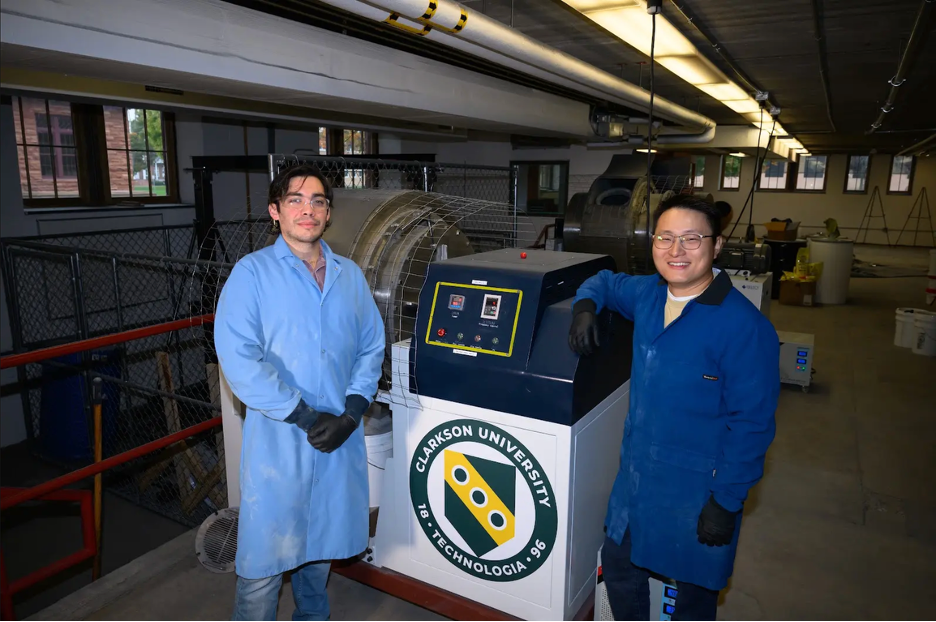
Victor Manuel Melgarejo Cazares has worked on projects such as electrochemical treatment of harmful algal blooms in lake water and analysis of energy use in campus buildings. Source: Clarkson University
Victor Manuel Melgarejo Cazares, International Student from Mexico: PhD in Environmental Science and Engineering
Is a Master’s in Environmental Engineering worth it?
Yes, absolutely. One of the biggest advantages of Environmental Engineering is that most projects in the field are multidisciplinary and interdisciplinary. It involves a much broader range of work, from social studies and economics to laboratory research, engineering implementation, deployment, and execution. Getting this master’s can open doors to specialised fields while broadening your perspective within your own field. I speak as someone who entered graduate school with a BS in Mechanical and Electrical Engineering.
Is Environmental Engineering a good degree choice for the next five years?
Absolutely yes. Environmental Engineering offers long-term career opportunities because climate challenges require continuous innovation, implementation, and monitoring. From energy systems and carbon sequestration to recycling and environmental remediation, the field covers a wide range of needs. As countries pursue sustainable development, there will be continued demand for professionals who can develop and improve these solutions for years to come.
Does AI play a significant role in Environmental Engineering? Could AI lead to mass layoffs in the future?
No, but also yes. AI will definitely impact environmental engineering, but I don’t believe it will replace our expertise or lead to major layoffs. AI can process and analyse huge amounts of information, making it useful for assessing environmental policies, technologies, and potential solutions.
However, environmental engineers still need to interpret these assessments and make decisions. Creativity and ingenuity are also difficult to replace, particularly in research and identifying unexpected problems. Even with automation, implementation and fieldwork still require human expertise. Ultimately, AI should be viewed as a tool, not a substitute.
Follow Clarkson University on Facebook, X, Instagram, and YouTube