At a college fair in Mexico, a mother walked right past Liz Nino’s booth.
Nino, Executive Director of International Enrolment at Augustana College, asked why she wasn’t stopping. The mother apologised. Her family simply wasn’t considering US colleges. She assumed they couldn’t afford them.
Instead, her family was considering a private university in Mexico charging approximately US$16,000 a year in tuition, before room and meals. They started doing the math, eventually realising that once additional costs were included, the family’s expected investment was comparable to what they would pay at Augustana after financial aid.
“She had nearly ruled out the US option without ever stopping to ask what it would actually cost her family,” Nino says.
It is an easy calculation to make too early. The published cost of a four-year private college in the US can look prohibitive from thousands of kilometres away. What that number often doesn’t show is the institutional aid an international student may qualify for. And at Augustana, that can change the math considerably.
Do international students get financial aid at US colleges?
Some US colleges offer financial aid to international students, and Augustana offers two that can be combined: merit scholarships and need-based international financial aid.
For students entering Augustana in 2027–28, merit scholarships range from US$29,000 to US$33,000 per year. There are three tiers — Presidential, Dean’s, and Founders — with the amount varying according to the strength of a student’s academic profile.
The merit scholarship recognises what a student has achieved academically. Need-based financial aid for international students considers the family’s financial resources and can provide additional support on top of merit awards.
“We are need-aware, meaning we look at a student’s ability to meet the remaining cost as part of the admission process,” says Nino. “Our goal is to be very transparent with families about what we can offer and what we realistically expect the family to contribute.”
There are limits, and Augustana is transparent about them. Its scholarships are not intended to cover the full cost of attendance, and not every student receives the highest merit award. Eligible merit awards can continue across four years, subject to the renewal requirements of each scholarship tier.
International students can apply for merit scholarships and need-based international financial aid. Source: Augustana College
Can international students work to help pay for college in the US?
They can, within restrictions. What families should not do is build a four-year funding plan around it. Nino has heard versions of this plan from international families: “We can pay the first year, and then they can work to pay for the rest.”
F-1 students are generally limited to working up to 20 hours per week while school is in session, and Nino says on-campus employment is typically better suited to personal expenses than tuition, room, and board.
Should the published price stop you from considering a US private college?
“The published price is not necessarily the price a family will pay,” Nino says. “A family that never asks about financial aid may never discover that the opportunity is within reach.”
Jalane Tsague, from Douala, Cameroon, almost discovered that too late.
“I was extremely scared that I would not be able to afford a four-year private college such as Augustana,” she says. Still, she applied.
“Turns out the scholarship package I was offered was better than a lot of other schools I got into.”
At Augustana, Tsague studied business administration with a minor in accounting. She worked as a business and accounting tutor and completed internships spanning tax, marketing and development, and data entry. She credits resources like CORE (the college’s Careers, Opportunities, Research, Exploration team), counselling, and tutoring with helping her manage academic stress, develop skills for future roles, and secure her internship.
Tsague did not have to sacrifice such opportunities because she could not afford business-casual attire, petrol, rent, and lunches. She used her Augie Choice grant — up to US$2,000 available to Augustana students for a qualifying experiential learning opportunity — to help cover them. “It lifted a huge weight off my shoulders,” she says.

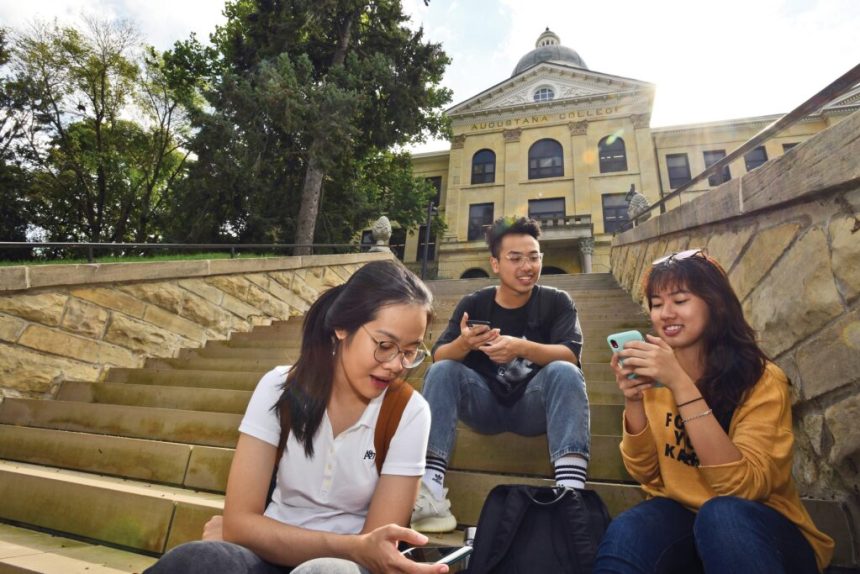
Augustana College has several teams dedicated to supporting and empowering international students. Source: Augustana College
What is student life really like for international students at Augustana College?
International students already make up a substantial part of life on Augustana’s campus along the Mississippi River in Rock Island, Illinois. Nino says approximately 500 attend the college, representing nearly 21% of the student body.
“Families can feel confident that they are not sending their student to a campus where they will be the only international student,” she says. “They are joining a diverse community where international students are an important part of the campus experience.”
And that experience can stretch well beyond Rock Island. Fernanda Rubi, a 2024 graduate from Managua, Nicaragua, spent two weeks conducting research in Sweden during her sophomore year. A Wallenberg Faculty Grant for Scandinavian Studies covered the expenses.
“I never imagined I would have the chance to conduct research in Europe without worrying about the financial burden,” she says.
More opportunities followed. Rubi later spent a summer interning in Washington, DC, with a full scholarship covering her housing. She also studied abroad in Brazil with support from Augie Choice.
“Our students have used the grant in very different ways,” shares Nino. “One student spent a year in China, another used the grant to support AI research. We want students to have the opportunity to do something beyond the expected path, whether that means research, an internship, international travel, or another experience that helps them discover what they are capable of.”
Is a private US college worth the investment?
Among Augustana’s 2025 graduates, 88% were employed, continuing their education, in a service position, or pursuing other opportunities within six months of graduation. Of those who applied to graduate or professional school, 93% were accepted into their first or second choice.
Georgetown University’s Centre on Education and the Workforce offers a longer view: it places Augustana in the top decile of US institutions for 20-, 30- and 40-year return on investment, with a 40-year net present value of US$2.175 million.
Nino loves watching what happens next. “One of the great benefits of being a small college is that I get to know our students personally,” she says. “I see them regularly, watch them grow throughout their four years, and often stay connected with them after graduation.”
She has seen international graduates go on to careers in the US at Deloitte, Amazon, and John Deere, while others have pursued master’s degrees and PhDs.

From Rock Island, Illinois to the top organisations in the US, the likes of Amazon, Deloitte, EY, and Walt Disney Company. Source: Augustana College
Luis Navarrete had not pictured any of that when he began looking at universities. “As an international student, the US wasn’t really in the picture when choosing higher education,” says the 2024 graduate from San Salvador, El Salvador. “That changed when I met Liz Nino through a college advisor.”
At Augustana, he studied communication studies and French, interned at the college’s EDGE Centre and State Farm, and used Augie Choice to spend six weeks studying French in Dijon, France.
During international student orientation, Navarrete had written a letter to his future self about what he hoped those four years might become. “I think I’ve gone beyond the expectations I initially wrote down,” says Navarrete, who is currently working at Adventum Funds & Advisory, LLC in Austin, Texas.
These are the kinds of outcomes a price listed on a university website cannot calculate — the distance between the future a student imagines at the beginning and the one they eventually build. Start by finding out what Augustana could make possible.
Follow Augustana College on Facebook, Instagram, LinkedIn, X, and YouTube