Why international students choose Malaysia, and why they stay
Picture this. A student landing at an airport for the first time in a country they have never visited. The flight was long. The terminal is loud and unfamiliar. Somewhere in their bag is a folder of documents they have checked forty times since leaving home.
This moment, the gap between the arrival gate and the immigration counter, is one of the most quietly vulnerable experiences an international student will ever have. Most destinations leave them to navigate it alone.
In Malaysia, there is a friendly face waiting. Students arriving in Malaysia are greeted by dedicated support personnel who guide them through immigration and make sure their very first experience of a new country is not confusion or anxiety, but welcome. It is a small thing. It is also exactly the right thing. And more often than not, it is the moment that makes them stay.
A world first: putting the student experience first
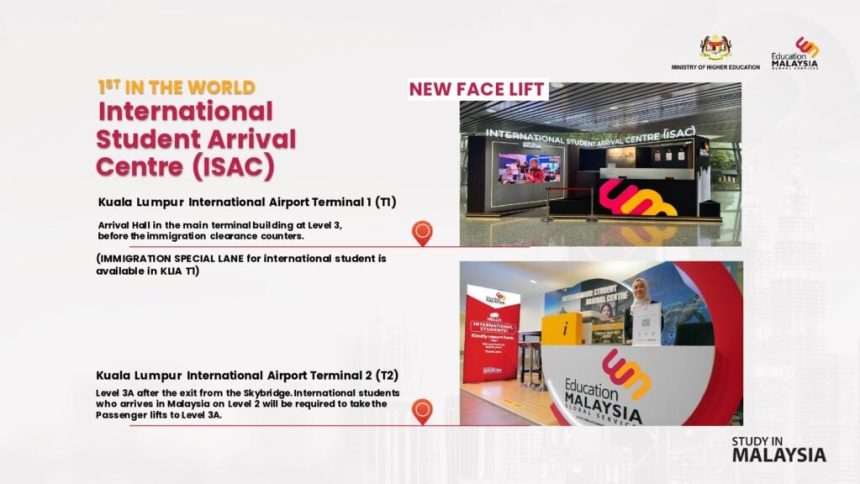
That welcome is made possible by the International Student Arrival Centre (ISAC), the first of its kind in the world, established by EMGS at Kuala Lumpur International Airport at Terminals 1 and 2. Through four dedicated lanes, students receive assistance with immigration clearance, airport reception, and arrival support. They are also welcomed with goodie bags that include a free SIM card and the complimentary experience of tasting the famous Malaysian ‘Teh Tarik’ and coffee.

Above all, it points to a question we do not ask often enough in international education: what do students actually take home?
Beyond the internationally recognised degree, what they carry with them is the confidence built from navigating the world on their own terms. The friendships formed across cultures they had never encountered before. The quiet realisation that the world is more connected, and more welcoming, than it once seemed. That is the real return on studying abroad. And it is the part that serves not just the student, but the country they go back to build.
An environment that feels like a second home
There is something about Malaysia that reduces the friction of being somewhere new. A student from West Africa finds halal food without having to search for it. A student from South Asia hears familiar languages in the street. A student from the Middle East studies in English without feeling culturally displaced in every other aspect of daily life.
These are not small things. They are the diSerence between a student who merely survives their time abroad and one who genuinely thrives during it.
When students thrive, they learn more and engage more deeply. They build networks that last decades. And when they go home, this is the part that matters most, they return as advocates. For the education they received. For the idea that the world is worth engaging with. And increasingly, for Malaysia.
Malaysia among the world’s top 14 study destinations
Malaysia’s place among the world’s top 14 study destinations did not happen overnight. It reflects years of sustained commitment to quality, student welfare, and the kind of experience that brings people back, or keeps them here longer than they planned.
Malaysia’s place among the world’s top 14 study destinations did not happen overnight. It reflects years of sustained commitment to quality, student welfare, and the kind of experience that brings people back, or keeps them here longer than they planned
These are destinations that have spent generations building their reputations. That Malaysia belongs in that group is worth noting, not as a boast, but as a measure of how far the country has come.
The ranking matters less than what it represents.
Transnational education and the future of student mobility
Student mobility is growing more complex. Learners today build qualifications across institutions and borders simultaneously, and the destinations that offer genuine flexibility will become increasingly attractive.
Malaysia’s transnational education (TNE) partnerships give students pathways that many destinations simply cannot match, qualifications recognised globally, academic journeys that cross borders without losing coherence or credential value.
Malaysia is also opening its doors through its Edutourism program, a growing category that blends learning and travel in equal measure. More than 80 Malaysian higher education institutions offer Edutourism programs across 11 package categories. With programs ranging from one week up to six months, the experience is designed for professionals, students, retirees, and lifelong learners alike.
Imagine enrolling in a Leadership and Management program, then stepping outside the classroom to learn the art of Batik Canting, craft a traditional Wau kite, or master the flavours of authentic Malaysian cuisine. Malaysia offers so much more outside of the classroom.
What students carry home
Through the Ministry of Higher Education Malaysia, the government reaffirms its commitment to internationalisation, as strongly emphasised in the Malaysian National Higher Education Plan (2026-2035).
Students will go back to tell stories of the stranger who helped them at the airport. The classmate who became a lifelong friend. The ordinary day when a foreign country finally started to feel like home. Students who leave well-served become Malaysia’s most powerful ambassadors, shaped by the exceptional, first-hand experiences Malaysia has to offer.
As the company under Malaysia’s Ministry of Higher Education dedicated to international student services, EMGS stands behind the brand ‘Study in Malaysia’, and that commitment is reflected in everything we do, and in our tagline: EMGS At Your Service.

About the author: Novie Tajuddin is the chief executive officer of Education Malaysia Global Services (EMGS), under Malaysia’s Ministry of Higher Education. With deep experience in education internationalisation development, he has been instrumental in positioning Malaysia as a preferred global education hub, engaging international stakeholders across APAIE, ICEF, EURIE, The PIE and beyond, and forging partnerships with foreign governments to expand scholarship and co-funding opportunities for students worldwide.