Born and raised in New York City, Jonathan How was initially a Greek and Roman Studies graduate from Vassar College who went on to work in the non-profit sector. He’s always loved the idea of being creative while solving some of the most consequential social and environmental problems today. Seeking to take that further, he signed up for the Postgraduate Diploma in Landscape Architecture (PDLA) at the University of Hong Kong (recently ranked #1 university in Asia). Later, he would go on to earn a Master of Landscape Architecture (MLA), a journey that included a lot of studio work often based on a site in Hong Kong.
“Being able to live, study, and work in the same location was helpful, because I could investigate the issues or problems for myself, while also doing desk research,” he says. “A lot of the problems we were working on were always relevant too – flooding, urban heat, forest fires, urbanisation. It’s all happening and in front of everyone’s eyes, so I liked learning in a dense but dynamic place like Hong Kong.”
The MLA stands out as the only programme in the region with professional accreditation from the Hong Kong Institute of Landscape Architects (HKILA) and more than 30 years of experience teaching the subject. That’s a key feature of the programme, alongside its highly advantageous location.
Studying in Hong Kong means having the Greater Bay Area (Pearl River Delta) and Southeast Asia as living laboratories practically in your backyard. These are areas with high-density cities and biodiverse natural regions, ideal for anyone seeking to understand our environmental futures in the face of the pressures of rapid urbanisation and climate change.
In one of his studio projects, Jonathan even kayaked and scuba dived around Hong Kong’s many small islands. He took photos and surveyed plants, species, and geology in the UNESCO global geopark to inform his mapping of the site and his intervention to propose a project that could conserve and promote the area for ecotourism.
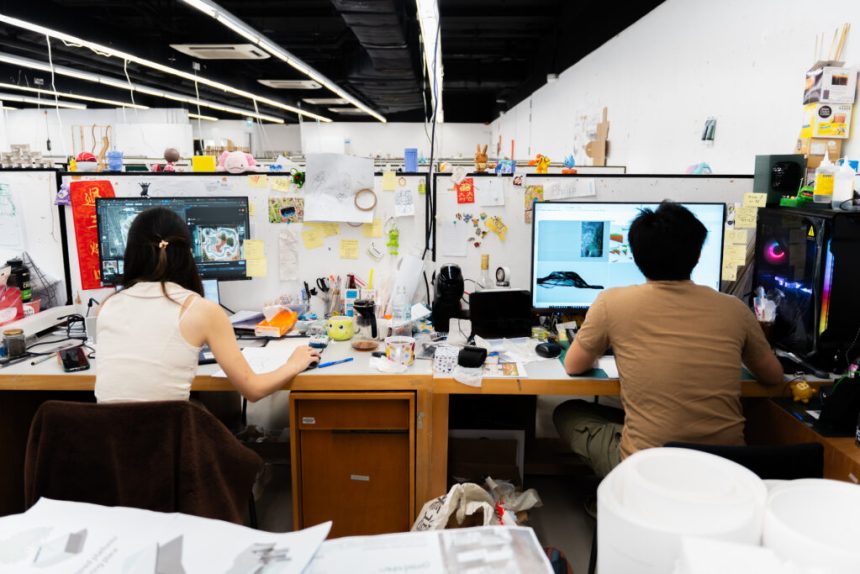
In project-based design studios, MLA students learn advanced visual communication and digital technology skills. Source: The University of Hong Kong
It was experimental and speculative, cementing itself as one of Jonathan’s favourite experiences at HKU. But he insists there was just as much to learn from regular studio sessions. Classmates shared many insights, as did professors who come from various backgrounds and are closely linked to Chinese, North American, and European landscape architecture networks. “It just makes for a more interesting and different learning environment,” Jonathan says.
Looking back, Jonathan believes completing both the PDLA and MLA “definitely gave him all of the technical, theoretical, and practical knowledge” to do what he does now: researching local landscape materials in Hong Kong and applying mixed-reality technologies to landscape design projects.
The curriculum ensures MLA students have the knowledge, skills, and experience to do something with this understanding. Modules cover the history of landscape architecture, its contemporary theories, biophysical systems, landscape materials and their technologies, as well as landscape design. It provides a strong foundation in ecological systems and construction techniques while instilling an adaptive, resilient mindset in its students.

MLA students work at a high level of academic writing and research. Through this process, they learn to think in ways that go beyond black-and-white thinking. Source: The University of Hong Kong
With the Faculty of Architecture’s new leadership under renowned Chinese architect Professor Yung Ho Chang, and Professor Ivan Valin serving as the Head of the Division of Landscape Architecture, the PDLA and MLA programmes now have a greater emphasis on its research-based design approach, with leading figures in this field to ensure an enriching learning environment.
For instance, Susanne Trumpf, who teaches across undergraduate and graduate programmes, co-directs the Taxon|Archive|Lab (TAL-L), a database and teaching tool for landscape materials. She leads the research on the use of urban soils as landscape material and the application of immersive technologies (AR/VR). Likewise, with an ecologically-focused approach and wide experience in ecological enhancement, Mathew Pryor brings to his classrooms decades of experience in leading numerous landscape restoration and ecological enhancement projects.
The curriculum also integrates crucial emerging topics regarding climate change with some of the world’s leading scholars in the areas of applied climatology and climate design (Prof. Chao Ren), urban public health and well-being (Prof. Bin Jiang), and geospatial analytics (Prof. Binley Chen).

Innovation and design quality are central to the MLA. Students engage with environmental and contextual challenges through research projects, field trips, overseas study tours, joint studios, and building exercises. Source: The University of Hong Kong
MLA graduate Howe Chan benefitted from this holistic approach. “It is difficult to emphasise just one of these areas, as incorporating them all as a comprehensive methodology is what trained me in complex, multi-layered decision-making,” he says. And by incorporating site research, fieldwork, and community engagement, learning became even more nuanced. Chan called his fieldwork experience “powerful.” During a visit to Dala, Myanmar, he gained a completely different sensory and cultural understanding despite having completed extensive desktop analysis, from data sets and satellite images to Google Street View and our elaborate design visions.
“This experience cemented the idea that a combination of intuitive feeling and meticulous on-site observation is irreplaceable in landscape architecture, a depth no desk research can fully provide,” he says.
Howe is now a landscape designer at Benoy, a global studio for architecture, urbanism, commercial strategy, landscape, and design. He credits his time at HKU for making him a professional who can use evidence-based or research-informed design to “serve the facts to fulfil the needs.”
“At HKU, I learned to replace guesswork with data — whether from site surveys, user studies, or environmental analysis,” he says. “This ensures that every design decision is anchored in the factual reality of the place and its people, ultimately delivering solutions that are not just conceptual but are resilient, functional, and truly meet the defined needs in reality.”
Follow the University of Hong Kong on Facebook.