LanguageCert leaders told The PIE News that universities across major study destinations are under pressure to demonstrate that international students possess the language skills needed to succeed academically and that their assessment partners can reliably demonstrate they are confident about defying fraudsters.
Edgar Wingfield, deputy software developer, shared a range of fraud tactics that the company had managed to identify and combat in its systems, such as using RFID chips to compare passport scans presented with the real image embedded to the passport of each test taker.
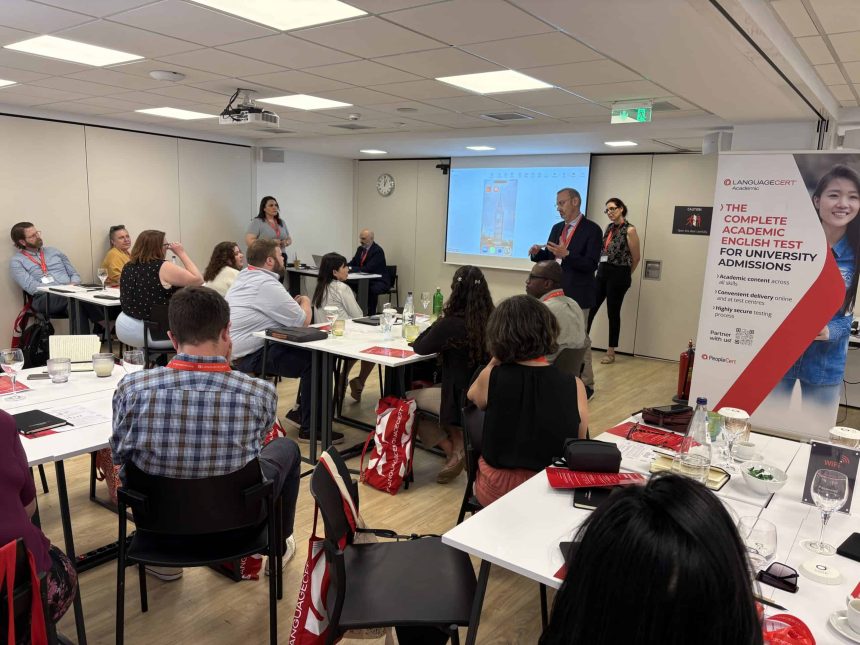
The sixth LanguageCert HE Summit was organised as institutions around the world face challenging conditions, with fewer applications noted by US colleagues and increased attention on visa approval data in the UK. The event had universities representing six countries in attendance.
“The stakes are getting very high, because I think the risks for [institutions] are now very high,” said Wingfield.
The company believes this environment is driving greater interest in assessment validity, security and reliability, with institutions seeking reassurance that language scores accurately reflect a student’s ability to study in English.
A recurring theme throughout the event was the challenge of maintaining confidence in high-stakes testing as fraud tactics evolve.
Attendees were shown the live proctoring room, with test takers around the world being watched from two different camera angles as they concentrated in similar fashion but from various at-home locations around the world.
Joy Olabisi, AVP Graduate Education at Georgia Tech, told The PIE it was impressive to see “how much security implementation has gone to ensuring that any kind of fraud or malpractice is minimised”.
Sharing that Georgia Tech had 16,000 international applicants with 6,000 admitted for the next fall intake, she noted: “We are always looking for additional [solutions] to ease the admissions process,” adding that the fact LanguageCert is administered virtually was a big plus.
“The only way that you can build confidence [in our testing integrity] is to invite them to see and experience and have this discussion,” explained chief languages officer, Marios Molfetas. “So, in essence, for us, we want to gain their trust, but equally we want to be scrutinised and tested and asked about scenarios,” he said.
The company was also happy to tackle the debate around online testing and if it should be considered less secure than traditional delivery methods.
The LanguageCert leaders argued that the effectiveness of any assessment model depends on the safeguards surrounding it, with exam centres also being vulnerable to determined fraud efforts.
You need to drill down into the details, and you need to manage risks, and you need to have an ability to react
Marios Molfetas, LanguageCert
“What we’re saying is an approach of A solution is safe and B solution is unsafe is a bit simplistic,” noted Molfetas. “You need to drill down into the details, and you need to manage risks, and you need to have an ability to react.”
The team characterised it as a “layered” approach to security, combining identity verification, live speaking assessments, technology-based monitoring and post-test analysis.
“The common thread is layers and layers of security,” explained Wingfield. “Not one single security measure guarantees anything. It’s all of them layered on top of each other. Just reading the chip off the passport is not on its own something that’s guaranteed to guarantee security for your exam. They all come together as a joint set of layers of security, where you will catch a very large proportion of the attempts.”
The discussion comes at a time when many universities are reassessing recruitment practices in response to changing government policy, especially in the UK where tighter BCA metrics are now measured.
Nirwarshi Thiemert, director of global enrolment services at Sommet Education, also spoke to The PIE about admissions at this global hospitality school group.
She said that in addition to robust testing partners, Sommet Education uses a remote interview software solution too to get the fullest picture of the student applicant. “All the interviews are done, both undergraduate and postgraduate programmes, by our colleagues, either in market or by the faculty,” she said. “It’s a way to ascertain their motivations for the programs, see who they are, really develop an engagement on a one-to-one basis.”
Beyond admissions, the summit also explored the impact of AI on language learning and assessment.
LanguageCert leaders acknowledged that AI is already transforming education and will inevitably influence how skills are evaluated in the future.
While AI tools are making information more accessible, executives argued that language proficiency remains a fundamental requirement for students studying abroad.
For now, LanguageCert says its priority remains ensuring that institutions can trust the results they receive.
“I would expect universities to push students towards the test-taking scenario that will give them the best results of guaranteeing as much as possible that the student who’s going to appear on their doorstep in September is actually going to be of a level that they’ve been told they are,” summarised Wingfield.