
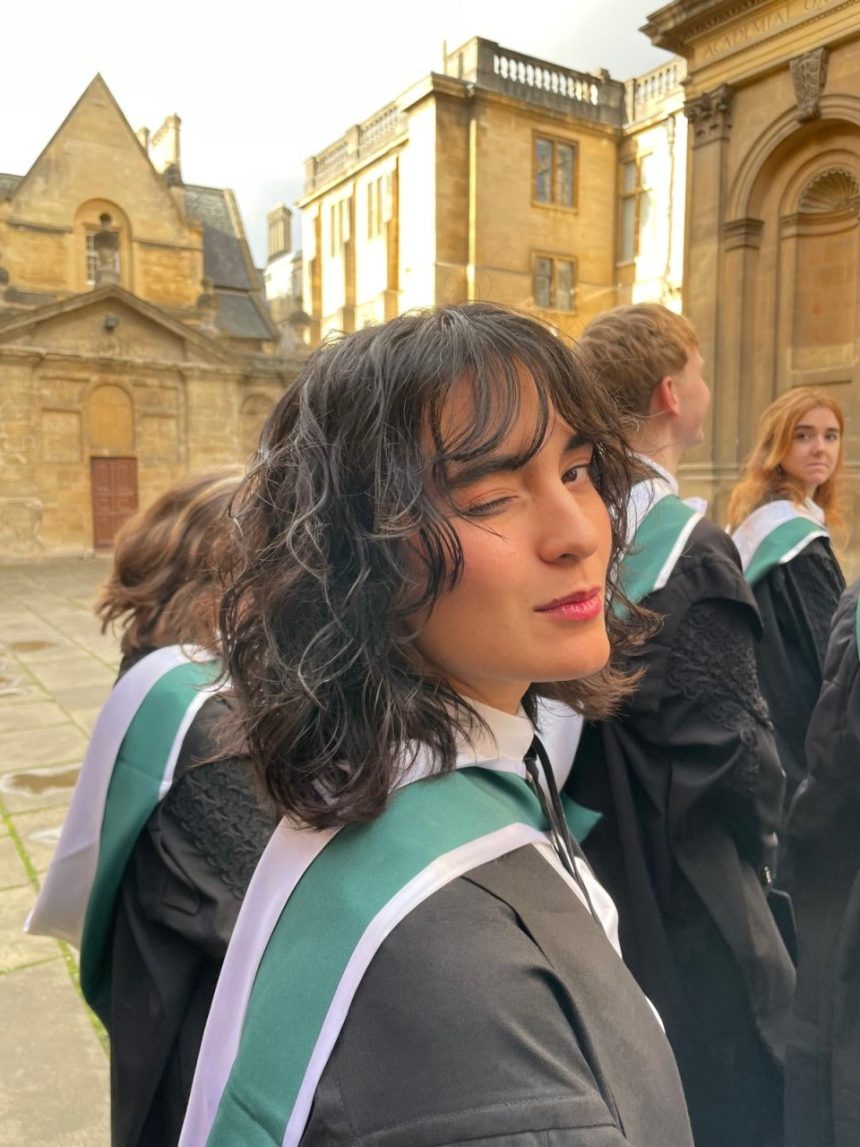
In the presence of Eleanor Wikstrom, she appears to be an “academic weapon.”
She did her undergrad at Harvard and is completing her second degree at Oxford as a Rhodes Scholar. But interestingly, going into the #1 universities in two superpower countries was never really in the books for her – until she literally encountered it in a book.
Growing up, no one around her had gone to Harvard or was even interested in doing so. Raised in Oakland, California, Wikstrom first encountered the idea of an elite academic career almost by accident — in a library copy of “The Overachievers: The Secret Life of Driven Kids”.
The book was meant as a warning about the intensity of elite college admissions. Instead, Wikstrom read it as a guide.
“I was in an environment where I wasn’t really surrounded by a lot of that toxic competition, and so I took it like a blueprint,” Wikstrom recalls. When the acceptance letter arrived, going felt like “a no-brainer.”
That instinct to turn an unlikely spark into a fully formed path has defined Wikstrom’s life since — through four years at Harvard, a Rhodes Scholarship, and now a second master’s degree at Oxford.
As a Rhodes Scholar, Wikstrom’s first master’s is in Social Science of the Internet. She’s completing her second master’s in Global and Imperial History. Source: Eleanor Wikstrom
Finding a pathway in social studies
Wikstrom arrived at Harvard convinced the future held medicine, or maybe law, or maybe teaching.
“I didn’t really have any experience with those three,” she admits.
What actually stuck was social studies, Harvard’s interdisciplinary honours major spanning government, economics, history, anthropology, and sociology, capped off by a mandatory 30,000-word senior thesis.
“That was one of the most intellectually enriching experiences of my life,” Wikstrom says, describing the pull toward theory-heavy coursework that eventually shaped a cohort of like-minded students all wrestling with the same year-long theory course in their sophomore year.
But the road there wasn’t obstacle-free. Harvard’s competitive culture came as a shock to many of Wikstrom’s peers, some of whom experienced their first bad grade in their lives.
Wikstrom credits a grounded upbringing — supportive but never pressuring parents, and formative teenage years spent in spoken word poetry and long-distance running — with softening that landing for herself.
“Both of those things are quite individually driven,” Wikstrom says about her interests. “I think those two things have really shaped the way that I look at the confluence of what I’m interested in.”
Campaigning for a missing language
The most consequential turn in Wikstrom’s Harvard career had nothing to do with a syllabus. It began with a discomfort within herself: Despite a Filipino mother and deep family ties to Los Angeles’s Filipino community, Wikstrom had never learned to speak Filipino.
Wikstrom is hardly alone. Although Filipino is the fourth most spoken primary language in the US, behind English, Spanish, and Chinese, it lacks the same infrastructure of heritage-language schools and multigenerational fluency as Chinese does. As a result, many Filipino Americans grow up without becoming fluent in the language.
Wikstrom traces part of this to the Philippines’ history as a former American colony, where English retained prestige as the language of economic opportunity.
The 2021 Atlanta spa shootings, which killed six Asian women, further pushed Wikstrom to think more critically about how this linguistic erasure connected to broader histories of American imperialism in Asia.
Back at Harvard for sophomore year, Wikstrom discovered that students had been petitioning — unsuccessfully — for years to get Filipino offered as a language course, caught in bureaucratic limbo between the university’s East Asian and South Asian studies departments. By the way, Harvard has no distinct Southeast Asian studies department.
That’s when Wikstrom began writing op-eds in the Harvard Crimson while alumni worked in parallel to raise donor funding. By junior spring, the campaign succeeded: Harvard offered Filipino for the first time.
“I still think it’s one of the most meaningful things I got to experience during my time at Harvard,” she says.
That advocacy also redirected Wikstrom’s thesis. Originally planning to research Facebook’s role in the Myanmar genocide, Wikstrom discovered Myanmar was on the US State Department’s most restrictive travel list — a nonstarter for undergraduate fieldwork.
She initially resisted the pivot to studying the Philippines (“I don’t want to pigeonhole myself”), but became the project that Wikstrom ultimately cinched awards for. Specifically, her senior thesis on US colonialism in the Philippines won awards such as the Alexis de Tocqueville Prize for Best Thesis in Social Studies, the Senior Thesis Prize in Ethnicity, Migration, and Rights, and the Thomas Temple Hoopes Prize.

Wikstrom, now a Rhodes Scholar, is also a part of a boat club in Oxford. Source: Eleanor Wikstrom
Two master’s degrees, one mission
Following her bachelor’s, Wikstrom went on to bag a Rhodes Scholarship — an intensive process she describes as forcing “existential questions” about identity and purpose. This provided her with two years of funding at Oxford.
The first programme she chose, in global and imperial history, offered only a one-year track.With another year of funding available, Wikstrom chose to pursue a second master’s in the social science of the internet.
The choice makes more sense in light of her research interests: The Philippines remains a hub for cheap English-language digital labour, from content moderation to data labelling. Cambridge Analytica notablytested disinformation strategies there before deploying them in elections elsewhere, including in the US.
“There’s still a lot going on that I thought was very rich to dive into,” she says.
Furthering a career in academia without putting yourself in a box
For many, the pursuit of a career or life in academia can feel like a limiting one. It might seem like it requires a kind of regimented discipline from a young age, or a dedication to one specific topic.
But Wikstrom’s journey shows that it doesn’t always have to be the case. She’s pursued her interests from spoken poetry to cross country, and is now a Rhodes Scholar at Oxford.
Ironically, or perhaps fatefully, she shows the other side of the non-fiction book that she read all those years ago, “The Overachievers.” In the book, the author focuses on the obsessive focus that some high schoolers have on test scores, perfect grades, and elite colleges — which ends up damaging students’ mental health and killing their love of learning.
For Wikstrom, academia has never been the end goal — it’s always been the means for her to carry out her own interests and make an impact.
