Dear Minister Hill,
As a supporter of your work in the interest of the international education sector, I was particularly pleased with your appointment, which I believe will provide a valuable voice for this important industry.
I attended The PIE Live Asia Pacific conference this week to hear your session on the challenges facing the sector. I was disappointed to find that you seemed to be selective in your data and in my opinion did not offer a sincere appreciation for the sector, which has been particularly affected by the unpredictable visa outcomes for students from South Asia.
Your past addresses have often been characterised by a focus on hope, which I understand is a necessary element of political communication. However, I felt that some of your statements at this conference were misleading and that the audience was not prepared to defend itself.
I acknowledge that my interpretation of your statements may be incorrect and welcome any corrections.
You have indicated that the government will not “back off” from reducing net migration and that education is the only export industry that “takes up beds” contributing to the housing crisis.
This is a point that One Nation and to some extent the Coalition have been making for over two years. However, we have sufficient data to suggest that much of it is political rhetoric. The housing crisis is far more complex than that and we can all agree that the problem is not new arrivals but rather people on temporary visas exploiting the system and refusing to leave the country.
Instead of targeting international students, you should further increase onshore actions to prevent the abuse of student visas. You have previously pointed to the infamous statement by the former Australian Prime Minister, who asked international students “unable to fund their stay in Australia” to “go home”. While this was a poor moment during the pandemic, your current statements are not significantly different.
Instead of targeting international students, you should further increase onshore actions to prevent the abuse of student visas
I – along with the rest of the sector – stand with your efforts to prevent the abuse of student visas and the onshore “visa hopping” that should now be controlled following the ban on onshore commissions. You have mentioned that you have been shown evidence and videos of how some private providers are circumventing the commission ban by paying in cash or through scholarships. I have also seen these videos and promotions, as have others.
However, I have not heard of any action being taken against such practices and believe this has led to more providers attempting to do the same. I wonder why the department is not setting an example and communicating a clear message when you have indicated that the majority of onshore international movements are due to government TAFEs, which are in a state of decline. Is there a genuine intent to act?
In the context of politics, it is important to consider the full picture.
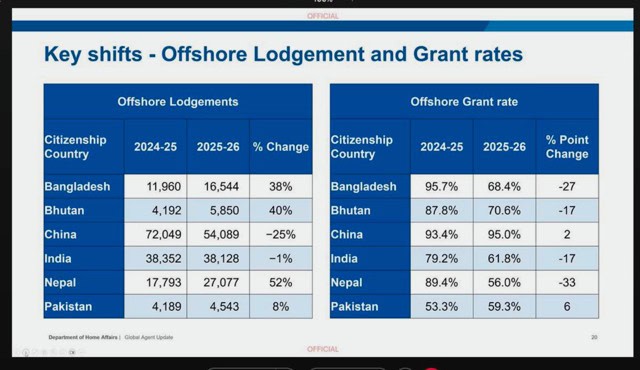
You have cited the visa grant rate for the full year as a way to prove that issuance rates have not changed significantly. But during the second half of the financial year 2025/26, visa grant rates for several destinations fell dramatically without legislative change around student visas requirements.

The visa grant rate for students commencing their university studies in the July 2025 intake was over 90% for Nepal, Bangladesh and Sri Lanka, and approximately 80% for those from India. But for students commencing in the February 2026 and July 2026 intakes, the visa grant rate has not been close to the 78% you refer to as the current rate.
This rate quoted by you is the average for all intakes since July 2025 and cannot be taken as the current ongoing visa grant rate. If the visa grant rate was as high as 90% in July 2025 for Nepal, it must have been significantly lower this year to achieve an average of 56%.
Therefore, it is challenging to dismiss the question of reduced visa grants and unpredictability of student visa applications. The sector wants to preserve the integrity of student visas – but we also want more clarity and objectivity during the process. Education providers and agents can then focus on students with a greater likelihood of securing visas and poor students will not be taking a gamble with their plans to study in Australia.
To elaborate on this point, you were selective in stating that despite the lower visa grant rate, the same number of visas were granted to Nepal as last year. This is because there was a significant increase in visa lodgements.
Taking Nepal as an example is therefore a selective comparison. If the same calculation is extended to India, the situation changes and your assertion fails. Offshore lodgements for 2025/26 are 38,128 and with a visa success rate of 61.8%, 23,566 visas will be granted over the full last fiscal year (July 2025/26).
To address another statement you made, I understand your disappointment with the reduced number of international students attending government TAFEs. I welcome your attention to this sector, which is a significant contributor to Australia’s skill needs and whose graduates have the highest likelihood of securing skilled immigration.
The affordability of TAFE courses makes them particularly attractive to international students. I would recommend reviewing the visa grant rate for the TAFE sector, which is often less than 10% in some South Asian markets.
This sector also contributes to the workforce for several trade and healthcare skills. By addressing these issues, Australia can become more attractive to international students, increasing enrolment and affordability. This will also reduce instances of “course hopping” onshore, as students will complete vocational diplomas that enhance their employability. Additionally, it is important to consider the current post-study work visa guidelines, which may disadvantage the TAFE sector.
In response to a question regarding Australia’s high student visa fee, you indicated that it is a small percentage of the student’s overall investment in Australia, making it appropriate and affordable. This argument would hold if the visa process was more objective and predictable. Currently, for some countries, more than half of the students have received visa refusals with no option to appeal, and the AUD$2,500 fee is a sunk cost.
Universities that have invested in the market have refunded tuition fees, education agents have gone unpaid and the visa fee has become another source of revenue for the government.
In our pursuit of maximising student revenue, we have overlooked the student who has lost a full year of their life due to the unreliable visa process. It might be a better model to levy a two part visa fee where AUD$1,000 is charged at application and AUD$1,500 is charged when the visa is granted. This is not such a new approach to visa fees and has precedence with some other categories.
While most institutions’ NOSC allocations have been maintained, the reduced visa grant rate and lower lodgements for several countries this year raise concerns about sustainability.
Minister, as you have mentioned several geo-political factors are affecting some sending countries. This is an opportune time for Australia to take a leadership role. While a decline in student numbers next year may be welcomed by the opposition and reduce political pressures, it is important not to attribute this solely to geo-political factors when addressing conferences next year and instead acknowledge some of the factors I have outlined above.
I would have shared the above with you, had we been able to meet in person at a planned meeting in Vijayawada, India. However, I have now been informed that the meeting will not take place. So, I will instead use the travel to motivate our student counsellors and maintain their interest in Australia future intakes. I live in hope.
Regards,
Ravi Lochan Singh
(Disclaimer: I am an education agent who often challenges weak arguments and as an Australian and in true Aussie spirit, seeks a fair go. The views expressed are my own and do not necessarily reflect the official views of any association or organisation.)