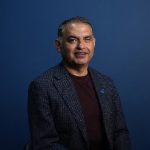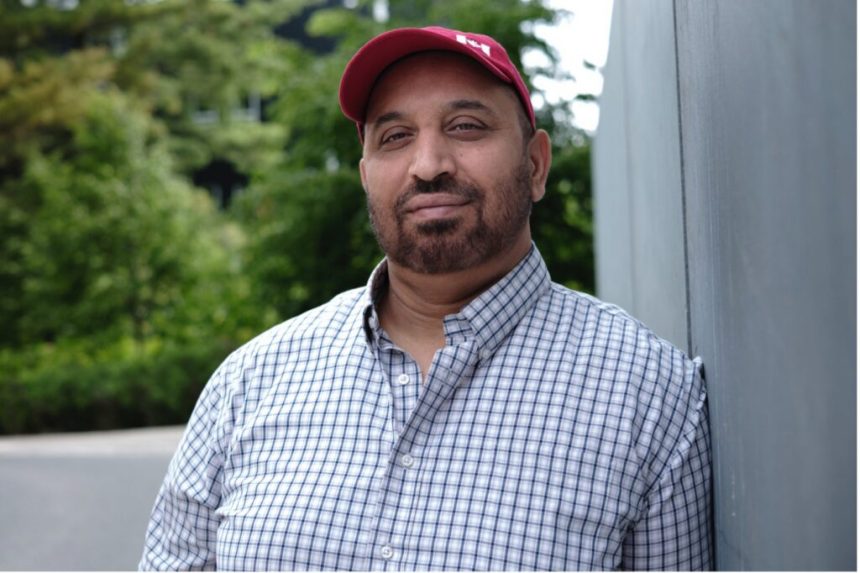
Growing up in Afghanistan, Ahmad Malgarai experienced both the opportunities and challenges of a country undergoing profound change. Those experiences inspired a deep belief in the power of education for personal and professional growth, to strengthen communities, and contribute to long-term development.
That belief brought him to Carleton University’s Faculty of Public and Global Affairs, where he completed both a master’s and a PhD in Economics. “I found a community that challenged me to think critically, grow intellectually, and persevere with purpose and determination,” he says. “Every challenge strengthened my belief that education is not only a pathway to opportunity but also a responsibility to give back, support others, and create positive change.”
Malgarai’s journey reflects what Carleton strives to offer every student: a place to grow and challenge themselves.
Malgarai earned both a master’s and a PhD in Economics from Carleton University’s Faculty of Public and Global Affairs. Source: Carleton University
World-class graduate programmes
Whatever your passion, there’s a programme at Carleton University that’s right for you. The Faculty of Public and Global Affairs focuses on delivering academically rigorous and professionally relevant graduate programming. It is home to some of Canada’s leading graduate degrees, including International Affairs, Public Policy and Administration, and Economics. There’s also master’s degrees from Canada’s only School of Journalism and Communication, the country’s only master’s degrees in Political Management and Philanthropy and Nonprofit Leadership, and a master’s in Migration and Diaspora Studies.
In addition, Carleton professors in the Faculty of Public and Global Affairs have secured more than US$70.48 million (CAD$100 million) in research funding to tackle such diverse issues and challenges as security and defense, media and misinformation, international trade, refugee policy, and climate change, among many others.
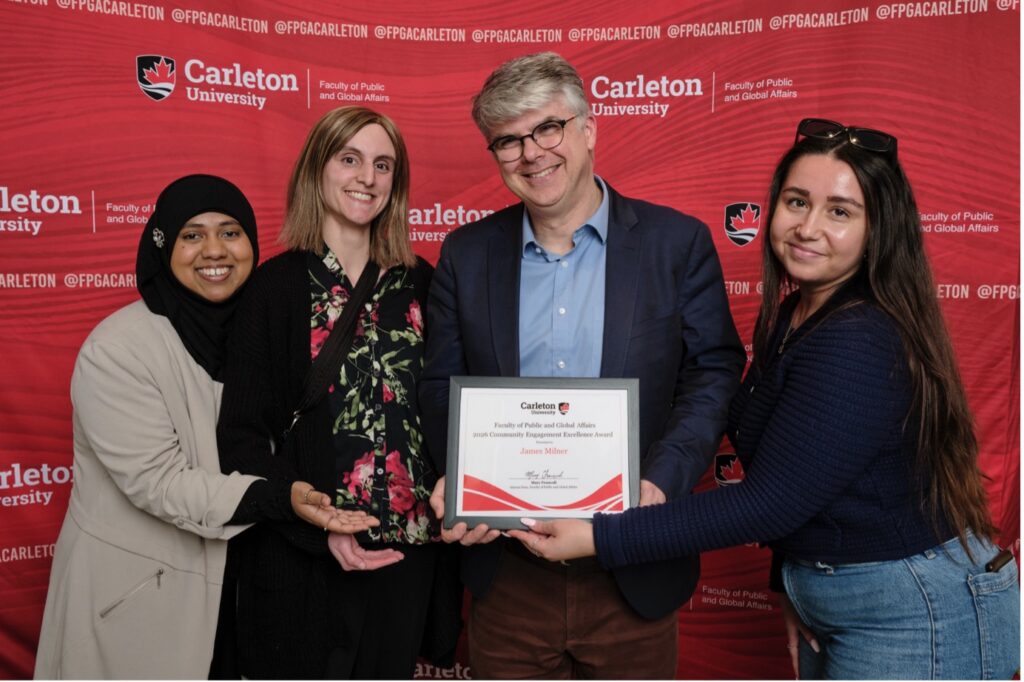
Dr. James Milner, co-director of the Local Engagement Refugee Research Network (LERRN), with graduate students Sal Sabila, Rachel McNally, and Georgiana Ghitau. Dr. Milner is holding an award in recognition of his outstanding graduate mentorship. Source: Carleton University
Sal Sabila, who came to Canada from Bangladesh, pursued the MA in Migration and Diaspora Studies. “The programme has given me the critical frameworks, language, and community to better understand migration, identity, and systemic oppression while connecting academic research with lived experience and grassroots advocacy,” she shares.
Behind every programme are professors who are international leaders in their field. James Milner is the project director of LERRN, the Local Engagement Refugee Research Network, which received $2.5 million in funding from Canada’s Social Sciences and Humanities Research Council to work with partners in 18 countries to advance protection and solutions with and for refugees.
“Graduate students play a central role in our collaborative research projects on global refugee issues,” Professor Milner says. “From conducting research, facilitating training, and supporting our academic and community partners around the world, graduate students have made invaluable contributions while gaining new skills, building their networks and experiencing the transformative potential of engaged research.”
Carleton faculty members may be high-profile researchers but they remain deeply committed to mentoring students. Zijun (Leslie) Rao, a graduate student from China completing her MA in Communication, appreciated this “balance of academic excellence and expert support” the most. “I found professors who were incredibly generous with their time and committed to helping students succeed, regardless of their background,” she says. “That gave me the confidence to pursue ambitious goals that are important to my future career plans.”

Zijun (Leslie) Rao, a graduate student from China. Source: Carleton University
Flexible degree paths
Every student’s graduate journey looks different. Some choose to develop professional skills through experiential learning, while others pursue independent research. Sabila’s master’s thesis, for example, looked at how intergenerational trauma is addressed in the prevention of violent extremism, particularly within racialised and immigrant communities in Canada. The university’s flexible master’s programmes support both paths, with many degrees completed in as little as 12 months.
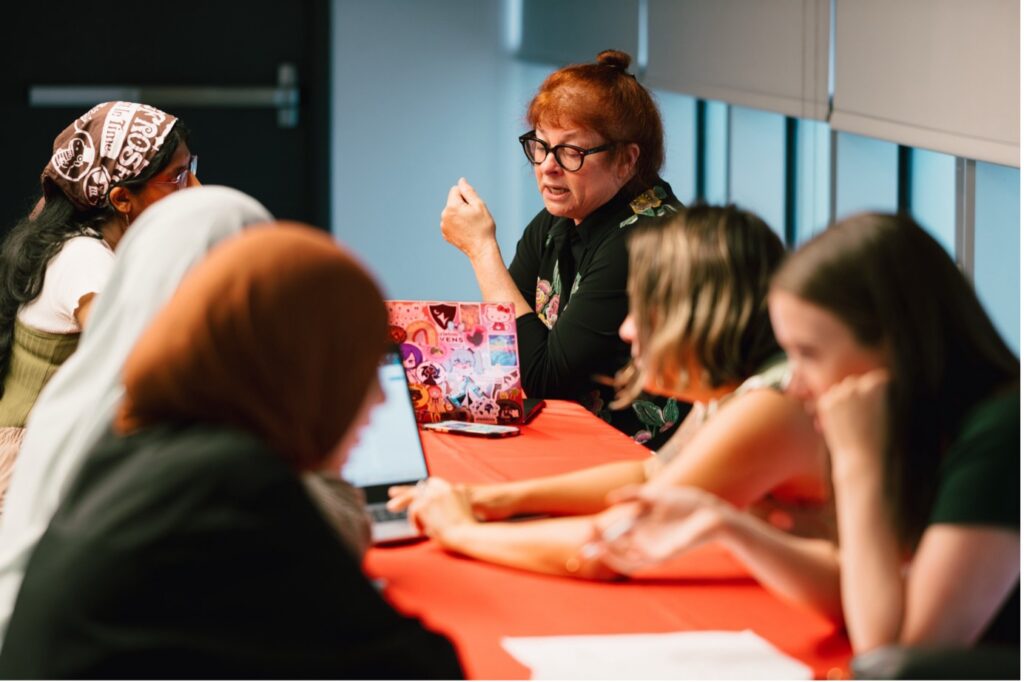
With nonprofits, cultural institutions, think tanks, consulting firms, and industry associations, Ottawa offers numerous networking opportunities. Source: Carleton University
Real-world learning. Real-world experience.
The classroom is only part of the experience. You’ll have opportunities to apply your knowledge through co-op placements, internships, community-based and action research, and partnerships with government, non-profit, media, and international organisations.
Sabila made the most of every opportunity outside the classroom. As President of the Migration and Diaspora Studies Student Society, she created a more inclusive and supportive community for fellow students. She also completed an internship with the Durable Solutions team at the United Nations High Commissioner for Refugees (UNHCR) in Canada in 2025. “This experience helped bridge my learning across research, community engagement and policy work,” she says.
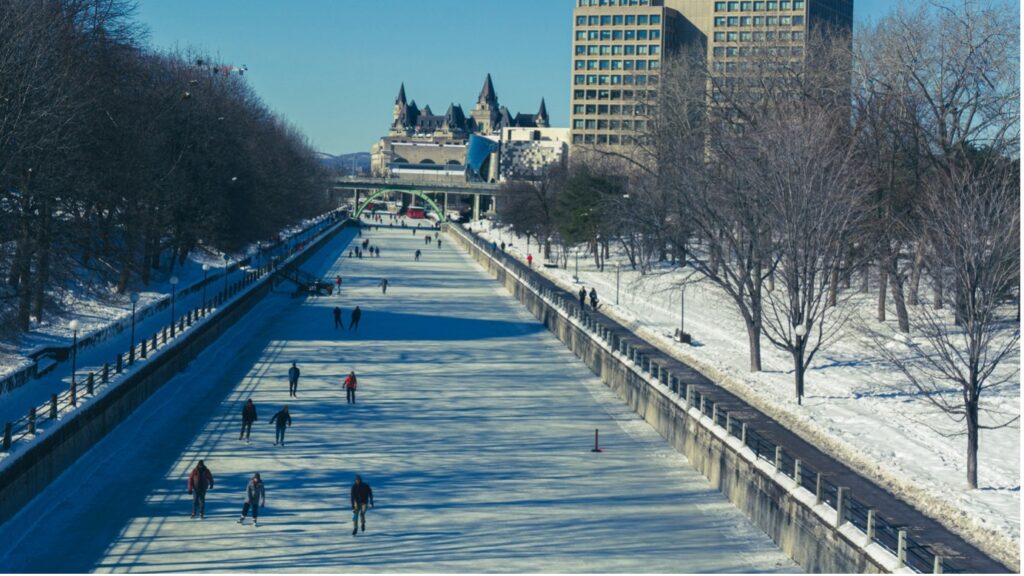
Study in a globally recognised technology hub while enjoying the security and quality of life of a G7 (Group of Seven) capital. Source: Carleton University
The right place to begin
Ottawa is an ideal location for international graduate students to advance their studies and career goals given the proximity to government, NGOs, international organisations and national media. It is also home to many diaspora communities and is well-known for its cultural festivals and as the home to the world’s longest ice-skating rink.
And the country is highly ranked on the list of Safest Countries in the World 2026, with Ottawa, the national capital, recognized as its most livable city. The university’s 150-acre campus is bordered by the UNESCO World-Heritage designated Rideau Canal on one side and the Rideau River on the other, creating a peaceful, park-like setting that’s surprisingly close to Parliament Hill and downtown Ottawa.
Within and beyond the classroom, Carleton’s Faculty of Public and Global Affairs empowers students to succeed on a global stage. Combining a vibrant international community, unparalleled access to Canada’s political and policy institutions, and a campus renowned for its natural beauty, Carleton is a place where international graduate students turn ideas into impact. The connections they make, the perspectives they gain and the opportunities they seize here will shape their careers and lives for years to come.
Follow Carleton University on Facebook, Instagram, YouTube, and LinkedIn