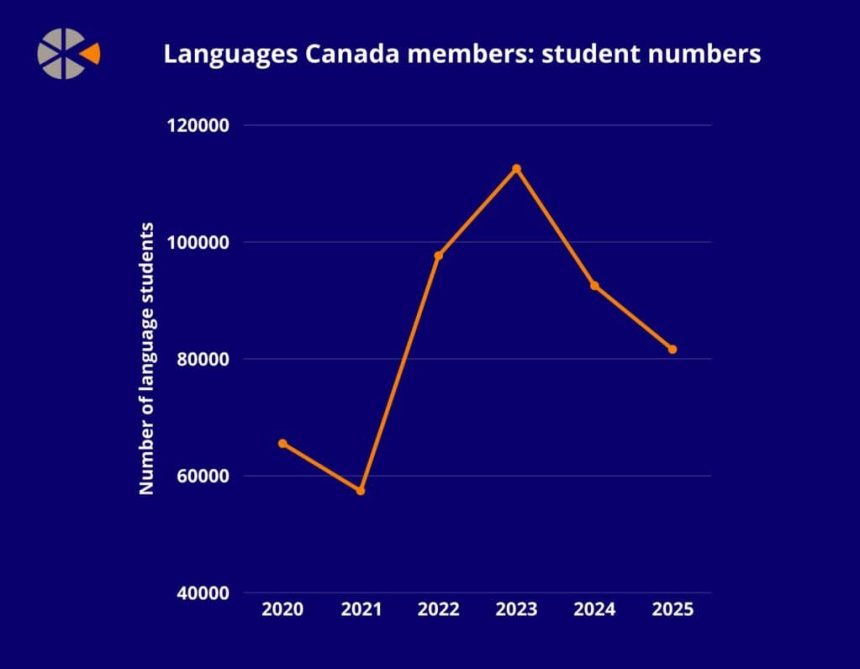
Canada’s official languages programs 2025 annual report has revealed a 13% decline in student numbers and a 19% drop in student weeks last year, citing unpredictable visa policy as the main driver of decline.
The Languages Canada survey of 160 member programs made for “sobering” reading, said the organisation’s executive director Gonzalo Peralta, laying blame squarely on federal government’s policy decisions.
“The sector is now in a state of crisis,” said Peralta: “While economic uncertainty and increased international competition contributed to the downturn, it is the policy environment that most decisively undermined the sector’s stability and growth.”

The survey found Languages Canada members welcomed fewer than 82,000 students who completed nearly 799,000 student weeks in 2025 – a year of sharp declines building on the 15% drop in student numbers recorded in 2024.
The findings “reflect not only shifting global conditions, but most critically, the direct impact of restrictive and unpredictable government immigration and visa policies,” said Peralta. “These policy decisions have significantly reduced enrolments, forcing programs to scale back operations and, in some cases, close entirely.”
Following the implementation of study permit caps in January 2024, Canadian colleges, universities and language programs have faced increasingly restrictive immigration policies and visa barriers, with Canada’s study permit approval rating falling to 36% last year.
The report found member programs’ direct economic contributions fell by 1% to CA$1.03 billion, marking a less drastic decrease than the previous year’s 13% drop.
Despite challenges, Peralta hailed the “resilience” of Canadian providers. “Public programs managed to maintain relatively stable enrolments compared to 2024, and institutions have expanded online and hybrid offerings.”
The report makes it unmistakably clear that the sector is now in a state of crisis
Gonzalo Peralta, Languages Canada
But he said the consequences of sustained declines were being felt across the country, with institutions “struggling to maintain viability” and communities losing the economic and cultural benefits they provide.
Of the near-82,000 language students, the overwhelming majority (92%) came to Canada to learn English, while French language student made up 8% of the total.
Private programs dominated the sector, accounting for over three quarters of language programs, while international students (93%) significantly outnumbered domestic students (7%).
Japan retained its position as the top source country, sending nearly 12,000 students, followed by Brazil, South Korea and Mexico, the report found.
In 2025, 40% of students entered Canada using an electronic travel authorisation (eTA), while 21% travelled on a temporary resident visa and 13% of students entered on a study permit. The remainder had Canadian citizenship or permanent residence.
In 2025, a regulation requiring two separate study permits for students attending two institutions – for example, a language school followed by a college or university – was implemented, “practically destroying” pathway programs in Canada, Peralta previously told The PIE News.
In response, a Joint Pathway Program (JPP) was launched early this year, bringing together private language schools and post-secondary institutions to support seamless student transition, which aims to transform language education in Canada.
At the same time, the report doubled down on the need for sector and government messaging that restores confidence in Canada as a welcoming study destination.
“Continued investment in quality, market diversification, and innovative recruitment will remain important, but these efforts can succeed only if policy-driven barriers to student access are addressed,” it stated.