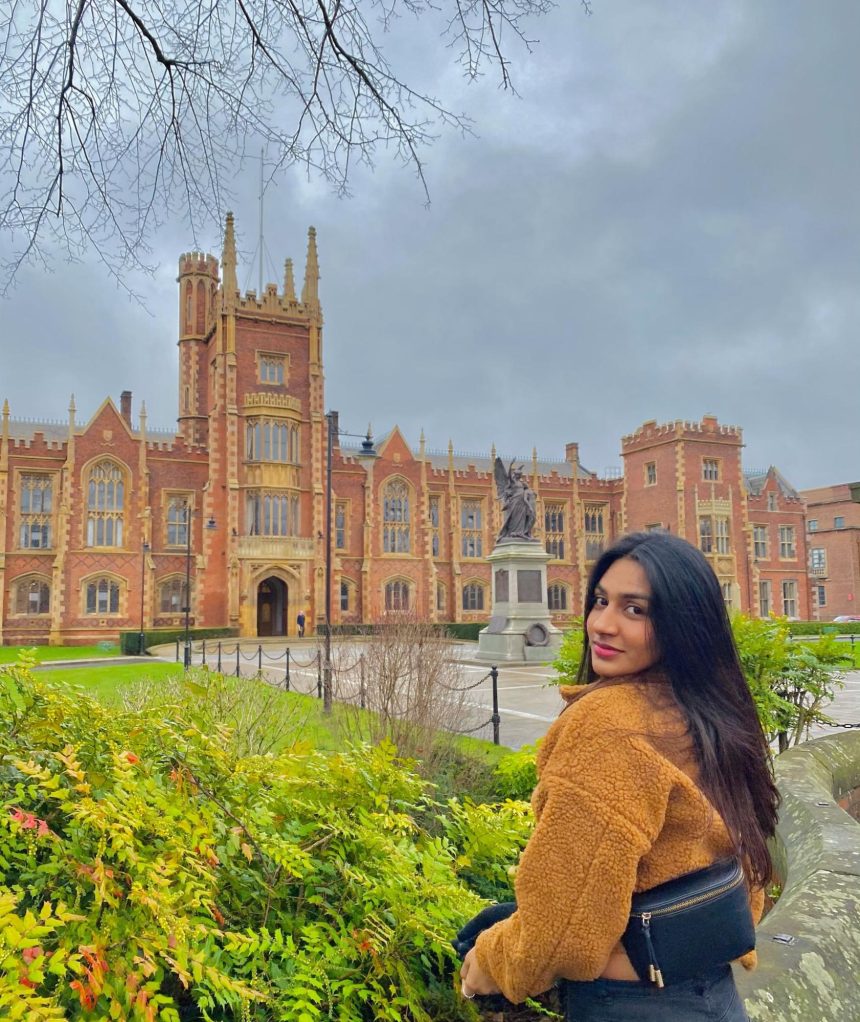
Most people who go to law school have a dramatic origin story. A life-changing moment. A mentor who inspired them. A cause they wanted to fight for.
Resshma Mohan‘s reason? A TV show.
“I just watched Suits, the popular US legal drama on Netflix,” says the co-founder of Kaapi Kreat, a South Indian lifestyle cafe based in Cyberjaya, Malaysia. “I thought it was going to be as fancy as that, but nope.”
The former law graduate says leaving a stable corporate job was not an easy decision, but one she made to create a future she believed in. Source: Resshma Mohan
“Study” was the only non-negotiable
Resshma grew up in Johor, a state in Malaysia, in a household where getting a degree was non-negotiable. Her mother made that clear from early on, not just to Resshma but also to her brother and cousins. “She has always been that auntie and that mum who constantly tells people, ‘study, study, study,’” she says.
But the career path was never dictated. Resshma came to law on her own terms. Growing up watching the news, she admired local Malaysian lawyers like Karam Singh and Ambiga Sreenevasan – especially the way they carried themselves and the confidence when they spoke.
“But choosing law, as in the programme itself, was honestly just because of Suits,” Resshma says.
With her mind made up, she enrolled in the Foundation in Law programme at Brickfields Asia College (BAC) in Kuala Lumpur, Malaysia. Since she had no interest in completing her entire degree in Malaysia, BAC’s 2+1 twinning programme with a UK university gave her the opportunity. She made a deal with her mother: pass the Foundation in one sitting, and she’d be sent to the UK.
And she did. After completing her two years locally, Resshma was finally about to head to the UK for her final year in October 2020.
However, it was during the COVID-19 pandemic.
As such, getting her father on board was not easy. He wasn’t ready to send his daughter that far in the middle of a worldwide crisis.
“I actually had to do a PowerPoint presentation for my dad to convince him,” she says. “He kept saying, ‘I don’t want my daughter to go.’ I told him I would be careful, wear my mask, and avoid unnecessary outings.”
Her father came around eventually. When Resshma finally boarded that flight, she became the first in her family to pursue a degree in the UK. “I know it made my family a little proud,” she says.

Resshma shares that her parents never forced her into a career path, but always encouraged her to pursue education. Source: Resshma Mohan
A degree earned in the middle of a pandemic
After arriving in the UK, specifically at Queen’s University Belfast, Resshma had two normal weeks before everything shut down. The second year of her degree had already been fully online from Malaysia. Now she was physically in the UK, attending classes virtually anyway.
“I had just one physical class,” she says. “I hate online studying. I need my notes and want to write in my books. So having online exams and my whole second year online felt very horrible.”
But she doesn’t frame it as a loss. Campus facilities and libraries stayed open, which gave the experience some grounding. Outside the classroom, she travelled, visited other universities, and spent time with hostel mates from different countries.
“I learned more because I was able to go out and experience life,” she says.
After completing her degree, she wanted to stay and continue her bar studies, but the fees were just too expensive. “And once you include accommodation, living expenses, and everything else, it can easily become RM200,000 (US$50,910) to RM300,000 (US$76,365),” she says.
She didn’t want to burden her parents with these extra costs, hence she chose to pause her studies and return to Malaysia. And she did so with greater confidence. “Studying in the UK made me realise that I can do anything, because I had already travelled so far away from home, and during COVID too.”
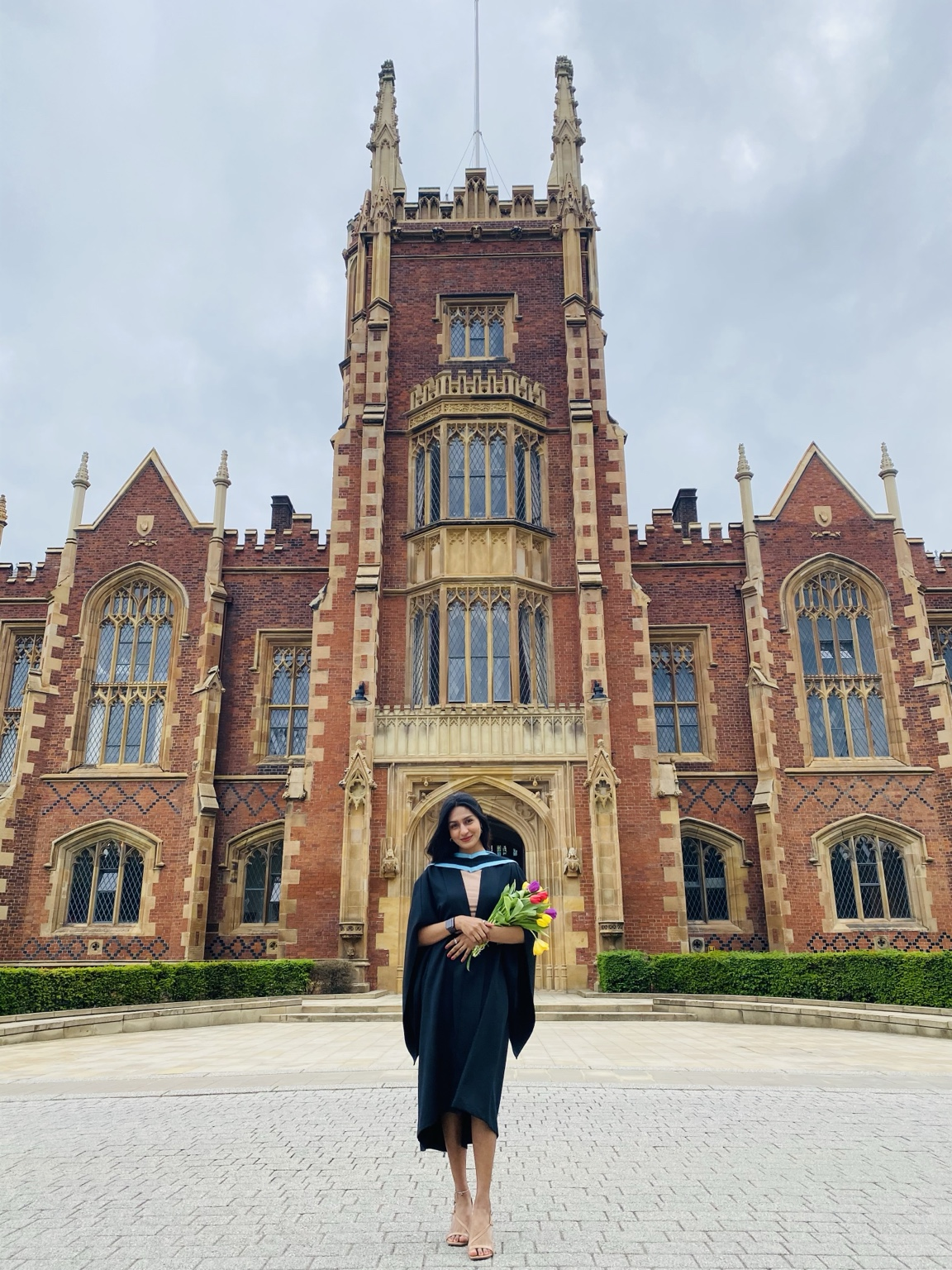
The former law student-turned-entrepreneur says building a café has taught her lessons no classroom could offer. Source: Resshma Mohan
The ceiling with no door through it
Coming home in 2021 with a law degree but no professional qualification left Resshma in a limbo. She started at a small firm, then moved to Skrine, one of Malaysia’s largest firms, where she managed hundreds of active bankruptcy cases. The work was demanding, and she loved it – but the ceiling was fixed. Without the bar or the Certificate in Legal Practice (CLP), she could only rise to the level of a senior paralegal.
Since CLP runs on the same exam-heavy format that had derailed her during A Levels, Resshma decided it was not the right path for her.
The UK Bar was what she actually wanted, but that required money she didn’t have. She continued working while exploring different opportunities and applying for scholarships. Along the way, she gained valuable experiences at the Malaysia Competition Commission and later at Wise, a fintech company, where she broadened her understanding of different industries while continuing to find ways to move closer to her legal aspirations.
With no funding in sight, she shifted her strategy entirely: build something meaningful and create a sustainable source of income, which will then help her move closer to her goal of pursuing the bar. That became Kaapi Kreat.
Resshma was still at Wise when she started Kaapi Kreat, but eventually left to give her full focus to the business. “At that stage, it was just me and my partner running it,” she says. “Leaving everything to him while I just pushed ideas, didn’t feel fair.”
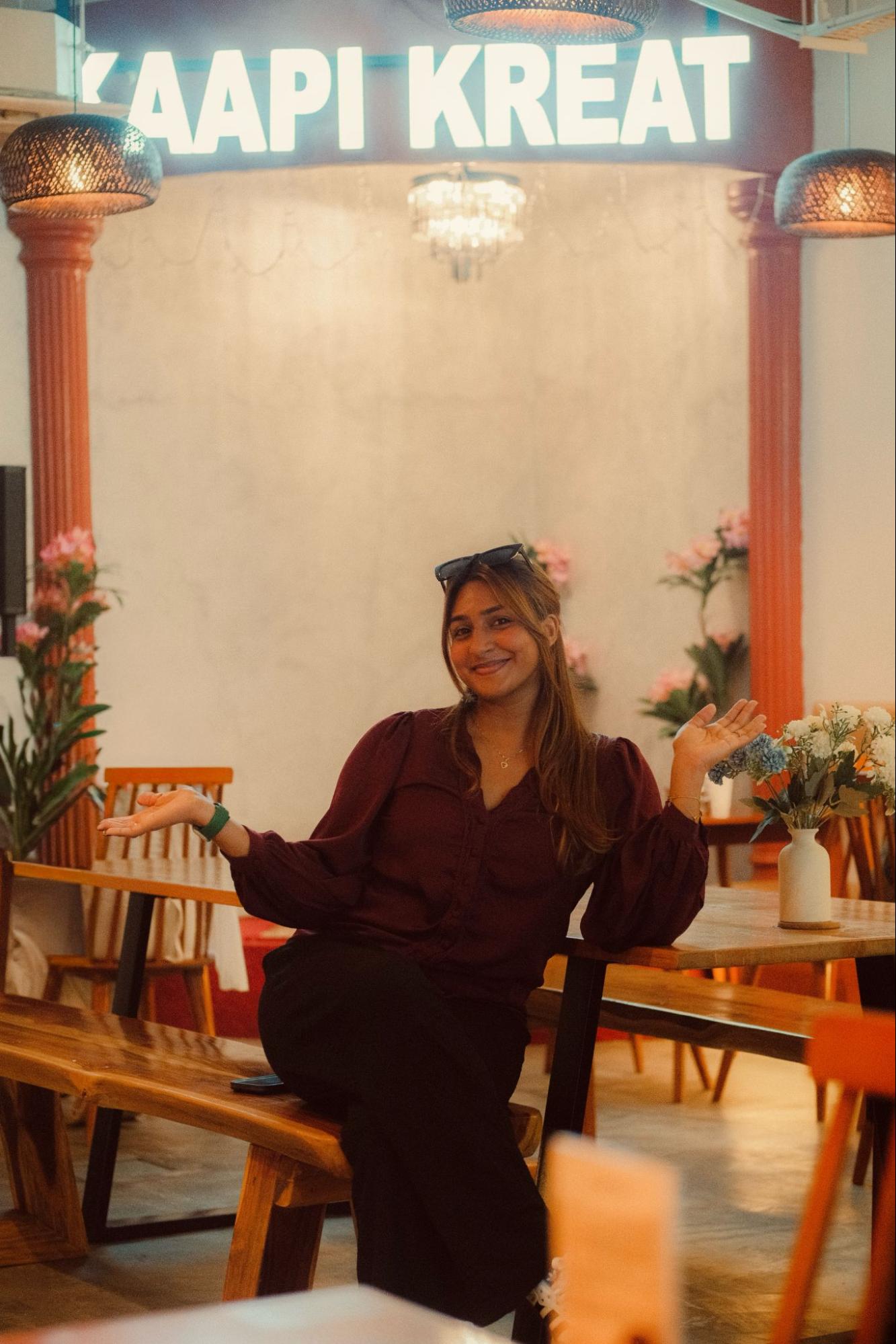
A law degree may have shaped her thinking, but entrepreneurship gave Resshma a new way to apply her skills. Source: Resshma Mohan
Building something from nothing
The idea for Kaapi Kreat came together when Resshma and her business partner Joshua — a content creator with a strong marketing background — realised the timing was right to build something of their own. Resshma was looking for a new venture, while Joshua had an established audience and a set of creative skills that he had yet to turn into a business.
Together, they saw an opportunity to combine their strengths.
However, the concept did not take shape immediately. They explored several ideas, from an event space to a creativity hub, before eventually settling on a café. Looking back, Resshma says the café they have today is still close to the vision they had from the beginning.
The turning point came during a brand trip to the UK, where they visited café after café and came back genuinely inspired. When they came back to Malaysia, they found their current unit in Cyberjaya — a ground-floor space that fit their budget and simply felt like the right place to start.
“Let’s just do it,” they told each other. “There’s nothing wrong with trying.”
With investments from Resshma, Joshua, and several other business partners, that idea eventually became a reality.
The name Kaapi Kreat carries its own meaning. Both Resshma and Joshua are serious coffee drinkers – she says they cannot survive without it. A trip to Chennai, where they tried the local cold coffee, stayed with them long after they returned and fed directly into the café’s South Indian identity.
“Everything started with coffee,” Resshma says. “And that’s what the name represents, too.”
That foundation has held. Kaapi Kreat now draws a near-full house most days, and an expansion is in the works. It’s something they didn’t anticipate, but aren’t turning down. “We are not rushing into it,” she says. “We are planning it properly.”
Law, meanwhile, hasn’t left her mind. She plans to pursue the bar abroad one day. “Despite the success of Kaapi Kreat, I truly cannot let go of law,” she says. “It is my passion, and I really want to do my bar. Financially, though, I just can’t do it yet. But I will one day.”