Dr. Sabrina Volponi has always believed that science could protect the natural world. That belief led her to study Environmental Science and Mathematics at Bridgewater College and later pursue a PhD in Civil and Environmental Engineering at the University of Notre Dame. Dr. Sam Smith approached civil engineering from a different angle. At Princeton University, where he earned his PhD in Civil and Environmental Engineering, his research brought together structural engineering, coastal infrastructure, and machine learning to study how ocean waves interact with curved structures.
Their paths may be different, but they’ve now led them to the same place: Kansas State University (K-State). They’re joining the Department of Civil Engineering as the newest Assistant Professors for the Master of Science in civil engineering, bringing their expertise to a graduate research environment that covers environmental, geotechnical, structural, transportation, and materials and water resources engineering.
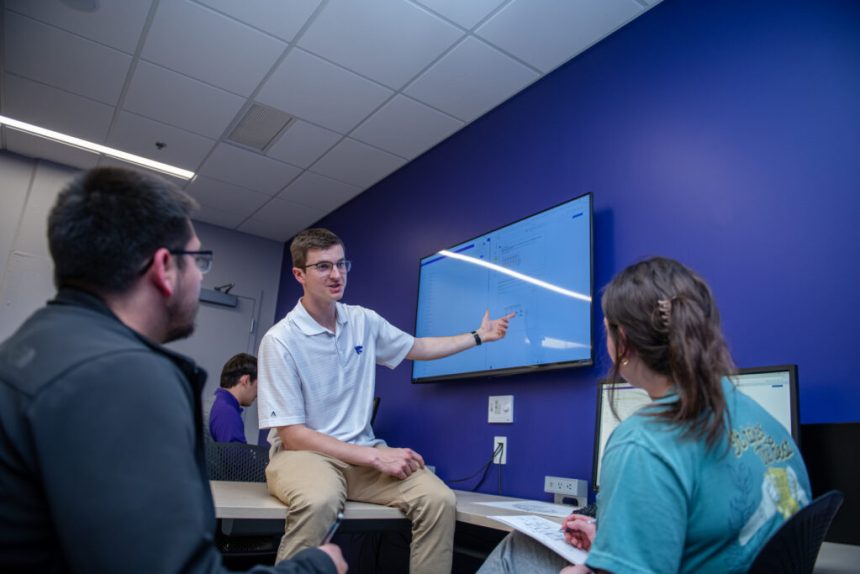
Professors regularly encourage students to take on leadership roles in academic and professional organisations to build skills for their future careers. Source: Kansas State University
A front-row seat to innovation
Dr. Volponi leads the Volponi Lab, where she focuses on improving predictions for contamination risks and developing ways to remove natural pollutants. Dr. Smith leads K-State’s new Structural Intelligence Lab, which explores how machine learning can transform structural engineering.
And you can be part of that work sooner than you might expect. “Graduate students typically get involved in research early, often within their first year,” shares Dr. Volponi. “That early start matters because facing hurdles that require technical expertise to overcome can give students a clearer sense of purpose in their coursework.”
In her lab, for example, students are out in the field collecting tracer data and running their first simulations well before they have finished their coursework.
Dr. Volponi’s research is part of a much bigger picture at K-State. Across the department, researchers are working on real-world challenges while also looking ahead to where civil engineering is going next. “My own position was created with a focus on AI and machine learning in structural engineering, alongside other emerging priorities like 3D-printed structural components and structural health monitoring,” Dr. Smith says.
“These are the areas that will define the profession over the next several decades, and the department is investing accordingly. Our programme will equip students to rigorously develop, train, test, and understand the limits of these technologies for real-world structural engineering applications.”

The department has specialised laboratories for research in environmental engineering, hydraulic engineering, materials testing, geotechnical engineering, structural engineering, and water resources engineering. Source: Kansas State University
Built for what comes next
Research opportunities aren’t the only thing that stands out about the master’s programme. Depending on your interests, you can choose to complete a thesis or a project.
“Thesis students do original research (24 hours of coursework plus six hours of thesis). Project students take more coursework instead (28 hours plus a 2-hour project),” shares Dr. Smith.
An online option is available as well. “It delivers the exact same curriculum and academic rigour as the on-campus degree,” Dr. Smith adds. “Both cohorts are held to identical evaluation standards, culminating in a comprehensive final oral examination before a faculty committee.”
Thesis students often continue to a PhD or move into research and development, while project students head straight into design, construction or consulting. Either way, you’ll have many opportunities to prepare for your career before graduating.
“Graduate transition to employment is driven by direct industry connections, funded research exposure, and high-demand technical training. Students connect with employers through the K-State Career Centre and the department’s Civil Engineering Advisory Council, while sponsored research projects and conference travel awards allow them to build professional networks before graduation,” says Dr. Smith.
Then there’s the training itself. Within Dr. Smith’s own speciality, structural analysis and design courses combine theory with hands-on training, preparing students for industry and government roles. Meanwhile, those pursuing academia gain experience in research, publishing, and teaching.
The same career-ready approach runs across the department. “Students gain hands-on experience with field methods, data analysis, and modelling approaches that translate directly to work at environmental consulting firms, engineering firms focused on water quality and remediation, and state and federal agencies,” says Dr. Volponi.
“Beyond technical training, they develop the ability to communicate their findings to non-specialist audiences, a skill essential to writing regulatory reports and advising clients. It is this combination that sets our graduates up to succeed, wherever they land.”
Follow K-State’s Department of Civil Engineering on Facebook, X, and Instagram