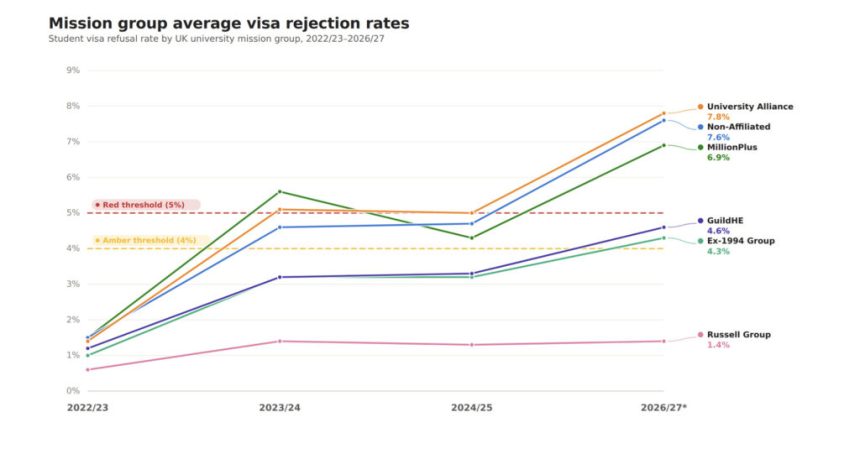
- Using HESA 2024/25 data, The PIE News has forecast the visa refusal rate for each mission group of universities in the UK by applying the current visa issuance data to the last known demographic mix of each mission group
- The projection shows that the Russell Group will have an average visa refusal rate below 1.4%, while all other university mission groups will be > 4% refusals – placing them in the amber or red thresholds
- The analysis shows that the MillionPlus and University Alliance mission groups are predicted to breach the 5% BCA threshold for visa refusals
- Our analysis only looks at mission group data averages and not at specific universities within those groups. Each university will have a different performance based on their own recruitment activity
- There is no suggestion that UKVI treats applications for Russell Group universities differently to the rest of the sector. The performance is based on the nationality mix each mission group attracts and the associated visa refusal rates.
A two-tier system could be emerging in the UK as universities within the Russell Group experience a very different outlook to other mission groups in the sector.
The PIE has been working with the consultancy Higher Insights to analyse the nationality mix recorded in the 2024/25 HESA data, applied to the current visa refusal rates by nationality.
The analysis provides a baseline refusal rate for each mission group despite the fact some recruitment activity will have undoubtedly changed in the time since the HESA data was published. The UKVI no longer tracks mission group in visa issuance data, having previously split Russell Group data out from the rest of the sector.
The data predicts that the average visa refusal rate for the Russell Group will remain at approximately Basic Compliance Assessment (BCA) threshold.
The University Alliance (7.8%), MillionPlus (6.9%) and the universities formerly represented by the now- defunct 1994 Group (4.2%) are likely to be amber or red rated on the metric of visa refusals by 2026/27 if the current visa issuance rates continue.
Mission groups speaking to The PIE have raised concerns over an “uneven playing field” being created by the new compliance requirements – with a major component of the new rules, visa refusals, largely out of institutions’ control as rejections soar amid complaints of opaque decision making from the authorities.
It is also increasingly clear that post-92 universities are being disproportionally impacted by the increases in visa issuances and refusal rates in key recruitment market
Vanessa Wilson, University Alliance
Meanwhile, University Alliance refuted that on average its members would receive a red rating, commenting that using data from a previous cohort did not “provide the necessary nuance to such a consequential issue for individual institutions” – especially as insitutions continually tighted the checks they make in the application process.
“However, it is also increasingly clear that post-92 universities are being disproportionally impacted by the increases in visa issuances and refusal rates in key recruitment markets,” acknowledged CEO Vanessa Wilson.

There is no evidence to suggest that applicants to Russell Group institutions are actively being favoured by the UKVI. However, because of demographic mix of students naturally attracted to these institutions, the Russell Group benefits from higher proportions of lower-risk visa applicants from countries such as China, the US and from within the European Union.
In 2024/25, the Russell Group attracted a massive 75% share of all Chinese student entrants to the UK; 50% of US entrants; 61% from Hong Kong; and 60% from Malaysia. This contrasts with only 4% share of the total UK student entrants from Pakistan, Bangladesh and Nigeria – now considered ‘high-risk’ markets.
Speaking to The PIE, Russell Group chief executive Libby Hackett said that the only way to maintain public trust in the international education sector was through a “robust, fair and trusted” visa system.
The University College London, which is part of the Russell Group, attracted more than one in 10 Chinese students applying to the UK during this period. The visa refusal rate for Chinese students is below 1%, essentially providing a 10x counterweight against any refusals UCL may get from other markets.
“Analysis of the new requirements underlines how effective Russell Group universities are at attracting excellent global talent and maintaining high quality and compliance,” said Hackett. “We know the vast majority of student visa applicants are genuine, but more can be done to plug the gaps and protect the reputation of our sector.”
The next biggest international student recruiters for the UK; BPP and the University of Hertfordshire, are part of GuildHE and Alliance Group representative groups, and both rely on much higher proportions of students from countries at risk of visa refusals.
While GuildHE does not consider itself a mission group, it sees itself as a representative group for institutions not served by Universities UK.
GuildHE chief executive, Brooke Storer-Church, said that while a direct comparison between the representative group and mission groups “doesn’t say much on its own”, “due to the diversity of our membership as a representative body, the underlying issue this analysis raises is a real one”.
“If the new RAG ratings in BCA metrics effectively reward institutions for recruiting from a narrow band of countries that are deemed lower risk, rather than for the strength of their compliance and recruitment practices, that penalises institutions for the diversity of their international partnerships,” she said.
If the new RAG ratings… effectively reward institutions for recruiting from a narrow band of countries that are deemed lower risk, rather than for the strength of their compliance and recruitment practices, that penalises institutions for the diversity of their international partnerships
Brooke Storer-Church, GuildHE
“Among our members, that risk falls hardest on those with genuine, wide-ranging and specialist international recruitment partnerships. We’d welcome a BCA framework that assesses institutions on their own practices rather than on a demographic mix largely set to solidify large, established recruitment routes.”
Meanwhile, MillionPlus chief executive Rachel Hewitt said that The PIE and Higher Insights’ data analysis reinforced the group’s concerns that “the new BCA regime risks creating an inherently uneven playing field across UK higher education”.
Although the group supports a robust visa system, Hewitt stressed that it needed to be “fair, proportionate and reflect the circumstances of individual institutions” and called for more transparency over decision-making from UKVI.
“Visa refusal rates can be significantly influenced by factors outside an institution’s direct control, including the countries and markets from which it recruits, while smaller universities and those with lower international recruitment volumes are more exposed to fluctuations in their figures,” she said.
India is the one shared territory that provides volume to all mission groups and has seen steadily increasing visa refusal rates. Some Russell Group institutions that have attempted to increase activity in the region may be impacted with higher refusal rates, with some agent stakeholders describing a potential two-tier split within the Russell Group itself.
The Russell Group is often perceived as the UK’s elite group of research-intensive institutions, despite the fact other British universities not in the association are more highly ranked on various metrics.
The 1994 Group, which was formally disbanded in 2013 but serves as a useful benchmark in the data, represents the majority of other research-intensive universities that are not part of the Russell Group.
The Russell Group’s global reputation enables these universities to command a greater share of higher tariff applicants, often paying substantially higher tuition fees. Transparent Approach to Costing (TRAC) data produced by the Office for Students highlights that the model of research-intensive universities with a large number of international students was the most financially viable model within the UK sector in 2024/25.
The group’s continued dominance will be compounded if our analysis proves correct as the only mission group to receive a “Green” rating for visa issuance under the new red-amber-green compliance rating – including the exclusive ability to increase their CAS allocation. The situation would be tantamount to a cap on the rest of the sector and later the majority of Student and Graduate visas being issued to Russell Group graduates.
International student market share is also directly impacting on domestic market share, with UCAS data from 2026 showing that 38% of accepted domestic applicants were accepted to higher tariff providers this year. By cross-subsidising loss-making domestic fees with international fees, higher tariff universities are able to confidently increase both markets segments despite the financial uncertainty in the sector.